Heat loss calculations are among the most important parts of renewable heating system design. For installers working with air source heat pumps, ground source heat pumps, and low-carbon heating systems, accurate calculations are essential for efficiency, comfort, and system reliability.
An incorrect heat loss calculation can lead to oversized systems, higher operating costs, customer complaints, and reduced performance. Within renewable heating, precision matters far more than it does with traditional gas boiler systems.
For installers moving into the low-carbon sector, understanding heat loss is a fundamental skill that supports system design, commissioning, and compliance with modern industry standards.
Heat Loss Calculation Basics
A heat loss calculation measures the amount of heat a property loses through its walls, floors, roof, windows, and ventilation. The final figure determines the heating output required to maintain comfortable indoor temperatures in colder weather.
The calculation is normally completed room by room. This allows installers to size radiators, underfloor heating and renewable heat sources correctly across the property.
In the UK, external design temperatures are used to reflect winter conditions in different regions. Internal temperatures vary by room type.
Typical indoor design temperatures include:
- Living rooms at 21 degrees
- Bedrooms at 18 degrees
- Bathrooms at 22 degrees
Renewable heating systems operate differently from traditional boilers. Heat pumps perform best with lower flow temperatures, which means system design must be more accurate to achieve suitable comfort levels.
Basic Heat Loss Formula
A simple heat loss formula helps installers understand the principles behind room calculations.
The standard formula is:
Heat Loss (W) = Area × U Value × ΔT
This calculation measures the amount of heat escaping through a surface.
The formula uses:
- Area measured in square metres
- U value measured in W/m²K
- Temperature difference between inside and outside conditions
For example:
- External wall area = 12m²
- U value = 0.30
- Temperature difference = 24 degrees
The calculation would be:
12 × 0.30 × 24 = 86.4W
This means the wall loses approximately 86 watts of heat under those design conditions.
Every external surface within the room is calculated individually before ventilation losses are added.
Room By Room Heat Loss Example
A room by room example helps demonstrate the importance of accurate calculations.
Imagine a typical living room within a UK semi-detached property.
Room details:
- Room size of 5 metres by 4 metres
- Ceiling height of 2.4 metres
- Two external walls
- Double glazed windows
- One radiator
- Moderate insulation levels
The installer calculates heat loss from:
- External walls
- Windows
- Floor area
- Ceiling area
- Ventilation losses
The total room heat loss may reach approximately 1.8kW.
This means the heating system must provide at least 1.8kW of heat output to maintain comfort during colder weather.
If the heating system operates at lower temperatures suitable for a heat pump, the existing radiator may no longer provide sufficient output.
This could require:
- A larger radiator
- An additional emitter
- Improved insulation
- Lower flow temperature optimisation
Without proper calculation, the room may struggle to reach comfortable temperatures in winter.
Renewable Heating Considerations
Traditional gas boilers can often mask poor system design because they operate at higher temperatures. Heat pumps do not have the same flexibility.
An undersized emitter or an inaccurate room calculation can significantly affect performance. This is one reason heat loss calculations are heavily emphasised in heat pump training and in MCS aligned installation standards.
Renewable system installers must consider:
- Building fabric performance
- Window and door insulation values
- Air leakage levels
- Ventilation losses
- Existing radiator suitability
- Flow temperature requirements
- Domestic hot water demands
- Occupancy patterns
The aim is to design a heating system that maintains comfort while operating as efficiently as possible.
Fabric Heat Loss
Fabric heat loss refers to heat escaping through the building’s structure.
The main areas include:
- External walls
- Windows
- Doors
- Roofs
- Floors
Each construction material has a U value, which represents the rate of heat transfer. Lower U values indicate better insulation performance.
Older UK properties often have higher heat losses due to limited insulation and ageing construction methods. This can affect the suitability of a heat pump unless energy-efficiency improvements are made.
Ventilation Losses
Ventilation heat loss occurs when warm air leaves the property, and colder air enters from outside.
This can occur through:
- Extract fans
- Open chimneys
- Air bricks
- Window vents
- General draughts
Ventilation losses are especially important in older properties with poor airtightness.
In many retrofit projects, reducing uncontrolled ventilation can considerably improve renewable heating performance.
Oversizing Problems
Oversizing remains one of the most common issues in renewable heating installations.
Oversized systems may lead to:
- Short cycling
- Increased electrical consumption
- Reduced efficiency
- Higher installation costs
- Unstable room temperatures
- Increased wear on components
Accurate heat loss calculations prevent unnecessary oversizing and support stable system operation.
Emitter Sizing
Once heat loss figures are established, emitters can be sized correctly for low-temperature operation.
Traditional radiators sized for gas boilers may not provide sufficient output at lower heat pump flow temperatures.
Renewable heating installers often need to:
- Increase radiator sizes
- Install additional radiators
- Use fan assisted emitters
- Specify underfloor heating
- Improve insulation standards
Emitter sizing is directly linked to system efficiency.
Heat Pump Flow Temperatures
Flow temperature is one of the most important factors in the efficiency of renewable heating.
Heat pumps operate most efficiently at lower temperatures compared with gas boilers. Many systems are designed to operate between 35 and 50 degrees, depending on the property and emitter design.
Accurate heat loss calculations enable installers to design systems that achieve comfortable temperatures without relying on excessively high flow rates.
Heat Loss Calculation Tools
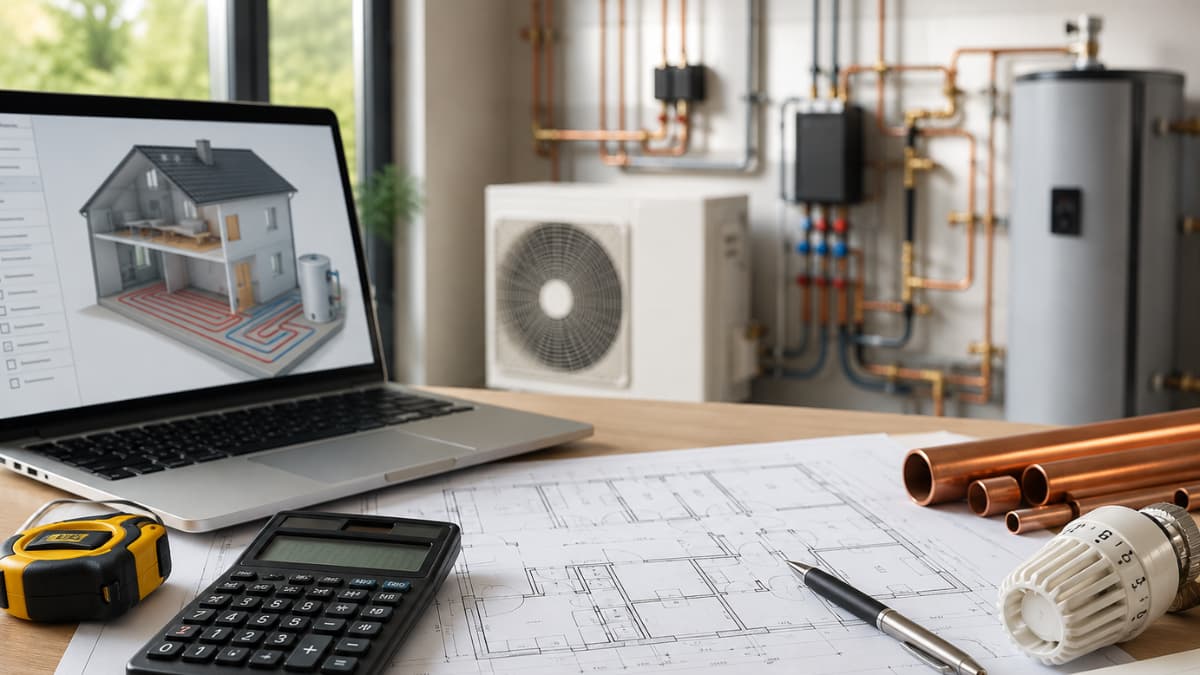
Most renewable energy system installers now use digital software and mobile apps to perform room-by-room heat loss calculations.
These tools improve accuracy, reduce survey time and support compliance with renewable heating standards.
Popular features include:
- Room by room calculations
- Radiator sizing
- Underfloor heating design
- Pipe sizing support
- Property survey forms
- Heat pump sizing
- System performance reports
- Customer quotations
Popular software and apps used within the UK heating industry include:
Heat Engineer
A widely recognised UK heat loss calculation platform used for renewable heating design, heat pump sizing and room by room assessments.
MCS Calculation Tools
Many installers use MCS aligned software platforms to support compliance and generate renewable system reports.
Manufacturer Design Software
Heat pump manufacturers often provide their own design tools to support sizing and commissioning.
Examples include:
- Vaillant design tools
- Mitsubishi Electric design software
- Samsung renewable sizing platforms
- Daikin installer tools
Underfloor Heating Design Software
Underfloor heating suppliers commonly provide specialist software for:
- Pipe spacing
- Circuit lengths
- Manifold sizing
- Floor outputs
Mobile Survey Apps
Some installers also use mobile apps that allow:
- Digital property surveys
- Photograph uploads
- Customer signatures
- Instant quotation generation
- Cloud based reporting
Installers should remember that software is only as accurate as the information entered during the survey process. Accurate measurements and correct property data remain essential.
Installer Mistakes
Several mistakes appear regularly during renewable heating surveys and installations.
These include:
- Estimating room sizes incorrectly
- Ignoring ventilation losses
- Using outdated radiator outputs
- Assuming existing systems are suitable
- Oversizing heat pumps
- Failing to account for insulation upgrades
- Relying on boiler era design practices
Training and practical experience help installers avoid these issues and improve overall system quality.
Survey Best Practice
A thorough site survey improves the accuracy of any heat loss calculation.
Best practice includes:
- Measuring every room carefully
- Checking insulation levels visually
- Assessing existing emitters
- Identifying draughts and ventilation points
- Discussing occupancy patterns with customers
- Recording pipework sizes
- Photographing installation areas
Attention to detail during the survey stage often prevents costly problems later in the installation process.
Renewable Training In Staffordshire
As renewable heating technologies continue to expand across the UK, installers must develop the skills needed to design, install and commission low-carbon heating systems correctly.
At Staffordshire Training Services, renewable training courses are designed to help engineers build both competence and confidence within the growing low-carbon sector.
Renewable energy training courses combine practical knowledge with industry-relevant guidance to support installers working with modern renewable heating technologies.
Whether progressing into heat pumps, low-temperature heating systems, or renewable system design, accurate heat-loss calculations remain one of the most important skills for today’s heating engineers.
Related Articles
- Quick Heat Pump Guide for Installers
- Weather Compensation and Heat Pump Efficiency
- Renewable Energy Training In The West Midlands
- Low Temperature Heating Systems For Renewable Installers
- Heat Pump System Design Basics for Gas Engineers Transitioning to Renewables
Prefer an AI Summary?