For many heating engineers, deciding to move into renewable energy is no longer the difficult part. The bigger question is deciding where to invest first.
Should you begin with air source heat pumps? Is ground source training likely to open the door to higher value projects? Or does a combined course provide better value for your business?
The answer depends on your existing customer base, the type of work you carry out and your plans for future growth. Return on investment is not simply measured by the cost of a training course or the value of a single installation. It is influenced by the opportunities that training creates over the coming years.
At Staffordshire Training Services, we believe the best investment is one that gives engineers the confidence to expand their services, adapt to industry changes and build a stronger business. This looks at the commercial factors that can help you decide which heat pump training route offers the greatest return.
Evaluating Your Investment
When comparing training courses, it is easy to focus on price or course duration. While these are important considerations, they only form part of the overall picture.
A better way to evaluate your investment is to consider the opportunities a qualification creates after you complete your training. The strongest return often comes from expanding your service offering, attracting new customers and positioning your business for growth rather than simply comparing the initial cost of a course.
When assessing your investment, consider factors such as:
- Current and future market demand
- The range of projects you can undertake
- Opportunities for servicing and maintenance
- The ability to quote for different renewable systems
- The direction of the heating industry
Thinking about training from this perspective allows you to make a decision based on business growth rather than short-term expenditure.
| Commercial Consideration | Business Value |
|---|---|
| Market demand | Greater number of potential installation opportunities |
| Service offering | Ability to provide additional renewable heating services |
| Recurring income | Servicing, maintenance and fault diagnosis |
| Business flexibility | Opportunity to quote for a wider variety of projects |
| Long Term Growth | Skills that remain valuable as renewable heating expands |
Comparing Your Training Options
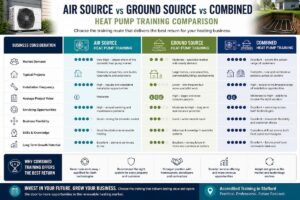
Every business has different objectives. Some engineers want the quickest route into renewable installations, while others are planning growth or expanding into commercial work.
The comparison below provides an overview before we look at each training route in more detail.
Air Source Heat Pump Training
For many heating businesses, air source heat pumps offer the most accessible route to renewable heating.
Air source systems account for the largest share of the domestic heat pump market and continue to grow in popularity across both new-build developments and existing homes. Their suitability for a wide range of property types means engineers are likely to encounter increasing demand over the coming years.
Training covers the practical skills required to install, commission, and maintain air source heat pumps, along with the principles of system design and hydraulic integration.
From a commercial perspective, air source heat pumps offer several advantages. Installation opportunities are widespread, projects are generally less complex than ground source systems, and there is strong potential for ongoing servicing and maintenance throughout the life of each installation.
For businesses entering the renewable market for the first time, air source heat pump training is often the quickest route to offering renewable heating services. It provides a practical introduction to the technology currently experiencing the greatest adoption in the domestic sector.
Ground Source Heat Pump Training
Ground source heat pumps serve a more specialised segment of the renewable heating market.
These systems are commonly installed in larger residential properties, rural homes, commercial buildings and developments where sufficient land is available for collector loops or boreholes.
Although installation volumes are generally lower than those of air source systems, individual projects are often more technically demanding and require greater planning and coordination. Engineers working in this sector frequently collaborate with groundworks contractors, architects, consultants and developers to deliver complete heating solutions.
Training covers collector circuit design, installation methods, commissioning procedures and routine maintenance, providing engineers with the knowledge needed to work confidently on these more complex systems.
For businesses already working in premium residential or commercial markets, ground source heat pump training can provide access to larger, higher-specification projects while broadening their renewable expertise.
Combined Heat Pump Training
For many heating businesses, the greatest value comes from understanding both technologies.
The combined course brings together the knowledge and practical skills required to install and maintain both air source and ground source heat pump systems in a single programme.
Rather than limiting your business to a single technology, combined training allows you to assess each property individually and recommend the system that best suits your customer’s requirements.
This broader capability creates several commercial advantages.
You can quote for a wider variety of projects, support both domestic and rural customers, and respond confidently as market demand continues to evolve. It also demonstrates a greater level of technical knowledge, helping build trust with homeowners, developers and commercial clients.
Perhaps the greatest benefit is flexibility. Every property presents different challenges, and knowing both technologies allows you to recommend solutions based on technical suitability rather than the limits of your qualifications.
For businesses looking beyond immediate opportunities, combined training often represents the strongest investment because it provides the flexibility to adapt as renewable heating continues to develop.
| Training Route | Commercial Opportunity | Business Benefit |
|---|---|---|
| Air Source Heat Pump Training | High volume domestic installations | Excellent entry point into renewable heating |
| Ground Source Heat Pump Training | Premium domestic and commercial projects | Access to larger and more specialised installations |
| Combined Heat Pump Training | Domestic, rural and commercial opportunities | Maximum flexibility and broader service offering |
Supporting Qualifications Add Value
Successful renewable installations rely on much more than simply fitting equipment. The most successful engineers understand system design, energy efficiency and safe working practices alongside installation techniques.
The Energy Efficiency for Domestic Heating and Hot Water Systems (Level 3) course develops knowledge of Building Regulations, heating controls and efficient system design. These principles underpin every successful renewable installation and help engineers deliver systems that perform efficiently from day one.
The Low Temperature Heating and Hot Water Systems (Level 3) course is particularly valuable for engineers working with heat pumps. It develops practical skills in room by room heat loss calculations, emitter sizing, pipework design and system configuration. These factors directly influence heat pump efficiency, running costs and customer satisfaction.
The Safe Isolation of Electrical Installations course provides essential knowledge for working safely with electrically powered renewable systems. As modern heating systems increasingly integrate electrical components, smart controls, and renewable technologies, this qualification supports safe working practices across a wide range of installations.
Taken together, these supporting qualifications help engineers deliver complete renewable heating solutions rather than simply installing individual products. They also strengthen the overall value of your investment in renewable training.
Creating Customer Value
The commercial value of renewable training extends well beyond the completion of an installation.
Every successful project creates an opportunity to build a relationship with a customer. While the initial installation is often the largest single piece of work, it can also lead to future servicing, maintenance, repairs and recommendations.
For many heating businesses, these ongoing relationships become just as valuable as winning the original project.
These opportunities include:
- Initial consultations and property surveys
- Heat loss calculations and system design
- Installation and commissioning
- Annual servicing
- Preventative maintenance
- Fault diagnosis and repairs
- Future upgrades and system improvements
- Recommendations from satisfied customers
When viewed across the lifetime of each customer relationship, the return on investment from quality training continues to grow. Building a reputation for professional renewable installations not only creates repeat business but also generates referrals that help your business expand over time.
Choosing The Right Investment
Every heating business has different ambitions, making it important to choose the renewable training route that best supports your plans.
| If Your Goal Is | Recommended Training Route |
|---|---|
| Enter the renewable market quickly | Air Source Heat Pump Systems Level 3 |
| Expand into specialist renewable projects | Ground Source Heat Pump Systems Level 3 |
| Offer both technologies with confidence | Air & Ground Source Heat Pump Systems Level 3 Combined Course |
| Develop a complete renewable service | Combined Heat Pump Training supported by Energy Efficiency, Low Temperature Heating and Safe Isolation courses |
There is no single answer that suits every business. Engineers primarily working in domestic heating may find air source training provides the fastest route into renewable installations. Businesses already involved in higher-specification residential or commercial projects may benefit from adding ground source expertise.
For those looking to maximise future opportunities and provide the widest possible range of renewable services, combined training offers the greatest flexibility and allows your business to adapt as the market continues to evolve.
Heat Pump Training Courses In Staffordshire
Staffordshire Training Services delivers accredited heat pump training from our purpose-built training centre in Stafford, supporting heating engineers from across Staffordshire, the West Midlands and beyond.
Our renewable training courses are designed for qualified plumbers, heating engineers and gas engineers looking to develop practical skills alongside industry-recognised qualifications. Whether you choose a focused course in air source or ground source heat pumps, or complete our combined Level 3 programme, training is delivered by experienced instructors with extensive knowledge of modern heating systems and renewable technologies.
Our renewable pathway also includes Energy Efficiency for Domestic Heating and Hot Water Systems, Low Temperature Heating and Hot Water Systems, and Safe Isolation of Electrical Installations. Together, these courses provide the knowledge required to design, install, commission and maintain renewable heating systems with confidence.
Investing in renewable training is ultimately an investment in the future of your business. By choosing the training route that aligns with your ambitions today, you can build the skills, flexibility, and confidence needed to meet customer demand and capitalise on the growing opportunities in the renewable heating sector.
Related Articles
- The Future of Heating with Renewables
- Adding Renewables to Your Heating Business
- Choosing Between Combined or Focused Heat Pump Training
- Advantages of Training in Both Heat Pump Technologies
- Renewable Energy Training In The West Midlands
Prefer an AI Summary?