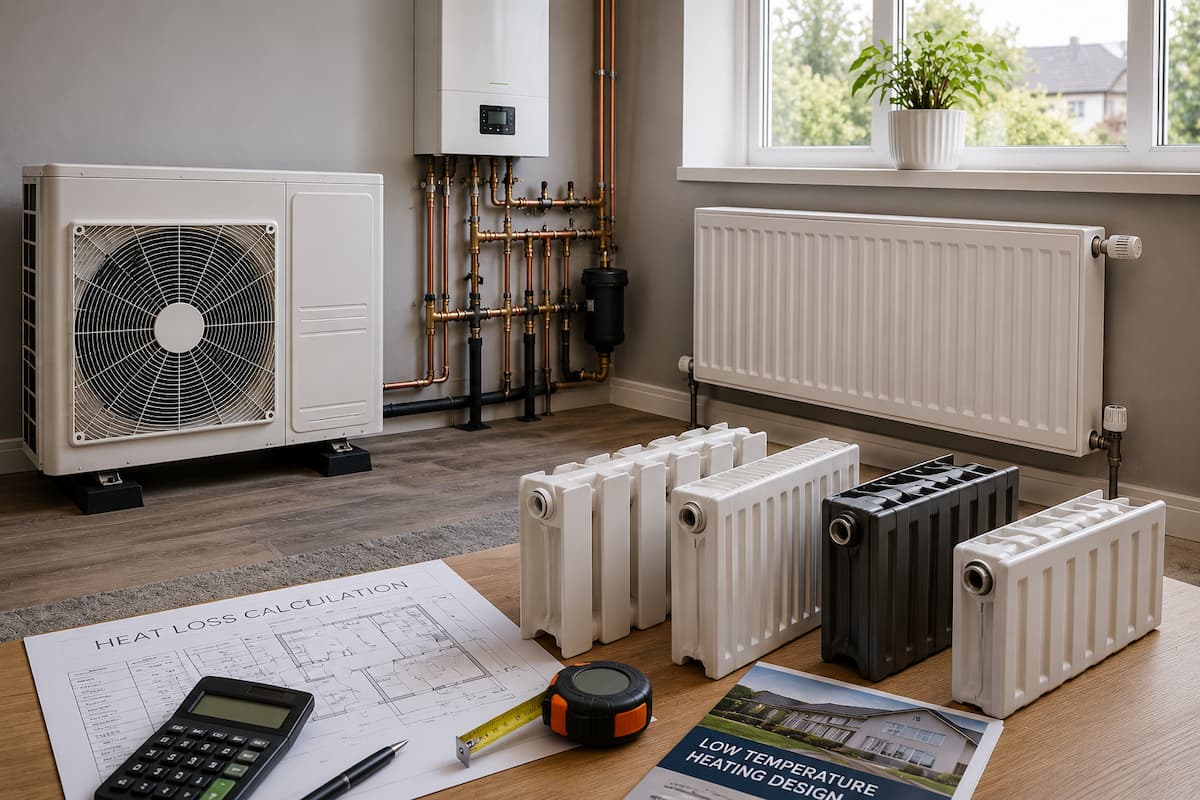
Radiator sizing is one of the most important parts of a renewable heating system design. As more UK properties adopt air-source heat pumps and low-carbon heating technologies, installers must understand the relationship among heat loss, flow temperature, and emitter performance.
A radiator that worked well with a traditional gas boiler may not provide enough heat when connected to a heat pump operating at lower temperatures. Without correct sizing, properties can suffer from poor comfort levels, higher running costs and reduced system efficiency.
For renewable installers, accurate radiator sizing is essential for achieving efficient and reliable heat pump performance.
Heat Pump Heating Principles
Traditional gas boiler systems commonly operate with flow temperatures between 70°C and 80°C. These higher temperatures allow relatively small radiators to produce large heat outputs.
Heat pumps operate differently.
Most renewable heating systems are designed to work between 35°C and 50°C. Lower flow temperatures improve efficiency but also reduce radiator output.
This means heat pump systems usually require:
- Larger radiators
- Additional emitters
- Improved insulation
- Better system balancing
- Accurate heat loss calculations
Radiator sizing is not simply about fitting bigger radiators. It is about matching the emitter output to the property’s heat demand under low temperature operating conditions.
Heat Loss Calculations
Heat loss calculations form the foundation of radiator sizing.
Each room in the property should be assessed individually to determine the amount of heat required during colder weather.
The calculation considers:
- External wall areas
- Window sizes
- Insulation levels
- Ventilation losses
- Floor and roof construction
- Indoor design temperatures
- Outdoor design temperatures
For example, a room with a calculated heat loss of 2kW requires radiators capable of delivering at least 2kW of heat output at the chosen flow temperature.
Without accurate heat loss calculations, radiator sizing becomes guesswork.
Radiator Output
Radiators transfer heat into a room using convection and radiant heat.
The amount of heat a radiator can deliver depends on:
- Surface area
- Water temperature
- Room temperature
- Air circulation
- Radiator design
As the flow temperature decreases, the radiator output decreases.
This is why renewable heating systems often require larger heat emitters than traditional boiler systems.
Flow Temperature Comparison
The relationship between flow temperature and radiator performance is one of the biggest adjustments for engineers entering renewable heating.
| Heating System | Typical Flow Temperature | Radiator Output Impact |
|---|---|---|
| Traditional Gas Boiler | 70°C to 80°C | Higher radiator outputs |
| Condensing Boiler | 55°C to 65°C | Moderate radiator outputs |
| Air Source Heat Pump | 35°C to 50°C | Reduced radiator outputs requiring larger emitters |
| Ground Source Heat Pump | 35°C to 45°C | Efficient low temperature operation |
Lower flow temperatures improve heat pump efficiency but require more careful emitter design.
Delta T
Delta T describes the temperature difference used to rate radiator performance.
Many traditional radiators are rated using Delta T 50 conditions. This assumes much higher operating temperatures than most renewable heating systems use.
As Delta T reduces, radiator output falls significantly.
| Delta T Value | Typical System Type | Radiator Output Effect |
|---|---|---|
| Delta T 50 | Traditional gas boiler systems | Highest published radiator outputs |
| Delta T 40 | Lower temperature boiler systems | Reduced output |
| Delta T 30 | Many heat pump systems | Significantly reduced output |
| Delta T 20 | Very low temperature systems | Large radiators often required |
This is one reason installers cannot simply rely on existing radiator sizes when upgrading properties to heat pumps.
Radiator Output Example
The effect of lower flow temperatures can be significant.
Consider a radiator with a published output of 2.1kW at Delta T 50 conditions.
| Radiator Condition | Approximate Output |
|---|---|
| Delta T 50 | 2.1kW |
| Delta T 40 | 1.6kW |
| Delta T 30 | 1.1kW |
If the room heat loss remains 2kW, the radiator that previously worked well with a gas boiler may now be undersized for a heat pump system.
This demonstrates why larger emitters are often required within renewable heating installations.
Existing Radiator Assessments
Many retrofit properties contain radiators sized for older boiler systems.
Installers should assess:
- Radiator dimensions
- Panel type
- Existing pipework
- Current flow temperatures
- Room heat loss
- Insulation standards
Common signs that radiators may be undersized include:
- Rooms heating slowly
- Cold areas within rooms
- High flow temperature requirements
- Poor comfort levels
- Existing oversized boiler settings
Some radiators may remain suitable, while others may require upgrading.
Radiator Type Comparison
Different radiator designs perform differently under low temperature conditions.
| Radiator Type | Low Temperature Performance | Typical Application |
|---|---|---|
| Single Panel | Lower heat output | Smaller rooms with lower heat demand |
| Double Panel | Improved output | Common choice for retrofit projects |
| Triple Panel | Higher heat output | Higher heat loss areas |
| Fan Assisted Radiator | Excellent low temperature output | Compact spaces with limited wall area |
| Vertical Radiator | Variable performance depending on design | Space saving applications |
Choosing the correct radiator type depends on room size, heat demand and available installation space.
Fan Assisted Radiators
Fan assisted radiators are becoming increasingly popular in heat pump retrofit projects.
These emitters use integrated fans to increase airflow across the heat exchanger, allowing higher heat outputs at lower temperatures.
Benefits include:
- Strong low temperature performance
- Faster room response times
- Compact radiator sizing
- Useful for restricted wall space
- Improved output at lower flow temperatures
They are commonly used in:
- Flats
- Extensions
- Small rooms
- Retrofit properties
- Areas with limited wall space
Radiator Material Considerations
Radiator material can affect response times and performance.
| Material | Benefits | Considerations |
|---|---|---|
| Steel | Affordable and widely available | Slower heat response |
| Aluminium | Fast heat transfer and lighter weight | Higher installation cost |
Aluminium radiators are increasingly used within low temperature heating systems because of their rapid heat transfer characteristics.
Radiator Placement
Radiator positioning affects overall heating performance.
Best practice includes:
- Positioning radiators beneath windows where possible
- Avoiding blocked airflow
- Keeping furniture away from emitters
- Avoiding heavy curtains covering radiators
- Considering wall insulation behind emitters
Poor placement can reduce effective heat distribution within the room.
Oversizing and Undersizing
Correct radiator sizing is essential.
Undersized radiators may cause:
- Poor room temperatures
- Increased running costs
- High flow temperature operation
- Reduced heat pump efficiency
- Customer dissatisfaction
Oversized radiators are generally less problematic in renewable systems because they allow lower flow temperatures.
Larger radiators can help:
- Improve efficiency
- Reduce cycling
- Increase comfort
- Lower operating temperatures
- Improve heat pump performance
This is one reason renewable heating systems often benefit from generous emitter sizing.
Underfloor Heating Integration
Many renewable heating systems combine radiators with underfloor heating.
This hybrid approach can work well in retrofit projects where:
- Existing upstairs radiators remain
- Ground floors use underfloor heating
- Extensions use low temperature circuits
Underfloor heating operates particularly efficiently at lower temperatures due to its large surface area.
Installers must consider:
- Zoning
- Flow rates
- Mixing controls
- Manifold balancing
- Heat loss across different areas
Pipework Considerations
Low temperature heating systems often require higher flow rates than traditional boiler systems.
Existing pipework may not always be suitable.
Installers should assess:
- Pipe diameters
- Flow restrictions
- Microbore pipework
- Pressure losses
- Pump performance
Undersized pipework can reduce system performance and create circulation problems.
In some retrofit projects, selective pipework upgrades may be necessary.
Weather Compensation and Radiator Performance
Weather compensation controls help renewable systems adjust flow temperature according to outdoor conditions.
During milder weather, the system can run at lower temperatures while still maintaining comfort.
| Outdoor Temperature | Example Flow Temperature | Heating Demand |
|---|---|---|
| 12°C | 35°C | Lower demand |
| 7°C | 40°C | Moderate demand |
| 0°C | 50°C | Higher demand |
Correct radiator sizing allows the system to maintain comfort even as flow temperatures adjust.
Smart Heating Controls
Modern renewable systems increasingly rely on intelligent controls to improve efficiency and comfort.
Smart controls can help optimise:
- Flow temperatures
- Heating schedules
- Zoning
- Weather compensation
- Room temperature control
- System monitoring
Many systems now integrate with:
- Smart thermostats
- Mobile applications
- Open Therm compatible controls
- Remote monitoring platforms
A correct control setup can improve both comfort and seasonal efficiency.
Retrofit Example
Consider a typical three bedroom semi detached property undergoing a heat pump upgrade.
The property contains:
- Existing small panel radiators
- Standard double glazing
- Moderate loft insulation
- Some microbore pipework
- A gas boiler operating at 75°C
Room by room heat loss calculations reveal that several rooms require more heat output than the existing radiators can provide at lower heat pump temperatures.
The installer recommends:
- Larger double panel radiators
- Additional radiators in key rooms
- Improved loft insulation
- Weather compensation controls
- Careful system balancing
After the upgrades, the system can operate efficiently at lower flow temperatures while maintaining comfortable room conditions.
Heat Pump Retrofit Survey Checklist
A detailed survey improves radiator sizing accuracy and system performance.
Installers should check:
- Existing radiator dimensions
- Pipework condition
- Heat loss calculations
- Loft insulation levels
- Window types
- Existing controls
- Flow temperature targets
- Water quality
- Cylinder suitability
- Available wall space for upgrades
A detailed survey reduces the risk of poor performance after installation.
Short Cycling Problems
Incorrect system sizing can contribute to short cycling.
Short cycling occurs when the heat pump switches on and off too frequently.
This can lead to:
- Reduced efficiency
- Increased electrical consumption
- Compressor wear
- Unstable temperatures
- Reduced system lifespan
Correct radiator sizing and flow temperature optimisation help systems operate more steadily and efficiently.
System Balancing
System balancing is critical for radiator performance.
Poor balancing can lead to:
- Uneven temperatures
- Reduced heat output
- Increased running costs
- Noise issues
- Poor flow distribution
Installers should check:
- Lockshield valve settings
- Flow and return temperatures
- Pump settings
- Radiator heat distribution
- Differential temperatures
Hydraulic balancing ensures each emitter receives the correct flow rate based on room demand.
A properly balanced system improves both comfort and efficiency.
Water Treatment Requirements
Water quality plays a major role in the performance of renewable heating systems.
Sludge and debris can reduce radiator performance and restrict circulation.
Installers should consider:
- System flushing
- Magnetic filtration
- Chemical inhibitors
- Water quality testing
- Ongoing maintenance
This is particularly important in retrofit systems using older pipework and radiators.
Common Installer Mistakes
Several common mistakes affect radiator sizing within renewable heating systems.
These include:
- Ignoring heat loss calculations
- Using existing radiator sizes without checks
- Setting flow temperatures too high
- Overlooking Delta T
- Poor balancing
- Ignoring insulation improvements
- Failing to assess pipework
Renewable heating requires a full-system design approach rather than a simple boiler-replacement mindset.
Software and Design Tools
Most renewable installers now use digital software to support radiator sizing and heat pump design.
These tools assist with:
- Heat loss calculations
- Radiator outputs
- Flow temperature calculations
- Pipe sizing
- System reports
- Compliance documentation
Popular examples include:
- Heat Engineer software
- Manufacturer sizing platforms
- MCS aligned design tools
- Radiator output calculators
- Mobile survey applications
Software improves consistency but still depends on accurate site surveys and the installer’s understanding.
Heat Pump Training In Staffordshire
As heat pump installations continue to increase across the UK, installers must develop the practical and technical skills needed to design efficient low temperature heating systems correctly.
At Staffordshire Training Services, heat pump training courses are designed to help engineers build confidence alongside technical competence.
Training combines industry-relevant guidance with practical understanding to support installers as they progress into renewable heating technologies.
For engineers entering the low-carbon sector, radiator sizing knowledge is now one of the most important parts of successful heat pump installation.
Related Articles
- Quick Heat Pump Guide for Installers
- Heat Pump System Design Basics for Gas Engineers Transitioning to Renewables
- Heat Pump Training Courses In The West Midlands
- Heat Loss Calculations for Renewable System Installers
- Low Temperature Heating Systems For Renewable Installers
Prefer an AI Summary?