If you are planning to work with refrigeration, air conditioning, or heat pump systems, obtaining the correct F-Gas certification is an essential part of your career. One of the first decisions you will need to make is whether to complete Category 1 or Category 2 certification.
While both qualifications allow engineers to work with fluorinated greenhouse gases, they cover different levels of responsibility and different types of equipment. Choosing the right category depends on your existing experience, the type of systems you intend to work on, and your career goals.
At Staffordshire Training Services, we offer both Category 1 and Category 2 Level 3 F-Gas training, helping engineers gain the knowledge, practical skills, and recognised qualification needed to work legally with refrigerants.
F-Gas Certification Requirements
Anyone installing, servicing, maintaining, repairing, leak checking, or recovering refrigerants from systems containing fluorinated greenhouse gases must hold the appropriate F-Gas certification. This is a legal requirement throughout the UK.
The regulations exist to ensure refrigerants are handled safely, minimise emissions that contribute to climate change, and maintain high professional standards across the HVAC and renewable heating industries.
Whether you are installing an air conditioning system or servicing a refrigerant-based heat pump, holding the correct certification demonstrates your competence and compliance.
Purpose Of Category 1 Certification
Category 1 is the most comprehensive F-Gas qualification available. It allows engineers to carry out every activity involving stationary refrigeration, air conditioning, and heat pump systems regardless of refrigerant charge.
Engineers with Category 1 certification can legally undertake:
- Installation of complete systems
- Servicing and maintenance
- Leak checking
- Refrigerant recovery
- Commissioning
- Repair work on all system sizes
Because it covers all refrigerant quantities, Category 1 provides the greatest flexibility and is often regarded as the industry standard for engineers working full-time in refrigeration, air conditioning, or renewable heating.
At Staffordshire Training Services, applicants for Category 1 should already hold a refrigeration qualification or relevant certification before attending the course.
Purpose Of Category 2 Certification
Category 2 is designed for engineers working on smaller systems containing limited refrigerant quantities.
This certification allows engineers to:
- Carry out leak checking
- Recover refrigerant
- Install, service, maintain and repair smaller refrigerant systems
The qualification applies to systems containing less than 3kg of refrigerant, or up to 6kg where equipment is hermetically sealed.
Category 2 offers an excellent route into the industry for experienced plumbers, heating engineers, gas engineers, and electricians who want to expand their skills without immediately working on larger commercial installations.
Applicants should have experience within the plumbing, heating, or electrical industries before enrolling.
Comparing Both Categories
Although both qualifications focus on safe refrigerant handling and legal compliance, they differ in the range of work they permit.
| Comparison Point | Category 1 | Category 2 |
|---|---|---|
| System Size | All refrigeration, air conditioning and heat pump system sizes | Smaller systems only |
| Refrigerant Quantity | No refrigerant volume restriction | Less than 3kg, or up to 6kg for hermetically sealed equipment |
| Installation | Permitted across all system sizes | Permitted within Category 2 system limits |
| Servicing And Maintenance | Permitted across all system sizes | Permitted within Category 2 system limits |
| Leak Checking | Permitted across all system sizes | Permitted within Category 2 system limits |
| Refrigerant Recovery | Permitted across all system sizes | Permitted within Category 2 system limits |
| Typical Candidate | Engineers with prior refrigeration qualification or certification | Plumbers, heating engineers, gas engineers or electricians with relevant experience |
| Best Suited To | Engineers wanting full scope across refrigeration, air conditioning and heat pump systems | Installers focusing on smaller domestic or light commercial systems |
For engineers planning a career in refrigeration or commercial HVAC, Category 1 generally offers the greatest flexibility. For those expanding into domestic heat pumps or smaller air-conditioning systems, Category 2 may provide everything required for their intended use.
Selecting The Right Qualification
Choosing between Category 1 and Category 2 should be based on the type of work you expect to undertake over the coming years.
Category 1 may be the better choice if you:
- Intend to work on commercial refrigeration systems
- Install larger air conditioning equipment
- Want unrestricted certification
- Already have refrigeration qualifications
Category 2 may be more appropriate if you:
- Install domestic heat pumps
- Service smaller air conditioning systems
- Already work as a plumber, heating engineer, or electrician
- Want to expand into HVAC while remaining focused on smaller systems
If your work changes over time, many engineers choose to progress to Category 1 as their experience grows.
Skills Developed During Training
Both certification routes combine classroom learning with extensive practical training.
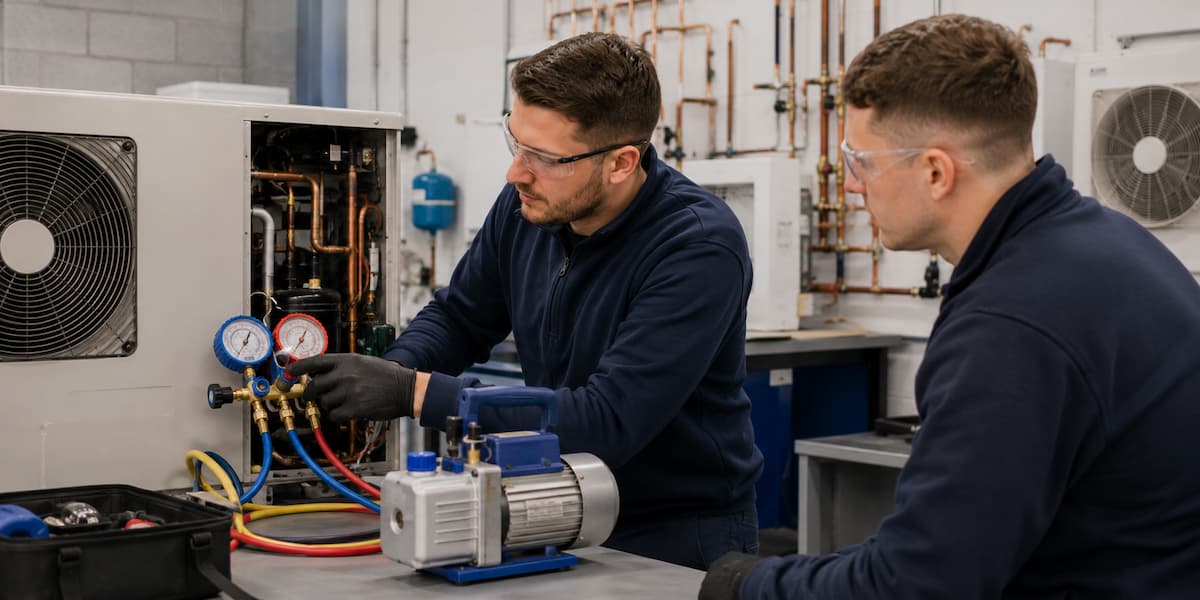
At Staffordshire Training Services, learners work on live refrigeration equipment within a dedicated training suite that reflects real working environments.
During the course, you will develop practical skills including:
- Safe refrigerant handling
- Leak detection procedures
- Refrigerant recovery techniques
- System commissioning
- Installation methods
- Environmental compliance
- Safe working practices
This practical approach helps engineers develop confidence alongside technical knowledge.
Assessment and Qualification
Assessment includes both written and practical examinations.
Candidates demonstrate their ability to work safely with refrigerants while correctly applying current F-Gas regulations. Practical assessments reflect the tasks engineers perform during installation, servicing, and maintenance work.
Successful candidates receive a recognised Level 3 F-Gas qualification for the category achieved. This certification supports registration with REFCOM and demonstrates compliance with current legislation.
Career Opportunities After Certification
Holding either Category 1 or Category 2 certification creates new opportunities across the heating, cooling, and renewable energy sectors.
Qualified engineers may carry out work involving:
- Air conditioning installations
- Refrigeration systems
- Refrigerant based air source heat pumps
- Maintenance contracts
- Planned servicing
- Fault diagnosis and repairs
Many engineers also find that F-Gas certification strengthens their reputation with customers by demonstrating professional competence and regulatory compliance.
Combining F-Gas and Heat Pump Training
Modern heat pump systems rely on refrigerants to transfer heat efficiently. While installing the heating side of the system requires knowledge of renewable heating, working on the refrigerant circuit requires the appropriate F-Gas qualification.
Many engineers therefore choose to combine F-Gas certification with Air Source Heat Pump Training or the Combined Air and Ground Source Heat Pump course at Staffordshire Training Services.
This combination allows installers to carry out installation, commissioning, servicing, maintenance, and fault finding across complete renewable heating systems while remaining fully compliant with current legislation.
As demand for low carbon heating continues to grow, engineers holding both qualifications are well positioned to expand their services and support customers adopting renewable technologies.
Training With Staffordshire Training Services
Our F-Gas training is delivered at our purpose-built training centre in Stafford over four to five days, depending on your experience.
Courses are taught face to face by experienced instructors who combine technical knowledge with practical industry experience. Working with live systems allows learners to develop real confidence before carrying out fieldwork.
Whether you choose Category 1 or Category 2, we aim to provide the skills, knowledge, and practical ability needed to work safely, professionally, and in full compliance with current F-Gas regulations.
Building The Right Foundation For Your Career
Choosing the correct F-Gas certification is an important step towards building a successful career in refrigeration, air conditioning, and renewable heating.
Category 1 provides the broadest qualification for engineers working across all system sizes, while Category 2 offers an excellent route for installers focusing on smaller refrigerant systems. Both qualifications support legal compliance, professional development, and access to growing opportunities across the HVAC sector.
If you are unsure which category best suits your experience or career plans, the team at Staffordshire Training Services can help you choose the most appropriate training pathway and support you in developing your skills.
Related Articles
- Getting Started with F-Gas Training
- F-Gas Legal Responsibilities For Installers
- F-Gas Training and Certification in Staffordshire
- F-Gas Certification for Engineers and Installers
- Oxy Fuel Brazing Is Essential For F-Gas Engineers
Prefer an AI Summary?