
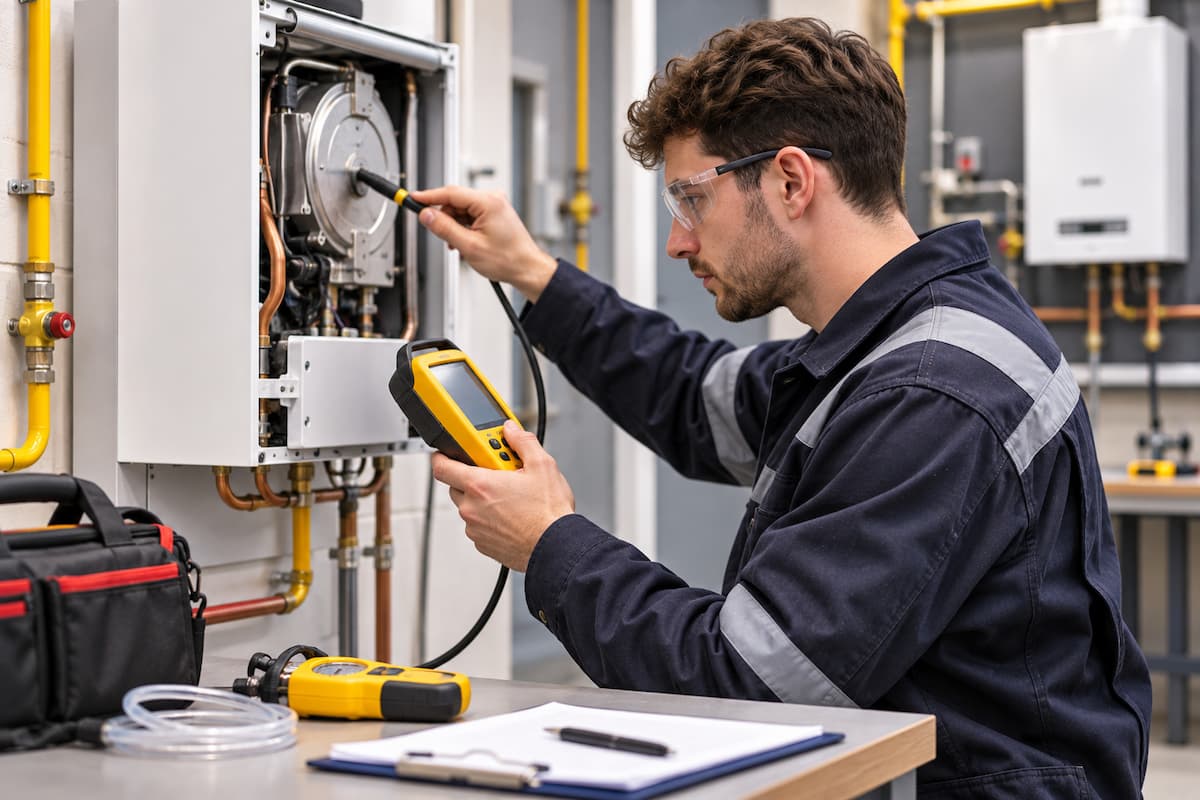
Completing your initial gas training is an important milestone. Still, before progressing into qualified gas work, you must demonstrate that you can apply your knowledge and practical skills to the required industry standards. For many new entrants, this means preparing for their first ACS gas assessment.
The Accredited Certification Scheme (ACS) is designed to assess the competence of gas engineers undertaking specific categories of gas work. It covers both theoretical knowledge and practical ability, ensuring candidates can work safely, follow appropriate procedures and recognise potentially dangerous situations.
For candidates progressing from a Gas Managed Learning Programme or another recognised training route, the first ACS assessment can feel like a significant step. However, understanding the assessment requirements, revising the relevant technical knowledge and developing a methodical approach to practical tasks can make the process more manageable.
At Staffordshire Training Services, our ACS Domestic Gas Safety and Appliances Initial Assessment provides eligible candidates with the opportunity to demonstrate their competence at our training centre in Stafford.
ACS Gas Assessment Requirements
ACS is not a single qualification that automatically permits an engineer to undertake every type of gas work. It consists of different assessment categories covering particular areas of competence.
For domestic gas engineers, CCN1 is the core domestic natural gas safety assessment. Additional appliance assessments establish competence for specific categories of work, such as boilers, cookers and other domestic gas appliances.
Candidates undertaking their first ACS assessment must satisfy the relevant entry requirements. This generally means completing an approved training pathway and obtaining the necessary evidence of training and supervised practical experience.
The ACS Domestic Gas Safety and Appliances Initial Assessment at Staffordshire Training Services is intended for candidates with suitable prior training, qualifications and experience.
Completing an initial gas training programme does not automatically qualify somebody to undertake gas work independently. Candidates must achieve the appropriate ACS certification and obtain the necessary Gas Safe registration before carrying out work within the relevant scope.
Progression From Gas Training To ACS
A recognised gas training programme develops the knowledge and practical experience needed to progress towards formal competence assessment.
During a Gas Managed Learning Programme, candidates undertake structured training covering essential gas safety principles, installation procedures, appliance operation and relevant legislation. Supervised workplace experience also allows them to apply their knowledge to actual installations.
Successful completion of the programme provides the appropriate training evidence required to progress towards ACS assessment.
The typical progression is:
- Complete a recognised gas training programme and supervised workplace experience.
- Obtain the appropriate Training Completion Certificate.
- Successfully complete the relevant ACS Initial Assessment.
- Progress towards Gas Safe registration for the appropriate categories of work.
The transition from training to assessment is important because ACS evaluates whether candidates can demonstrate competence, not simply whether they have attended a course.
The ACS Assessment Structure
ACS assessments typically combine theoretical knowledge testing with observed practical tasks.
The exact assessments depend on the categories being undertaken and the requirements of the certification scheme.
| Assessment Area | Purpose | Preparation Focus |
|---|---|---|
| Theoretical Knowledge | Establish understanding of gas safety requirements and technical principles | Legislation, standards, calculations and procedures |
| Practical Competence | Observe the candidate completing relevant gas tasks safely | Testing equipment, working procedures and accurate measurements |
| Fault Recognition | Assess the ability to identify unsafe conditions and abnormal results | Fault identification, investigation and appropriate safety actions |
| Appliance Competence | Assess work associated with the selected appliance categories | Installation, commissioning, servicing and safety checks within the relevant scope |
Candidates should understand the scope of their assessment before attending. Preparing for CCN1 alone is not necessarily sufficient if additional appliance categories are included.
Preparing For Theoretical Assessment
The knowledge assessment establishes whether candidates understand the principles and requirements governing safe gas work.
Rather than attempting to memorise isolated answers, candidates should focus on understanding the reasoning behind the procedures they have been taught.
Revision should cover the relevant parts of the Gas Safety (Installation and Use) Regulations, associated guidance, applicable standards and manufacturer instructions.
Candidates should also be familiar with core technical subjects, including combustion, gas pressure, ventilation, flueing, tightness testing and recognition of unsafe situations.
A useful revision approach is to revisit each subject and ask whether you can explain its purpose, identify the relevant safety requirements and recognise the consequences of an incorrect result.
For example, understanding the principles of combustion is more valuable than simply remembering a particular analyser reading. An engineer must appreciate the relationship between fuel, air supply, appliance operation and the safe removal of combustion products.
Preparing For Practical Assessment
Practical assessment requires candidates to demonstrate that they can complete tasks safely and competently.
Assessors are interested in the candidate’s working methods, use of equipment, interpretation of results and ability to respond appropriately to the installation being assessed.
A methodical approach is essential. Candidates should become comfortable checking the task requirements, identifying relevant hazards, selecting suitable equipment and following the correct procedure without unnecessary prompting.
Practical preparation should include familiarity with manometers, combustion analysers and other equipment relevant to the assessment categories.
Candidates should also understand the importance of checking instrument condition, suitability and calibration status before use.
The objective is not simply to complete a task quickly. It is to demonstrate that the work has been undertaken safely, accurately and in accordance with the relevant requirements.
Core Gas Safety Skills To Revise
Although individual assessment categories have their own requirements, several technical subjects form the foundation of domestic gas competence.
Gas Tightness Testing
Candidates need to understand the purpose of tightness testing, the equipment required and the correct procedures for the installation being assessed.
Preparation should include recognising the difference between installation leakage and other potential causes of pressure movement, such as temperature changes or stabilisation effects.
Engineers must also be familiar with the applicable requirements of IGEM/UP/1B Edition 4, where relevant to the installation and assessment.
A candidate should be able to explain the significance of their findings and take appropriate action rather than simply recording a pressure reading.
Gas Pressure and Flow
Gas pressure measurements help establish whether an installation and its appliances are receiving an appropriate supply.
Candidates should understand the difference between standing and working pressure, pressure loss through pipework and the relationship between gas flow and appliance performance.
An important part of assessment preparation is recognising that an apparently acceptable pressure reading under one set of conditions does not necessarily confirm satisfactory performance under operating load.
Combustion and Flue Gas Analysis
Understanding combustion is essential for engineers working with gas appliances.
Candidates should revise complete and incomplete combustion, combustion air requirements, flue gas composition and the correct use of combustion analysers.
They should also understand the importance of manufacturer instructions, correct analyser sampling procedures and interpreting results against the applicable appliance requirements.
Ventilation and Flueing
Ventilation and flueing requirements are directly connected to appliance safety.
Candidates need to understand the differences between open flued and room sealed appliances, the provision of combustion air and the safe removal of combustion products.
Practical preparation should include recognising inadequate ventilation, defective flue arrangements and conditions that could create a carbon monoxide risk.
Unsafe Situations
Recognising unsafe gas installations is an important aspect of professional competence.
Candidates should understand the current Gas Industry Unsafe Situations Procedure and the appropriate actions associated with different classifications.
This includes recognising situations requiring immediate safety action, communicating findings to the responsible person and completing the necessary documentation.
Using Technical Reference Materials
An important part of professional gas work is knowing where to find accurate technical information.
Candidates should be familiar with the relevant legislation, standards and manufacturer instructions used throughout their training. The permitted reference materials and arrangements for consulting them depend on the specific assessment.
Engineers should not rely on remembering every technical value without understanding its application. Instead, they need to develop the ability to identify the correct requirement and use it appropriately.
This is particularly important for appliance commissioning, pressure requirements, combustion measurements and installation procedures, where manufacturer specifications can vary.
Before attending, candidates should confirm the permitted reference materials and assessment arrangements with their training provider.
ACS Assessment Mistakes
Some assessment difficulties arise from gaps in technical knowledge, while others result from candidates rushing familiar procedures or failing to interpret their findings correctly.
The following are useful areas to concentrate on during preparation.
Rushing Practical Tasks
Working quickly is not the same as working competently.
Candidates should concentrate on completing procedures in the correct order, checking their work and ensuring that safety requirements are satisfied before progressing.
Incorrect Equipment Use
A candidate may understand the purpose of a test but still obtain an unreliable result through incorrect instrument setup or use.
Familiarity with equipment, measurement units and the correct interpretation of readings is therefore essential.
Overlooking Manufacturer Instructions
Gas appliances do not all share identical operating requirements.
Candidates should be comfortable locating relevant manufacturer information and applying it to the appliance being assessed.
Misinterpreting Results
Obtaining a measurement is only part of the assessment.
An engineer must be capable of recognising whether the result is acceptable, whether further investigation is necessary and whether the installation can safely remain in operation.
Failing To Recognise Unsafe Conditions
Candidates must demonstrate an appropriate response to unsafe conditions.
Continuing a procedure despite identifying a potentially dangerous situation can be more significant than making a minor technical error.
Building Confidence Before Assessment
Confidence develops through preparation and familiarity with the tasks being assessed.
Candidates should use the period before assessment to identify areas where their knowledge or practical ability is less secure. Revisiting these subjects is more productive than repeatedly practising tasks they already perform comfortably.
Practical preparation can also benefit from working through complete procedures rather than practising individual measurements in isolation.
For example, a candidate should be comfortable moving from an initial installation assessment through the appropriate checks, interpretation of findings and recording of results.
This helps develop the systematic working habits expected of a competent gas engineer.
It is also important to approach assessment with the correct mindset. ACS is intended to establish whether candidates meet the required competence standard, not to reward the fastest person to finish.
ACS Assessment Results and Referrals
ACS assessment is based on demonstrating the required competence against the relevant assessment criteria.
Candidates who complete the required assessments receive certification for the categories achieved.
Where a candidate does not meet the required standard, the outcome may be a referral requiring further preparation and assessment.
The precise arrangements depend on the assessment requirements and the certification body’s procedures.
A referral should be treated as an indication of the areas in which further competence needs to be demonstrated. Candidates should establish which elements require attention and complete the necessary preparation before reassessment.
ACS Initial Assessment Versus Reassessment
It is important to distinguish between candidates undertaking ACS for the first time and existing engineers renewing their qualifications.
The ACS Domestic Gas Safety and Appliances Initial Assessment is intended for eligible candidates progressing towards their initial certification.
The ACS Domestic Gas Safety and Appliances Reassessment is intended for existing qualified engineers who meet the relevant renewal eligibility requirements.
| Assessment | Initial ACS | ACS Reassessment |
|---|---|---|
| Candidate | Eligible new entrant | Existing qualified engineer |
| Purpose | Demonstrate initial competence | Renew existing competence |
| Previous ACS | Not required for the initial route | Relevant existing or recently expired certification normally required |
| Stafford Course Duration | 3 days | 2 days |
| Outcome | Certification in the categories passed | Renewed certification in the categories passed |
Both routes require candidates to demonstrate the relevant standard of competence. Existing industry experience does not remove the need to satisfy the assessment requirements.
ACS Certification and Gas Safe Registration
Completing ACS assessment is an important step towards working as a qualified gas engineer, but ACS certification and Gas Safe registration are not the same thing.
ACS provides evidence of competence in the categories assessed. Gas Safe registration is the legal registration requirement for businesses undertaking gas work within the scope of the Gas Safety (Installation and Use) Regulations in Great Britain.
An engineer must work within the categories covered by the relevant registration and must not assume that passing CCN1 automatically permits work on every gas appliance or installation type.
For candidates completing their first ACS, understanding this distinction is an important part of planning their progression into employment or self-employment within the gas industry.
Maintaining ACS Competence
ACS certification is not a qualification that remains valid indefinitely.
Gas engineers must maintain the appropriate certification and registration for the work they undertake. ACS certificates are normally valid for five years, after which reassessment is required to maintain certification.
Engineers should monitor their expiry dates and arrange reassessment within the relevant eligibility period.
Continuing professional development is also important because gas safety requirements, technical standards, appliances and working practices can change between assessment cycles.
For newly qualified engineers, developing the habit of keeping technical knowledge current is an important part of professional competence.
ACS Gas Training at Staffordshire Training Services
At Staffordshire Training Services, we provide accredited gas training courses and assessments for candidates entering the gas industry and experienced engineers maintaining their qualifications.
Our ACS Domestic Gas Safety and Appliances Initial Assessment provides eligible candidates with a route to demonstrating their competence following recognised gas training. Existing qualified engineers can also undertake ACS Domestic Gas Safety and Appliances Reassessment to renew their certification.
Both courses are delivered at our purpose-built training centre in Stafford, where candidates benefit from experienced engineers and assessors and practical assessment facilities.
For candidates approaching their first ACS assessment, thorough preparation should focus on understanding gas safety principles, developing confidence with practical procedures and demonstrating sound professional judgement.
The aim is not simply to pass an assessment, but to develop the knowledge, competence and confidence needed for a successful career in gas engineering.
Related Articles
- Guide to ACS Renewal and Reassessment
- A Guide To Domestic Gas ACS Reassessment
- ACS Initial Assessment For Domestic Gas Explained
- ACS Domestic Gas Meter Installation Training and Assessment Guide
- Gas Safety (Installation and Use) Regulation Failures Found During ACS
Prefer an AI Summary?