Working within scope is a fundamental responsibility for every Gas Safe registered engineer. Holding a valid gas qualification does not automatically authorise an engineer to undertake every type of gas work, particularly where appliances are installed in environments outside their usual domestic or commercial setting.
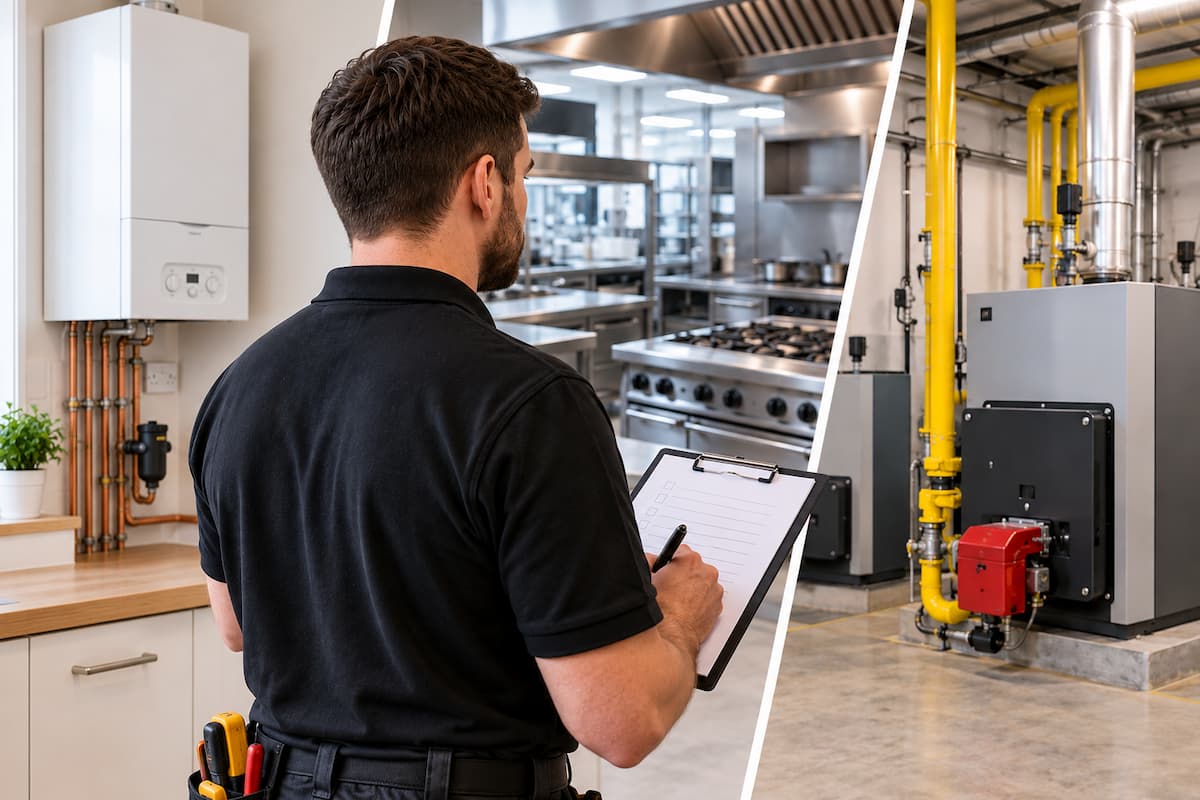
An engineer qualified to install domestic boilers, for example, may encounter a domestic boiler installed in a school, restaurant, office or commercial plant room. Although the appliance itself may be familiar, the surrounding installation and its intended use could introduce additional competency requirements.
Gas Safe Register Technical Bulletin TB 014(B) provides guidance on assessing these situations, helping registered businesses and engineers establish whether their existing work categories are sufficient or whether additional competence is required.
This article examines the legal requirements, registration categories, environmental risk assessments and practical situations that engineers may encounter.
Scope of Competence
An engineer’s scope of competence defines the gas work they are qualified, competent and registered to undertake. It is established through recognised gas safety qualifications, practical experience, assessment and the work categories recorded against their Gas Safe registration.
For example, an engineer holding Core Domestic Gas Safety (CCN1) and Central Heating Boilers and Water Heaters (CENWAT) may be registered to work on relevant domestic boilers and water heaters. However, those qualifications do not automatically permit work on commercial boilers, industrial heating systems or installations requiring additional non-domestic competence.
The distinction is particularly important where domestic appliances are installed in non-domestic premises. The appliance type, intended application, surrounding installation and applicable standards must all be taken into account.
Legal Requirements Under GSIUR
The Gas Safety (Installation and Use) Regulations 1998, commonly referred to as GSIUR, establish the principal legal requirements governing gas work in Great Britain.
Regulation 3 requires anyone undertaking gas work to be competent. Engineers must understand their responsibilities under the Gas Safety (Installation and Use) Regulations, including the duties placed on employers and others responsible for arranging gas work.
Businesses undertaking gas work within the scope of GSIUR must be registered with Gas Safe Register, subject to the applicable regulatory provisions.
These responsibilities extend beyond holding a certificate. Engineers must have sufficient knowledge, practical ability and understanding of the relevant safety requirements to complete their work safely.
The L56 Approved Code of Practice provides further guidance on the interpretation and application of GSIUR.
Gas Safe Register Rules of Registration
Gas Safe Register’s Rules of Registration reinforce these legal duties by specifying the conditions registered businesses and engineers must meet.
Section 2 establishes three important principles.
- Engineers carrying out gas work must be listed against a registered business and hold the appropriate registration work categories, supported by recognised certificates of gas safety competence.
- Gas work must comply with the applicable gas safety legislation and the requirements of the relevant health and safety enforcement jurisdiction.
- All gas work must be undertaken competently.
These rules apply across domestic and non-domestic environments, including installations where the appliance type does not clearly reflect the surrounding building or system.
The full requirements are available in the Gas Safe Register Rules of Registration.
Domestic and Non Domestic Gas Work
Gas work categories identify the types of appliances, installations and activities covered by an engineer’s recognised competencies.
Domestic gas engineers commonly hold a combination of core and appliance-specific ACS qualifications.
| ACS Category | Competence Area |
|---|---|
| CCN1 | Core Domestic Gas Safety |
| CENWAT | Domestic central heating boilers and water heaters |
| CKR1 | Domestic cooking appliances |
| HTR1 | Domestic gas fires and wall heaters |
| MET1 | Domestic gas meters |
Non-domestic gas work may require separate competencies covering commercial heating, catering equipment, larger gas installations and specialist systems.
These can include:
- Commercial core gas safety and associated appliance categories.
- Non domestic gas pipework, tightness testing and purging.
- Commercial catering appliances and installations.
- Commercial heating equipment and plant room systems.
- Specialist LPG installations and applications.
The appropriate categories depend on the equipment, work activity and installation characteristics rather than the building classification alone.
Risk Assessment for Different Installation Environments
Gas Safe Register Technical Bulletin TB 014(B) provides a risk assessment approach for engineers installing, servicing or maintaining domestic appliances in environments outside their usual domestic setting.
Three principal considerations help determine whether the installation satisfies domestic work category requirements.
Manufacturer’s Installation Instructions
The first consideration is whether the appliance manufacturer’s instructions permit installation and operation in the proposed environment.
Domestic appliances are designed and tested for particular applications. Installing an appliance outside its intended environment may introduce operating conditions that were not anticipated during its original design and certification.
For example, a domestic cooker may be suitable for use in a residential kitchen but not automatically suitable for installation in a commercial catering environment.
Engineers should establish:
- Whether the manufacturer permits the proposed installation environment.
- Whether the appliance will be used in accordance with its intended purpose.
- Whether any restrictions apply to ventilation, location or operating conditions.
- Whether additional manufacturer approval is required.
Where the manufacturer’s literature does not clearly permit the proposed application, guidance should be sought before proceeding.
Gas Safe Register provides a request for concession to manufacturer’s instructions process for situations requiring formal clarification.
A manufacturer’s concession addresses appliance suitability. It does not replace the need for appropriate gas safety competence.
Standalone Appliance Installation
The second consideration is whether the appliance operates independently within its immediate environment or forms part of a wider installation involving other appliances or systems.
Examples requiring closer assessment include:
- Domestic boilers forming part of modular boiler arrangements.
- Boilers installed within commercial plant rooms.
- Domestic cookers installed alongside commercial catering appliances.
- Appliances connected to larger installations involving specialist gas pipework and controls.
The technical bulletin specifically notes that the standalone consideration does not automatically exclude a domestic room sealed appliance installed in a catering environment. The remaining assessment criteria must still be satisfied.
The presence of other equipment can introduce additional safety requirements, particularly where appliances share controls, pipework or operating arrangements.
Gas Installation and Tightness Testing
The third consideration relates to the gas installation serving the appliance.
Where work requires interruption of the gas supply to the whole installation, engineers must establish whether the installation downstream of the relevant isolation valve falls within the scope of the current IGEM/UP/1B standard.
IGEM/UP/1B covers tightness testing and direct purging of small gas installations within its defined scope. The requirements, including changes introduced in Edition 4, are covered in our article on updates to gas tightness testing standards.
An engineer may be qualified to service a domestic appliance but require additional competence to test or purge a larger commercial installation supplying it.
This is particularly relevant where a single gas supply serves multiple appliances or areas of a building.
The three considerations are not exhaustive. Other site conditions, applicable standards and foreseeable risks may influence the assessment.
Examples of Working Within Scope
The following examples illustrate situations where additional qualifications or technical clarification may be necessary.
| Installation Scenario | Competency Considerations | Guidance |
|---|---|---|
| Domestic cooker in a school | Educational establishment requirements, including IGEM/UP/11 Edition 3. | Relevant non-domestic work categories are required in the example described by TB 014(B). CKR1 alone is insufficient. |
| Domestic boiler in an office | Manufacturer’s instructions, standalone operation, installation characteristics and relevant standards. | Domestic competence may be sufficient where the complete assessment supports it. |
| Domestic boilers in a commercial plant room | Modular arrangements, wider system integration, controls and commercial installation requirements. | Additional commercial competencies may be necessary. |
| Domestic cooker in a restaurant | Commercial catering environment, surrounding appliances and manufacturer’s permitted applications. | Commercial catering competence may be required, depending on the installation. |
These scenarios demonstrate the importance of assessing the installation as a whole rather than relying on the appliance description.
Additional Standards and Regulations
Working in unfamiliar environments may introduce legal obligations and technical standards that engineers do not routinely encounter during domestic installations.
The Health and Safety at Work etc. Act 1974 is particularly relevant in workplaces, where duties extend to employers, employees, contractors and others affected by the work.
Depending on the installation, additional requirements may involve workplace risk assessments, safe access, electrical isolation, ventilation, fire precautions and coordination with site management.
Two industry standards are especially relevant to the examples in the technical bulletin.
IGEM/UP/11 Edition 3: Gas Installations for Educational Establishments
This standard addresses gas installations in educational premises, including school food technology rooms.
Engineers undertaking work in these environments must account for the relevant installation and operational safety requirements.
IGEM/UP/1B: Tightness Testing and Direct Purging
This standard establishes procedures for qualifying small gas installations.
The applicable edition, gas type, installation volume and testing conditions must be checked before work begins.
Our gas tightness testing and pressure drop calculator supports engineers undertaking calculations within the applicable domestic IGEM/UP/1B requirements.
The calculator is a supporting tool and does not replace the relevant competency or prescribed testing procedures.
Checking Gas Safe Registration Categories
Before accepting unfamiliar work, engineers should review their Gas Safe registration details and the requirements of the proposed installation.
An engineer’s Gas Safe ID card identifies their registered work categories, which can also be checked through the Gas Safe Register.
The following checklist provides a practical starting point.
- Identify the appliance, gas type and proposed work activity.
- Check the relevant ACS certificates and their validity.
- Confirm the work categories recorded against the engineer’s Gas Safe registration.
- Review the manufacturer’s installation instructions and restrictions.
- Assess the installation environment and applicable specialist standards.
- Establish whether the appliance operates independently or forms part of a wider installation.
- Confirm that any necessary gas supply interruption, testing or purging is within scope.
- Seek clarification from Gas Safe Register or the relevant technical authority if requirements remain uncertain.
- Record the assessment before proceeding with the work.
This checklist supports the assessment process but does not replace the detailed requirements of Technical Bulletin TB 014(B).
Responsibilities of Gas Engineers and Employers
GSIUR places responsibilities on both individuals undertaking gas work and the businesses arranging or supervising those activities.
Engineers must recognise their professional limitations and avoid accepting tasks for which they lack the necessary competence.
Employers must allocate work appropriately and maintain sufficient oversight of the qualifications and experience held by their engineers.
For businesses operating across domestic and commercial sectors, this may involve:
- Maintaining accurate competency and registration records.
- Reviewing the requirements of proposed contracts.
- Matching engineers to suitable installation and appliance categories.
- Providing additional training and assessment where required.
- Reviewing competence following changes to equipment, standards or work activities.
These arrangements help businesses manage their legal duties and reduce the risk of engineers being assigned unfamiliar or unsuitable work.
Working Outside Registered Scope
Undertaking gas work without the appropriate competence or registration categories can result in serious safety and legal consequences.
Depending on the circumstances, breaches of gas safety legislation can result in enforcement action, penalties and legal consequences, including potential criminal prosecution.
There may also be contractual, insurance and professional consequences where work has been undertaken without the necessary competence.
More importantly, unfamiliar installation arrangements or incorrectly applied procedures can expose building occupants, employees and the public to significant safety risks.
Where an engineer identifies a potentially unsafe installation, the relevant unsafe situations procedures and legal duties must be followed.
Extending Gas Engineering Competence
Gas engineers can develop their professional capabilities through additional training, practical experience and recognised competency assessments.
For domestic engineers, this may involve adding appliance categories such as CKR1, HTR1 or MET1 to an existing CCN1 qualification.
Engineers maintaining their existing qualifications can follow the recognised ACS renewal and reassessment process, while those seeking additional work categories must complete the appropriate training and assessment requirements.
Engineers intending to undertake commercial work may need to follow a suitable non-domestic training and assessment pathway.
The precise route depends on existing qualifications, experience and the intended work categories.
Training develops technical knowledge and practical skills, while recognised assessment provides evidence of competence. Engineers must also ensure that any additional categories are correctly reflected in their Gas Safe registration.
Gas Training and ACS Assessment in Staffordshire
At Staffordshire Training Services, we provide accredited gas training and ACS assessment for engineers entering the industry, maintaining existing qualifications or expanding their domestic appliance competencies.
Our gas training courses in Staffordshire include domestic ACS assessment and reassessment opportunities covering relevant competencies such as CCN1, CENWAT, CKR1, HTR1 and MET1.
For candidates progressing towards their first domestic gas qualifications, our ACS initial assessment options support the recognised assessment pathway following suitable training and practical experience.
We also provide LPG changeover training and assessment for appropriately qualified engineers seeking to extend their competence into relevant LPG applications.
Training and assessment take place at our dedicated centre in Stafford, with experienced instructors and practical facilities designed to support professional development.
Whether you need to renew existing ACS qualifications or add further domestic appliance categories, Staffordshire Training Services can help you identify suitable training and assessment options.
Technical note: This article is based on the supplied Gas Safe Register Technical Bulletin guidance and the referenced regulatory framework. Engineers should consult the complete current bulletin, applicable standards and their Gas Safe registration details before making decisions about specific installations.
Related Articles
- Gas Safety (Installation and Use) Regulations For Engineers
- Gas Safety Regulation 26 for Engineers
- Building Regulations Part L for Gas Engineers
- L56 Approved Code Of Practice For Gas Engineers
- Unsafe Situations and Gas Engineer Legal Duties
Prefer an AI Summary?