Carbon monoxide remains one of the most serious dangers associated with gas appliances and combustion systems. For gas engineers, understanding carbon monoxide risks is essential for protecting occupants, maintaining compliance and preventing dangerous situations.
Carbon monoxide is often referred to as a silent danger because it cannot be seen, smelt or tasted. Unsafe combustion, poor flue performance and inadequate ventilation can all lead to dangerous levels developing within a property.
For engineers, prevention depends on correct installation, accurate testing, proper servicing and strong awareness of unsafe conditions.
Carbon Monoxide
Carbon monoxide is produced when fuel does not burn completely. This is known as incomplete combustion.
Safe combustion requires:
- correct gas supply
- adequate combustion air
- proper burner operation
- effective removal of combustion products through the flue system
When these conditions are disrupted, carbon monoxide production can increase.
Causes include:
- restricted combustion air
- blocked or damaged flues
- poor appliance maintenance
- incorrect appliance setup
- combustion instability
- component failure
Understanding how carbon monoxide forms helps engineers identify developing risks before they become dangerous.
Why Carbon Monoxide Is Dangerous
Carbon monoxide interferes with the body’s ability to carry oxygen. Exposure can cause serious illness and may become fatal.
One of the major dangers is that occupants may not realise they are being exposed until symptoms develop.
For engineers, this reinforces the importance of:
- proper combustion analysis
- safe flueing
- adequate ventilation
- correct appliance commissioning
- recognising unsafe situations quickly
Carbon Monoxide Movement Within Properties
Carbon monoxide does not simply rise or remain in one area. Once released, it mixes with the air and can spread throughout a property.
Engineers should understand:
- airflow patterns can move CO between rooms
- stairways and circulation spaces can spread contamination
- enclosed rooms may allow concentrations to build quickly
- extractor fans and ventilation changes can affect movement
- appliance location can influence exposure risk
This is important when assessing alarm placement, occupant exposure and overall property safety.
Sources Of Carbon Monoxide In Gas Work
Carbon monoxide can originate from a wide range of appliance and installation faults.
Potential sources include:
- poorly maintained appliances
- damaged burners
- blocked heat exchangers
- flue disconnection
- inadequate ventilation
- combustion air restriction
- incorrect appliance setup
- flue terminal blockage
- unsafe property modifications
Carbon monoxide risk is rarely caused by a single factor alone. It often develops from a combination of installation, maintenance and environmental issues.
Open Flue Appliance Carbon Monoxide Risks
Open flue appliances rely on natural flue draw and surrounding room air to operate safely. This makes them particularly sensitive to changes in ventilation and airflow disruption.
Engineers should understand:
- open flue appliances depend on stable room conditions
- poor ventilation can affect flue pull
- extractor fans may cause spillage
- property depressurisation can affect combustion safety
- blocked or restricted flues can allow combustion products into the room
Because these appliances depend heavily on environmental conditions, they require careful assessment during servicing and safety checks.
Ventilation and Carbon Monoxide Risk
Adequate ventilation is essential for safe combustion.
Engineers should assess:
- combustion air provision
- blocked or restricted vents
- modern sealed windows and doors
- effects of extractor fans
- changes to the property affecting airflow
Modern property upgrades can unintentionally reduce natural airflow, increasing the risk of carbon monoxide exposure.
Poor ventilation may result in:
- incomplete combustion
- unstable combustion readings
- spillage
- reduced flue performance
Ventilation assessment is, therefore, a key part of carbon monoxide prevention.
Property Alterations and Carbon Monoxide Risk
Changes made within a property can significantly affect combustion safety.
Examples include:
- replacement windows and doors
- loft conversions
- kitchen extractors
- internal refurbishments
- blocked air vents
- boxing in flue systems
An appliance that operated safely when installed may become unsafe after environmental changes within the property.
Engineers should always assess the wider installation environment, not just the appliance itself.
Flue Performance and Carbon Monoxide Prevention
Flues remove products of combustion safely from the property. Faults within the flue system can allow carbon monoxide to enter occupied spaces.
Engineers should inspect:
- flue continuity
- secure connections
- corrosion or deterioration
- signs of staining or spillage
- flue terminal condition
- concealed flue access and integrity
Poor flue performance is one of the most serious risks of carbon monoxide in gas work.
Combustion Analysis and Carbon Monoxide Detection
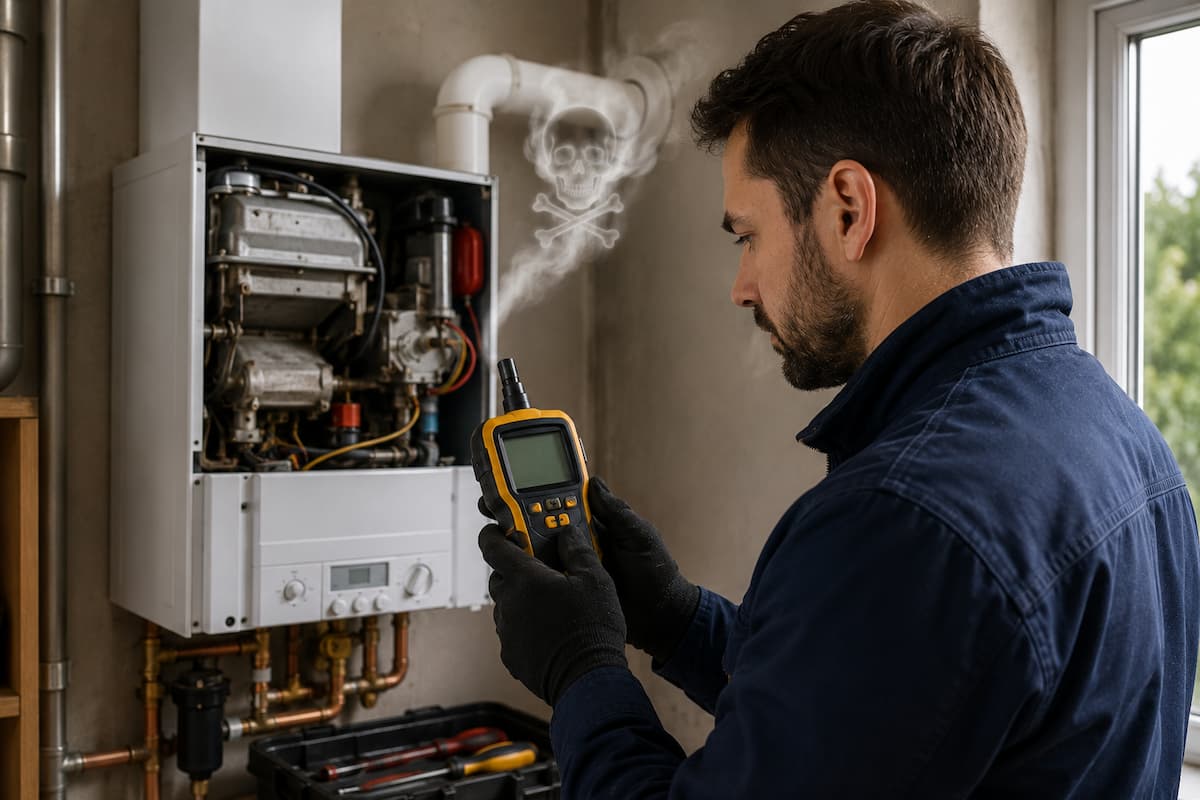
Combustion analysis plays a critical role in identifying unsafe combustion conditions.
Engineers should:
- carry out flue gas analysis during commissioning and servicing
- assess combustion ratios carefully
- investigate abnormal readings
- avoid relying solely on visual appliance appearance
Unsafe combustion may not always be obvious without testing.
Worsening combustion ratios or unstable readings may indicate developing combustion issues and an increased risk of carbon monoxide.
Combustion analysis allows engineers to identify faults before they become dangerous.
Indicators Of Carbon Monoxide Risk
Engineers should recognise practical warning signs that may indicate unsafe combustion or carbon monoxide production.
These include:
- yellow or unstable flames
- staining around the appliance
- signs of spillage
- excessive condensation
- repeated appliance lockouts
- unusual burner noise
- occupant reports of headaches or dizziness
- evidence of flue deterioration
These indicators should always prompt further investigation.
Carbon Monoxide Symptoms
| Exposure Level | Possible Symptoms | Engineer Consideration |
|---|---|---|
| Low Level Exposure | Headaches, fatigue, dizziness | Investigate appliance and ventilation performance |
| Moderate Exposure | Nausea, confusion, persistent headaches | Potential ongoing combustion issue |
| High Exposure | Collapse, loss of consciousness | Immediate emergency response required |
| Severe Exposure | Life threatening conditions | Emergency services involvement required |
Low Level Exposure Risks Over Time
Low level carbon monoxide exposure may develop gradually over time. Symptoms are often mistaken for illness, tiredness or poor ventilation.
Engineers should be aware that:
- intermittent appliance faults may create inconsistent exposure
- occupants may report symptoms that improve outside the property
- low level exposure may continue unnoticed for extended periods
This reinforces the importance of regular servicing and proper combustion testing.
Spillage and Unsafe Combustion
Spillage occurs when combustion products are not properly removed through the flue system.
This may result from:
- blocked flues
- inadequate ventilation
- poor flue design
- combustion instability
- airflow disruption
- extractor fan operation
Spillage is a serious warning sign and must never be ignored.
Spillage Testing Procedures
Spillage testing helps engineers assess whether combustion products are being removed safely.
Engineers should consider:
- appliance operating conditions
- room airflow patterns
- effects of extractor fans
- property depressurisation
- stability of flue pull
Spillage may occur intermittently, particularly where airflow conditions change during appliance operation.
Where spillage is identified, the engineer must investigate fully and take action to prevent danger.
Unsafe Scenario
An engineer attends a property where the customer reports headaches while the boiler is operating.
During inspection:
- staining is identified around the appliance
- a kitchen extractor fan is operating nearby
- combustion readings are unstable
- evidence of poor ventilation is present
Further investigation identifies flue performance issues and spillage under certain operating conditions.
In this situation, the engineer must:
- classify the appliance appropriately
- isolate or make safe where required
- advise the responsible person clearly
- document findings and actions
This type of scenario highlights how multiple factors can combine to create carbon monoxide risk.
Carbon Monoxide Alarms and Regulations
Carbon monoxide alarms provide an important additional safety measure within properties.
Engineers should:
- understand current alarm requirements
- ensure alarms are positioned appropriately
- advise customers on alarm testing and maintenance
However, alarms have limitations.
Engineers should explain that:
- alarms are secondary protection
- alarms do not prevent carbon monoxide formation
- activation may not occur immediately at lower concentrations
- alarms do not replace servicing, combustion analysis or flue inspection
An alarm should never be treated as a substitute for proper engineering practice.
Engineer Responsibilities Under Gas Safety Regulations
Gas engineers have clear responsibilities under gas safety legislation.
Engineers must:
- identify unsafe combustion conditions
- classify unsafe situations correctly
- act to prevent danger
- advise responsible persons appropriately
- document findings and actions clearly
Failure to act appropriately where carbon monoxide risk exists can have serious legal and safety consequences.
Unsafe Situations and Carbon Monoxide Risk
Carbon monoxide risks are closely linked to unsafe situations and procedures.
Examples include:
- flue disconnection
- severe combustion instability
- dangerous spillage
- inadequate ventilation affecting combustion safety
These situations may require classification as At Risk or Immediately Dangerous, depending on severity.
The engineer’s responsibility is to prevent danger and ensure that unsafe appliances are not left operational.
Emergency Actions For Engineers
Where serious carbon monoxide risk is suspected, engineers should:
- assess the immediate level of danger
- isolate unsafe appliances where required
- advise occupants appropriately
- recommend emergency medical attention where symptoms are reported
- advise emergency services involvement where necessary
- confirm the appliance is not reused until safe
- document all actions clearly
Strong communication and decisive action are essential during high-risk situations.
Carbon Monoxide Risk Factors
| Risk Factor | Potential Impact | Engineer Focus |
|---|---|---|
| Poor Ventilation | Incomplete combustion | Assess combustion air provision |
| Blocked Flue | Combustion products entering property | Inspect flue continuity and terminal |
| Poor Appliance Maintenance | Unsafe combustion performance | Carry out servicing and testing |
| Incorrect Appliance Setup | Combustion instability | Verify commissioning and combustion readings |
| Property Alterations | Reduced airflow and ventilation | Assess environmental changes |
| Damaged Flue Components | Spillage and CO leakage | Inspect flue condition thoroughly |
Carbon Monoxide Emergency Response Checklist
| Emergency Action | Engineer Requirement | Complete |
|---|---|---|
| Assess Immediate Danger | Identify severity of combustion or spillage issue | ☐ |
| Make Safe | Isolate appliance where required | ☐ |
| Advise Occupants | Communicate risks clearly | ☐ |
| Medical Advice | Recommend medical attention if symptoms reported | ☐ |
| Prevent Reuse | Ensure unsafe appliance is not reused | ☐ |
| Documentation | Record findings and actions clearly | ☐ |
Prevention Through Good Engineering Practice
Carbon monoxide prevention depends heavily on consistent engineering standards.
Good practice includes:
- correct installation methods
- safe commissioning procedures
- combustion analysis during servicing
- proper flue inspection
- ventilation assessment
- accurate documentation
- following manufacturer instructions
Strong workmanship and testing significantly reduce risk.
Carbon Monoxide Prevention Checklist
| Check | Description | Complete |
|---|---|---|
| Combustion Analysis | Flue gas readings checked and recorded | ☐ |
| Ventilation | Combustion air provision assessed | ☐ |
| Flue Integrity | Flue system inspected fully | ☐ |
| Appliance Condition | Burners and combustion components inspected | ☐ |
| Commissioning | Appliance setup verified against manufacturer guidance | ☐ |
| CO Alarm | Alarm provision confirmed and discussed with customer | ☐ |
| Documentation | Results and actions recorded clearly | ☐ |
Carbon Monoxide Awareness in ACS Assessment
Carbon monoxide awareness forms an important part of ACS assessment and reassessment.
Candidates are expected to:
- recognise unsafe combustion indicators
- understand spillage risks
- interpret combustion readings correctly
- apply unsafe situations procedures
- demonstrate safe working practices
A strong understanding supports both assessment performance and safety.
Gas Training In Staffordshire
Engineers can strengthen their knowledge of combustion safety and practical competence through training at Staffordshire Training Services.
Our gas training in Staffordshire supports ACS preparation, combustion analysis, unsafe-situations procedures, and broader gas safety compliance.
Protecting Occupants Through Safe Gas Work
Carbon monoxide prevention is one of the most important responsibilities in gas engineering. Safe installation, correct combustion analysis, effective flueing and proper ventilation all play a role in protecting occupants from harm.
By recognising warning signs, understanding airflow and spillage behaviour, following structured procedures and maintaining high standards of workmanship, engineers can reduce risk and improve appliance safety.
Strong carbon monoxide awareness supports safer homes, safer installations and safer engineering practice.
Related Articles
- Combustion Principles For Gas Engineers
- Combustion Analysis and Flue Gas Testing For Gas Engineers
- Ventilation and Flueing Requirements For Gas Appliances
- Tightness Testing and Gas Soundness For Engineers
- Unsafe Situations and Gas Engineer Legal Duties
Prefer an AI Summary?