Expansion vessels are an essential component in many modern domestic plumbing and heating systems. They may look relatively simple from the outside, but the principle behind them is fundamental to the safe, reliable operation of sealed systems.
Water expands as its temperature rises. In an open vented system, this volume increase can be accommodated through an open vent or storage cistern. In a sealed system, however, the water has nowhere to expand naturally. Without a way to accommodate this additional volume, system pressure would increase as the water heated.
An expansion vessel provides the space needed to accommodate this change while helping maintain system pressure within the intended operating range.
For plumbers and heating engineers, understanding expansion vessels involves more than knowing where they are installed. Engineers need to recognise the relationship between water temperature, system pressure, vessel pre-charge and expansion volume. They also need to distinguish between vessels designed for sealed heating circuits and those intended for potable domestic water systems.
An Expansion Vessel
The primary purpose of an expansion vessel is to accommodate the increase in water volume that occurs as water heats.
This is particularly important in sealed systems because the water cannot simply expand back into an open cistern.
An expansion vessel helps:
- Accommodate thermal expansion
- Control pressure increases
- Protect system components
- Reduce unnecessary operation of pressure relief valves
- Maintain stable system operation
- Prevent excessive pressure within pipework and equipment
To understand the component properly, plumbers first need to understand the physical process taking place inside the system.
Thermal Expansion Of Water
Water changes volume as its temperature changes.
Consider a sealed central heating system filled while cold. When the boiler begins operating, the temperature of the water circulating through the boiler, radiators and pipework rises.
As the water heats, its volume increases.
If the system were full of water with no available expansion space, even a relatively small increase in volume could cause a substantial increase in pressure.
The expansion vessel creates a controlled space for this additional volume. As the system cools again, the water contracts and the vessel helps return water to the system.
This process occurs repeatedly every time the system heats and cools.
Open and Sealed Systems
The role of an expansion vessel becomes clearer when you compare open and sealed systems.
In a traditional vented hot water system, expansion can be accommodated through an open vent or, in the case of the primary heating circuit, through the feed and expansion cistern.
A sealed heating system does not have an open feed and expansion cistern. Instead, the expansion vessel provides the space needed to accommodate changes in water volume.
This is one reason expansion vessels have become such an important component within modern domestic heating installations.
Expansion Vessel Construction
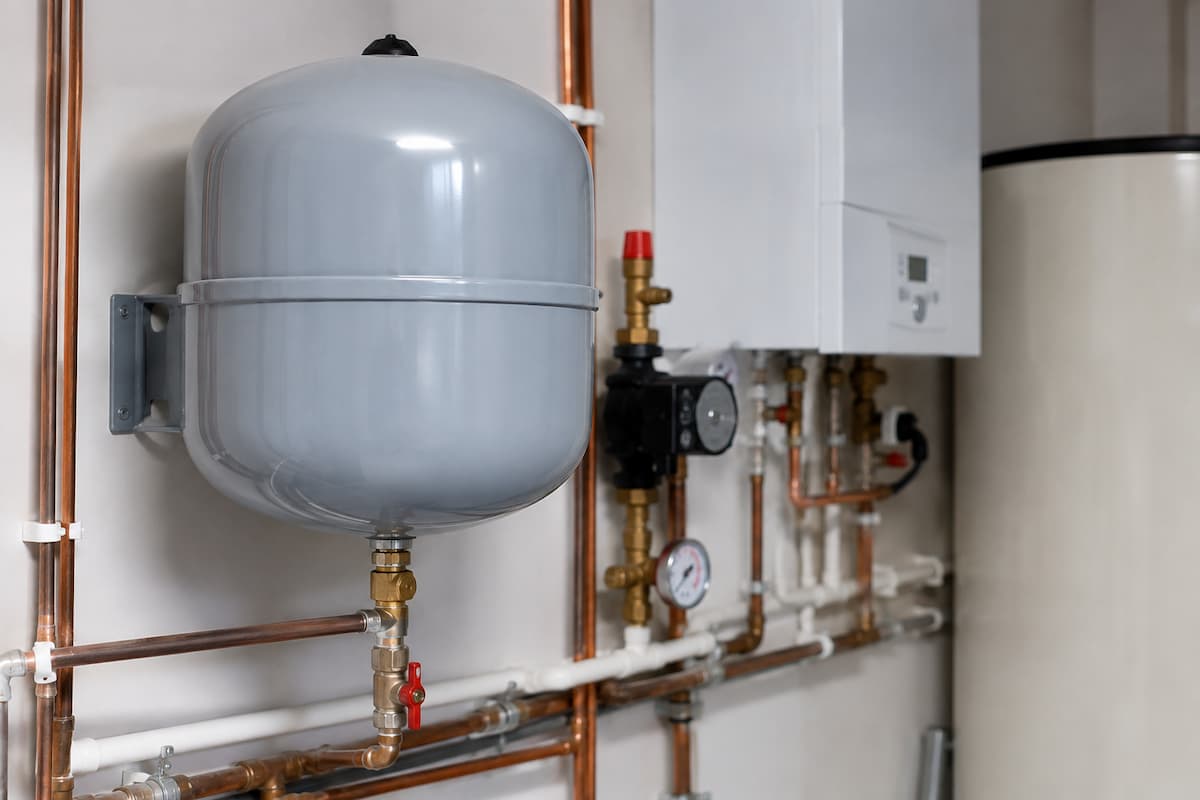
A typical expansion vessel is a sealed metal container divided internally by a flexible membrane.
On one side is system water.
The other side contains a compressed gas charge, usually air or nitrogen, depending on the vessel design.
The membrane separates the two sides.
The vessel therefore contains:
- A steel outer shell
- Flexible diaphragm or membrane
- Water connection
- Gas charged chamber
- Gas charging valve
The gas chamber is compressible. For practical plumbing purposes, water is effectively incompressible.
This difference allows the vessel to accommodate thermal expansion.
Expansion Vessel Cutaway Diagram
A cutaway diagram is particularly useful for visualising the relationship between the vessel’s water and gas sides.
Expansion Vessel
┌─────────────────┐
│ │
│ Gas Charge │
│ │
├─────────────────┤
│ Flexible │
│ Membrane │
├─────────────────┤
│ │
│ System Water │
│ │
└────────┬────────┘
│
│
System Connection
A more detailed training diagram could show the vessel in three conditions: system cold, system operating and vessel fault. This makes the diaphragm’s movement and changes in gas volume much easier for trainees to visualise.
The Diaphragm
The diaphragm separates the system water from the gas charge.
As water enters the vessel, the diaphragm moves and compresses the gas on the opposite side.
As the water cools and contracts, the compressed gas pushes against the diaphragm and the water moves back towards the system.
The diaphragm therefore moves throughout normal heating cycles.
Its condition is critical to correct vessel operation. If the diaphragm ruptures, water can enter the gas side of the vessel and the vessel can no longer perform its intended function correctly.
The Gas Charge
Before putting an expansion vessel into operation, the gas side contains a predetermined pressure known as the pre-charge.
This pressure matters because it sets the vessel’s starting condition.
The required pre-charge depends upon factors including:
- System design
- Static head
- Cold fill pressure
- Vessel manufacturer requirements
- Application
Plumbers should not assume that every vessel requires the same pre-charge pressure. Always follow manufacturer specifications and system design requirements.
Pre-Charge and System Pressure
Pre-charge pressure and system fill pressure are related, but they are not the same measurement.
Pre-charge pressure refers to the pressure in the gas side of the expansion vessel under the specified conditions for checking.
The system pressure refers to the pressure of the water within the plumbing or heating circuit.
Understanding the difference is important during servicing. Simply looking at the boiler pressure gauge does not tell an engineer the condition of the expansion vessel’s gas charge.
This distinction builds on the wider principles of pressure within domestic plumbing systems, where static pressure, operating pressure and pressure changes all need to be considered when assessing system performance.
Pressure During The Heating Cycle
A correctly operating sealed heating system will normally show some pressure increase as the system heats.
This is expected.
The expansion vessel does not prevent pressure from changing completely. Instead, it controls the increase by accepting the additional water volume.
The basic sequence is:
1. The system is filled while cold.
2. The boiler begins heating the water.
3. Water volume increases.
4. Additional water moves into the expansion vessel.
5. The diaphragm moves.
6. The gas charge compresses.
7. System pressure rises in a controlled manner.
8. The heating system reaches operating temperature.
9. The system eventually cools.
10. Water contracts and moves back from the vessel.
This cycle may occur several times each day during the heating season.
Pressure Changes as a Diagnostic Clue
The pressure gauge’s movement can provide useful information about an expansion vessel’s condition.
A small, controlled pressure increase as the heating system warms may be normal.
A large increase from cold pressure towards the pressure relief valve setting may indicate that the system is not accommodating expansion correctly.
Possible causes can include:
- Loss of vessel pre-charge
- Failed diaphragm
- Undersized expansion vessel
- Isolation between the vessel and system
- Incorrect initial system pressure
Pressure behaviour should therefore be considered alongside other diagnostic evidence rather than viewed in isolation.
This is an important principle for trainee plumbers. The pressure gauge is not simply displaying a number. Changes between cold and operating conditions can provide useful evidence about activity elsewhere within the system.
Expansion Vessels in Central Heating Systems
Sealed central heating systems use an expansion vessel to accommodate expansion within the primary heating water.
The vessel may be located:
- Inside a combination boiler
- Inside a system boiler
- Adjacent to the boiler
- Elsewhere within the heating circuit
Many modern boilers contain an internal expansion vessel, but that doesn’t mean an additional external vessel will never be required.
Large heating systems may contain more water than the boiler’s internal vessel can adequately accommodate.
System design and vessel sizing therefore remain important, particularly where an existing heating system has been extended, or additional water volume has been introduced.
Expansion Vessels in Unvented Hot Water Systems
Expansion vessels are also used with many unvented hot water cylinders.
The principle is similar, but the application is different.
When stored domestic water inside a hot water cylinder heats, its volume increases. Because an unvented system is supplied directly from the mains and includes backflow prevention, the expanding water needs a dedicated way to accommodate the extra volume.
Some cylinders use an external expansion vessel. Others incorporate an internal expansion arrangement.
The expansion provision forms part of the wider safety and pressure management strategy of the unvented hot water system.
Heating and Potable Water Vessels
This distinction is particularly important for trainee plumbers.
An expansion vessel used on a sealed central heating circuit and one used with potable domestic water may look very similar.
They should not be treated as interchangeable components.
A heating expansion vessel is designed for use within the closed primary heating circuit.
A potable expansion vessel is specifically designed and approved for applications involving wholesome domestic water.
Always select the appropriate vessel for its intended application, considering manufacturer instructions and relevant requirements.
Visual appearance or vessel colour alone should never be relied upon to determine suitability.
Internal Expansion Arrangements
Not every unvented hot water cylinder uses a separate external expansion vessel.
Some manufacturers design cylinders with an internal expansion space or air gap.
The principle remains the same. Space must be available to accommodate the increased water volume as its temperature rises.
Engineers therefore need to identify the manufacturer’s expansion arrangement before diagnosing pressure-related problems.
Assuming that every unvented cylinder should have an external vessel can lead to incorrect diagnosis and unnecessary component replacement.
Expansion Vessel Position
Vessel position depends upon the system design, application and manufacturer requirements.
Correct positioning helps ensure the vessel can respond properly to changes in system volume and pressure.
Installation considerations include:
- Connection location
- Pipe sizing
- Accessibility
- Support
- Isolation arrangements where appropriate
- Manufacturer instructions
- Future servicing requirements
A vessel should also be adequately supported. The weight can increase significantly if the vessel becomes filled with water.
Accessibility matters too. Engineers may need access to the charging valve and water connection during future inspection and maintenance.
Expansion Vessel Sizing
Expansion vessels are available in many capacities.
Selecting a vessel simply because it physically fits the available space is not acceptable system design.
Vessel sizing depends upon factors such as:
- Total system water content
- Cold fill pressure
- Maximum operating temperature
- Maximum allowable system pressure
- Expansion characteristics
- Manufacturer specifications
Larger systems generally contain more water and therefore create a greater expansion volume during heating.
An undersized vessel may initially appear to work correctly but can allow pressure to rise excessively as the system reaches full operating temperature.
System Water Volume
System water volume includes considerably more than the water inside the boiler.
It can include water contained within:
- Radiators
- Underfloor heating circuits
- Boilers
- Heat exchangers
- Distribution pipework
- Low loss headers
- Buffer vessels
- Other connected components
This becomes particularly important when modifying existing heating installations.
Adding several radiators, underfloor heating or a substantial volume of additional pipework increases system water content and may alter the expansion requirements.
For the plumber, this means the expansion vessel should be considered as part of the complete hydraulic system rather than as an isolated boiler component.
Expansion Control and Hot Water Safety
Expansion arrangements within hot water systems form part of a wider safety framework.
Stored hot water systems must safely accommodate the temperatures and pressures that can occur during normal operation and foreseeable faults. Appropriate temperature control, pressure control and discharge arrangements work together to protect the installation.
Expansion control should therefore never be considered as an isolated component choice. It forms part of the overall design and safety strategy of the hot water installation.
This becomes especially important with unvented cylinders because several safety devices may operate in sequence if normal expansion control fails.
Fault Diagnosis
Once plumbers understand the relationship between temperature, water volume, gas charge and system pressure, many expansion vessel faults become easier to interpret.
Rather than immediately replacing a pressure relief valve because it is discharging, an engineer should consider the sequence of events that caused system pressure to reach the valve’s operating point.
A relief valve may simply be responding correctly to another problem.
The underlying issue could involve the expansion vessel, pre-charge, system fill pressure, vessel sizing or another part of the pressure control arrangement.
That diagnostic approach is particularly important with expansion vessels because the visible symptom may occur elsewhere in the system.
Expansion Vessel Sizing Principles
An expansion vessel needs sufficient usable capacity to accommodate the increase in water volume as a system moves from its cold condition to its maximum operating temperature.
This does not mean that a heating system containing 150 litres of water requires a vessel equal to the expected increase in water volume. The vessel contains a gas charge, and its usable expansion capacity depends on the system’s operating pressures.
Factors affecting vessel sizing include:
- Total system water content
- Initial system temperature
- Maximum operating temperature
- Vessel pre-charge
- Cold fill pressure
- Maximum permissible system pressure
- Pressure relief valve setting
- Manufacturer requirements
For this reason, base vessel selection on an appropriate sizing calculation or manufacturer guidance rather than a rough estimate.
Estimating System Water Content
Before sizing a vessel correctly, consider the amount of water in the system.
This may include water contained within:
- Boiler
- Radiators
- Pipework
- Underfloor heating
- Heat exchangers
- Low loss headers
- Buffer vessels
- Hydraulic separators
- Other connected equipment
Manufacturer data can often provide the water content of individual components.
Pipework also contributes to total system volume. This becomes increasingly significant in larger properties and installations containing long heating circuits.
A plumber modifying an existing installation should consider whether the alteration has substantially increased system volume. The expansion provision that was adequate for the original installation may no longer be sufficient after major changes.
Boiler Expansion Vessels
Many modern boilers contain an expansion vessel inside the appliance casing.
For relatively small heating systems, this may provide sufficient expansion capacity for the complete primary circuit.
However, an internal vessel should not automatically mean the system has adequate expansion capacity.
An installation containing numerous radiators, extensive underfloor heating or additional system components may contain considerably more water than the boiler manufacturer anticipated for the internal vessel alone.
An additional external vessel may therefore form part of the system design.
Vessel Capacity and Acceptance Volume
A useful distinction for trainee plumbers is the difference between an expansion vessel’s physical size and the amount of expansion water it can actually accept.
A vessel labelled as having a particular capacity cannot normally accept that entire volume as expansion water during operation.
The gas charge occupies part of the vessel. As system water enters, it compresses this gas.
The amount of water the vessel can accept while remaining within the permitted pressure range is sometimes referred to as its acceptance volume.
This is one reason vessel sizing cannot be based solely on the number printed on the outside of the vessel.
Why Pre-Charge?
The gas pressure inside the vessel before it accepts system water is known as the pre-charge.
Correct pre-charge is fundamental to vessel performance.
If the pre-charge is unsuitable for the installation, the vessel may have less usable expansion capacity than intended.
A vessel with insufficient pre-charge may already contain too much system water while the installation is cold.
A vessel with excessive pre-charge may not begin accepting water at the intended point.
The correct value depends on system design and manufacturer requirements, not a universal pressure that applies to every installation.
Checking Pre-Charge
One of the most important practical principles for trainee plumbers is that you cannot assess vessel pre-charge accurately simply by attaching a gauge while the water side remains pressurised.
Water-side pressure acts against the diaphragm and affects the reading.
To assess the gas charge correctly, the vessel must be placed under the conditions specified by the manufacturer. This normally requires removing water pressure from the vessel side before measuring the gas charge.
The precise procedure depends on the appliance, vessel and installation.
Engineers should therefore follow manufacturer instructions rather than applying the same servicing procedure to every vessel.
Cold Fill Pressure
Cold fill pressure is the pressure of the sealed heating system after it has been filled and before the water reaches operating temperature.
The appropriate pressure depends on the installation.
Factors include:
- Static height of the system
- Boiler requirements
- Vessel pre-charge
- Property layout
- Manufacturer specifications
An engineer should not assume that every domestic heating system should be filled to the same pressure.
The pressure required in a compact bungalow installation may differ from that needed to serve equipment several floors above the boiler.
Static Head
Static head describes the vertical height of water above a reference point within the system.
In a sealed heating installation, the vessel needs sufficient pressure to maintain positive pressure at the highest point of the system.
As the vertical distance increases, the pressure requirement at the vessel also changes.
This is particularly relevant in:
- Multi-storey homes
- Properties with loft conversions
- Tall townhouses
- Systems with plant located in basements
- Larger domestic installations
Understanding static head helps plumbers see why pre-charge and fill pressures must match the individual installation.
Pressure Through a Normal Heating Cycle
The pressure gauge provides useful information about system behaviour.
A typical sealed system begins at its designed cold fill pressure.
As the boiler heats the water, thermal expansion pushes additional water into the expansion vessel.
The diaphragm moves and compresses the gas charge.
System pressure consequently increases.
When heating stops and the system cools, the water contracts. Pressure falls, and the expansion vessel returns water to the circuit.
The important diagnostic point is not that pressure changes, but whether the change is appropriate for the particular installation.
Excessive Pressure Rise
A heating system that experiences a substantial pressure increase as it heats may have a problem with its expansion provision.
For example, an engineer may encounter a system that appears satisfactory while cold but climbs rapidly towards the pressure relief valve setting as the boiler reaches operating temperature.
Possible causes include:
- Loss of vessel pre-charge
- Ruptured diaphragm
- Undersized vessel
- Incorrect cold fill pressure
- Vessel isolated from the system
- Restricted vessel connection
- Additional system volume exceeding the original design
The pressure gauge behaviour during the complete heating cycle can therefore provide useful diagnostic evidence.
Pressure Relief Valve Discharge
A pressure relief valve protects a sealed system against excessive pressure.
If system pressure reaches the valve’s operating point, it discharges water.
An important diagnostic lesson is that the valve may be doing exactly the job it was designed to do.
Replacing the pressure relief valve without identifying the cause of excessive pressure may therefore fail to solve the problem.
Where pressure rises significantly during heating, the expansion vessel and associated pressure conditions should form part of the investigation.
Repeated discharge can also affect the valve itself. Deposits or debris may prevent a valve from resealing correctly after it has operated, resulting in continued leakage even after the original pressure fault has been corrected.
Loss Of Pre Charge
Expansion vessels can gradually lose their gas charge.
This may occur through:
- Natural permeation over time
- Leakage from the charging valve
- Previous incorrect servicing
- Component deterioration
As the gas charge falls, the amount of useful expansion space available within the vessel can reduce.
The system may then exhibit a greater pressure increase during heating.
A vessel that has lost charge is not necessarily mechanically damaged. Assess its condition before deciding whether to recharge or replace it.
Waterlogged Expansion Vessels
The term waterlogged often describes an expansion vessel that has lost much of its effective gas cushion and contains excessive water.
When the vessel lacks sufficient compressible gas volume, it can no longer accommodate thermal expansion effectively.
Possible symptoms include:
- Rapid pressure increase during heating
- Pressure relief valve discharge
- Significant difference between hot and cold pressure
- Repeated need to top up the heating system
- Pressure dropping after the system cools
These symptoms can also have other causes, so investigate them rather than treating them as automatic proof of vessel failure.
Failed Diaphragms
The flexible diaphragm inside an expansion vessel can eventually fail.
If it ruptures, water can pass into the vessel’s gas side.
One useful diagnostic sign is water appearing from the gas charging valve when checked properly.
A ruptured diaphragm usually means the vessel needs replacement because it loses separation between the gas and water chambers.
Plumbers should distinguish this mechanical failure from a vessel that has lost some of its pre-charge.
Vessel Connection Blockages
The expansion vessel itself is not always responsible for an expansion fault.
The pipe or connection between the vessel and heating system can become restricted.
If water cannot move freely between the system and vessel, the expansion capacity effectively becomes unavailable even if the vessel itself remains serviceable.
Possible restrictions include:
- Corrosion products
- Sludge
- Debris
- Closed isolation valves
- Damaged connecting pipework
This reinforces the importance of diagnosing the complete expansion arrangement rather than focusing solely on the vessel.
External Vessel Installation
An external expansion vessel may be installed where additional capacity is required or where an existing internal vessel no longer suits the system design.
Installation should take account of:
- Correct vessel specification
- Appropriate sizing
- Secure mounting
- Suitable connection point
- Pipework support
- Servicing access
- Manufacturer requirements
Do not leave the vessel unsupported by its connecting pipework unless the manufacturer specifically permits that arrangement.
Larger vessels can become particularly heavy if filled with water, making suitable support an important installation consideration.
Expansion Vessels in Unvented Systems
Expansion vessel diagnosis differs when working with unvented hot water cylinders.
Here, the vessel accommodates expansion of stored domestic water rather than water within the primary heating circuit.
A problem with the expansion arrangement may cause water to pass through the expansion relief valve and become visible at the tundish.
Possible causes can include:
- Loss of expansion vessel charge
- Failed vessel diaphragm
- Incorrect pressure conditions
- Loss of an internal air gap where applicable
- Inlet control problems
Because the tundish provides visible evidence of safety valve discharge, it can provide an important clue during diagnosis.
The cause of discharge should always be established rather than assuming the tundish or relief valve itself is faulty.
Potable Expansion Vessel Requirements
An expansion vessel connected to wholesome domestic water must be suitable for that application.
Materials in contact with the water must be appropriate for potable water use, and the vessel should comply with the relevant product and installation requirements.
This is another reason a central heating expansion vessel should not simply be substituted for a potable vessel because it has a similar capacity or physical connection.
The engineer needs to confirm:
- Intended application
- Vessel specification
- Pressure rating
- Temperature rating
- Manufacturer approval
- Suitability for potable water where applicable
Component selection is part of safe system design.
Internal Air Gap Systems
Some unvented cylinders accommodate thermal expansion using an internal air gap rather than a separate external vessel.
Over time, the designed air space may require restoration in accordance with the manufacturer’s servicing procedure.
Symptoms of lost expansion capacity may resemble those associated with a failed external vessel, particularly repeated discharge during the heating cycle.
For plumbers, the first stage is therefore identifying the type of expansion arrangement fitted to the cylinder.
Then follow the manufacturer’s instructions for the correct servicing procedure.
Vessel Location and Temperature
Expansion vessel location can influence operating conditions.
In heating systems, manufacturers may specify a particular connection point to ensure predictable pressure conditions and reliable operation.
Where system design allows, protect the vessel from unnecessary heat exposure.
Correct positioning supports:
- Stable pressure control
- Reliable diaphragm operation
- Appropriate vessel life
- Easier servicing
Installation convenience should not take priority over system design requirements.
Isolation Valves and Expansion Vessels
Isolation around expansion vessels requires careful consideration.
A service valve may make maintenance easier, but an expansion vessel must not accidentally be left isolated from the system during normal operation.
If the vessel is isolated, it can no longer accommodate thermal expansion.
Pressure can then rise rapidly during heating.
Where manufacturer-approved servicing arrangements are provided, they must be returned to their correct operating position before the system is recommissioned.
## Recharging An Expansion Vessel
A vessel that has lost gas charge but still has an intact diaphragm may sometimes be recharged.
This should only be carried out after establishing:
- The vessel is serviceable
- The diaphragm has not failed
- The correct pre-charge value
- The correct conditions for checking pressure
- Manufacturer servicing requirements
Simply adding air until you reach an arbitrary gauge reading is not an appropriate repair method.
After servicing, recommission the complete system and check its pressure behaviour through an operating cycle.
Replacement Considerations
Replacement becomes necessary where the vessel is damaged, the diaphragm has failed, or the vessel is otherwise unsuitable for continued service.
Do not select a replacement solely by matching the old component’s physical dimensions.
The engineer should confirm:
- Vessel capacity
- Application
- Pressure rating
- Pre-charge requirements
- Temperature suitability
- Connection size
- Physical mounting
- Potable water approval where required
Replacing an incorrectly sized vessel with another identical vessel reproduces the original design problem.
A Diagnostic Sequence
When an engineer suspects an expansion vessel problem within a sealed heating system, diagnosis should follow a logical sequence.
System Pressure Problem
│
▼
Check Cold Pressure
│
▼
Run Heating System
│
▼
Observe Pressure Rise
│
▼
Excessive Rise?
/ \
No Yes
│ │
Investigate Check Expansion
Other Causes Provision
│
▼
Check Vessel Charge
│
▼
Check Diaphragm
│
▼
Check Vessel Connection
│
▼
Confirm Vessel Size
│
▼
Repair Or Replace
│
▼
Recommission System
This approach prevents the engineer from jumping immediately to component replacement.
Symptoms and Possible Causes
Several symptoms can point towards problems with expansion control.
| Symptom | Possible Expansion Related Cause |
|---|---|
| Pressure rises sharply as heating operates | Low pre-charge, failed diaphragm or undersized vessel |
| Pressure relief valve discharges | Excessive system pressure caused by inadequate expansion capacity |
| Pressure falls significantly after cooling | Loss of water following relief valve discharge or expansion fault |
| Frequent system topping up | Water loss requiring investigation, potentially following repeated discharge |
| Water from vessel charging valve | Possible diaphragm failure |
| Vessel appears full of water | Loss of gas cushion or diaphragm failure |
| Tundish discharge on unvented cylinder | Expansion control or safety device operation requiring investigation |
These observations provide diagnostic clues, not final diagnoses. Several plumbing and heating faults can produce similar symptoms.
Avoiding Parts Swapping
Expansion vessel faults demonstrate the importance of systematic diagnosis.
A plumber who repeatedly replaces pressure relief valves without examining the expansion arrangement may temporarily stop a leak without correcting the cause.
Likewise, replacing an expansion vessel without checking system pressure, vessel sizing, and the connecting pipework can cause the same fault to return.
Good fault finding asks a more useful question:
Which system condition caused this component to behave this way?
That approach moves the engineer away from swapping parts and toward diagnosis.
Routine Expansion Vessel Inspection
Expansion vessels should be considered part of the complete plumbing or heating system, not components investigated only after a pressure fault develops.
A routine inspection can reveal deterioration, installation problems and changes in system behaviour before they lead to repeated pressure loss or operation of safety devices.
Depending on the type of installation, an inspection may consider:
- Vessel condition
- Secure mounting
- Signs of corrosion
- Water leakage
- Condition of connecting pipework
- Accessibility
- System pressure
- Pressure behaviour during heating
- Evidence of safety valve discharge
- Manufacturer servicing requirements
An inspection isn’t just about confirming that an expansion vessel is physically present. The engineer must establish whether the complete expansion arrangement can perform its intended function.
Starting With System Pressure
The pressure gauge can provide useful information before you disturb any components.
On a sealed heating system, an engineer should check the pressure while the system is cold and observe its behaviour as it reaches operating temperature.
The important point is the relationship between the readings.
If pressure remains relatively stable within the expected operating range, the expansion vessel may be accommodating thermal expansion correctly.
If pressure rises substantially as the system heats and then falls significantly after cooling, further investigation may be required.
Plumbers should avoid treating one pressure reading as a complete diagnosis. System behaviour through the heating and cooling cycle provides considerably more information.
Visual Vessel Inspection
Before further checks, inspect the vessel externally.
Signs requiring attention may include:
- Corrosion
- Rust staining
- Water marks
- Damaged casing
- Loose brackets
- Unsupported pipework
- Leakage around connections
- Damage to the charging valve
The installation should also provide reasonable access for future servicing.
A vessel mounted where the charging valve cannot be accessed may make proper maintenance unnecessarily difficult.
Checking the Vessel Connection
An expansion vessel can only function if water can move freely between the system and the vessel.
The connecting pipework should therefore form part of the inspection.
Potential issues include:
- Closed valves
- Restricted connections
- Sludge
- Corrosion products
- Damaged pipework
- Incorrect installation
A perfectly serviceable vessel provides little expansion protection if it has effectively been isolated from the system.
This diagnostic distinction matters because replacing the vessel would not correct a blockage elsewhere in the expansion connection.
Checking Vessel Charge
When testing the gas charge, follow the correct manufacturer procedure.
The water side normally needs to be placed under the specified pressure conditions before you can obtain an accurate pre-charge reading. Measuring the vessel while the water side remains pressurised can produce a misleading result.
The engineer should establish:
- Manufacturer specified pre-charge
- Correct test conditions
- Existing vessel pressure
- Condition of the charging valve
- Whether the vessel retains its charge
A low charge does not automatically mean the vessel requires replacement. Further investigation is needed to determine whether the diaphragm remains serviceable.
Testing For Diaphragm Failure
A ruptured diaphragm prevents the expansion vessel from maintaining the intended separation between system water and the gas charge.
One possible indication is water appearing at the gas charging valve during appropriate inspection.
If water has entered the gas chamber because the diaphragm has failed, simply recharging the vessel will not restore correct operation.
Replacement is normally required.
This should be distinguished from a vessel with an intact diaphragm that has gradually lost some of its gas charge.
Pressure Relief Valves and Expansion Problems
The relationship between an expansion vessel and a pressure relief valve is particularly important when fault-finding.
A pressure relief valve protects a sealed system against excessive pressure.
If the expansion vessel cannot accommodate the increased water volume during heating, system pressure may continue rising until the relief valve operates.
The visible symptom may therefore be water outside the property from the relief discharge pipe.
The actual fault may be inside the expansion vessel.
This demonstrates an important principle for trainee plumbers: the location where a fault becomes visible is not necessarily where it originated.
Repeated Pressure Loss
A homeowner may report that the boiler pressure repeatedly drops and requires topping up.
It can be tempting to assume that the system leaks.
A leak is certainly one possibility, but an expansion fault can create a similar pattern.
For example:
1. The system is topped up while cold.
2. Heating starts.
3. Water expands.
4. The vessel cannot accept sufficient expansion.
5. System pressure rises excessively.
6. The pressure relief valve operates.
7. Water leaves the system.
8. The heating system cools.
9. Pressure falls below its previous cold reading.
10. The homeowner tops the system up again.
The same cycle then repeats.
Recognising this sequence can prevent unnecessary searches for hidden pipework leaks.
External Discharge Pipe Checks
If a sealed heating system repeatedly loses pressure, inspect the pressure relief discharge termination where accessible and safe to do so.
Evidence of discharge may include:
- Dripping water
- Dampness
- Water staining
- Mineral deposits
- Corrosion around the termination
A customer may not notice the discharge, especially if the pipe terminates in a location they rarely inspect.
This simple observation can provide an important clue during diagnosis.
Tundish Discharge On Unvented Cylinders
The same diagnostic principle applies to unvented hot water cylinders, although their safety arrangements differ from sealed central heating circuits.
Water visible through the tundish indicates that a safety valve is discharging.
Depending on the installation and the conditions under which discharge occurs, possible causes can involve:
- Loss of expansion capacity
- Expansion vessel charge
- Internal expansion arrangement
- Inlet pressure control
- Expansion relief valve
- Temperature and pressure relief valve
- Temperature control problems
The tundish is providing evidence of another event within the system. It should not simply be treated as the defective component.
Hot and Cold Pressure Behaviour
Observing the difference between cold and hot pressure can help separate several potential faults.
Consider three simplified examples.
Stable Pressure
The system begins at an appropriate cold pressure and rises moderately as it reaches operating temperature.
This generally suggests the system is accommodating expansion.
Large Pressure Increase
The system starts at an apparently normal cold pressure but climbs rapidly as temperature increases.
Expansion provision should form part of the investigation.
Pressure Falls Without Heating
The system loses pressure even while remaining cold.
This may point the investigation towards water loss rather than thermal expansion, although the complete system still needs to be assessed.
Thinking in terms of system behaviour helps plumbers move from symptoms towards causes.
Expansion Vessel Fault Finding Flowchart
A structured process helps avoid unnecessary component replacement.
Customer Reports Pressure Problem
│
▼
Check System Cold
│
▼
Inspect For Visible Leakage
│
▼
Check Relief Discharge
│
▼
Run Heating If Appropriate
│
▼
Observe Pressure Behaviour
│
▼
Large Rise During Heating?
┌─────┴─────┐
No Yes
│ │
Investigate Inspect Expansion
Other Causes Arrangement
│
▼
Check Vessel
Connection
│
▼
Assess Pre-Charge
│
▼
Assess Diaphragm
│
▼
Confirm Sizing
│
▼
Repair Or Replace
│
▼
Recommission
The precise testing procedure depends on the appliance, vessel, and system, but the principle remains the same: gather evidence before deciding which component needs attention.
Expansion Vessel Fault Scenarios
Realistic fault scenarios are particularly useful for apprentice plumbers because they demonstrate the relationship between individual components.
Pressure Rises Towards The Relief Valve Setting
A homeowner reports that boiler pressure is normal while cold but rises substantially once the heating has been operating.
Expansion capacity should be investigated.
The engineer would consider the vessel charge, diaphragm condition, vessel size and connection to the heating circuit.
Pressure Relief Pipe Drips Outside
Replacing the pressure relief valve immediately may not solve the problem.
The engineer should first determine whether excessive system pressure is causing the valve to operate correctly.
If an expansion fault is responsible, replacing only the relief valve leaves the original cause unresolved.
Pressure Needs Frequent Topping Up
The system may be losing water through a leak, but repeated relief valve discharge may also contribute.
Observing system pressure during a complete heating cycle can help identify the pattern.
Newly Extended Heating System Develops Pressure Problems
An installation may have operated correctly for years before you added additional radiators or underfloor heating.
The original expansion vessel may now be too small for the increased system water volume.
This illustrates the importance of reassessing expansion capacity whenever you substantially modify a heating system.
System Modifications
Changes to a heating system can alter its expansion requirements.
Examples include:
- Adding radiators
- Installing underfloor heating
- Extending pipework
- Adding a buffer vessel
- Installing a low loss header
- Replacing emitters
- Adding another heating zone
Each modification can increase the system’s total water content.
Consider the existing expansion vessel whenever you make significant changes.
An installation that was correctly designed originally can become inadequately protected after later alterations.
Larger Properties
Expansion vessel requirements become increasingly important in larger domestic properties.
A large house may contain:
- Numerous radiators
- Several heating zones
- Underfloor heating
- Long distribution circuits
- Multiple heat emitters
- Buffer storage
- More than one heat source
These installations can contain substantially greater water volumes than a typical small domestic heating system.
Assuming the expansion vessel supplied inside the boiler is automatically adequate can therefore lead to problems.
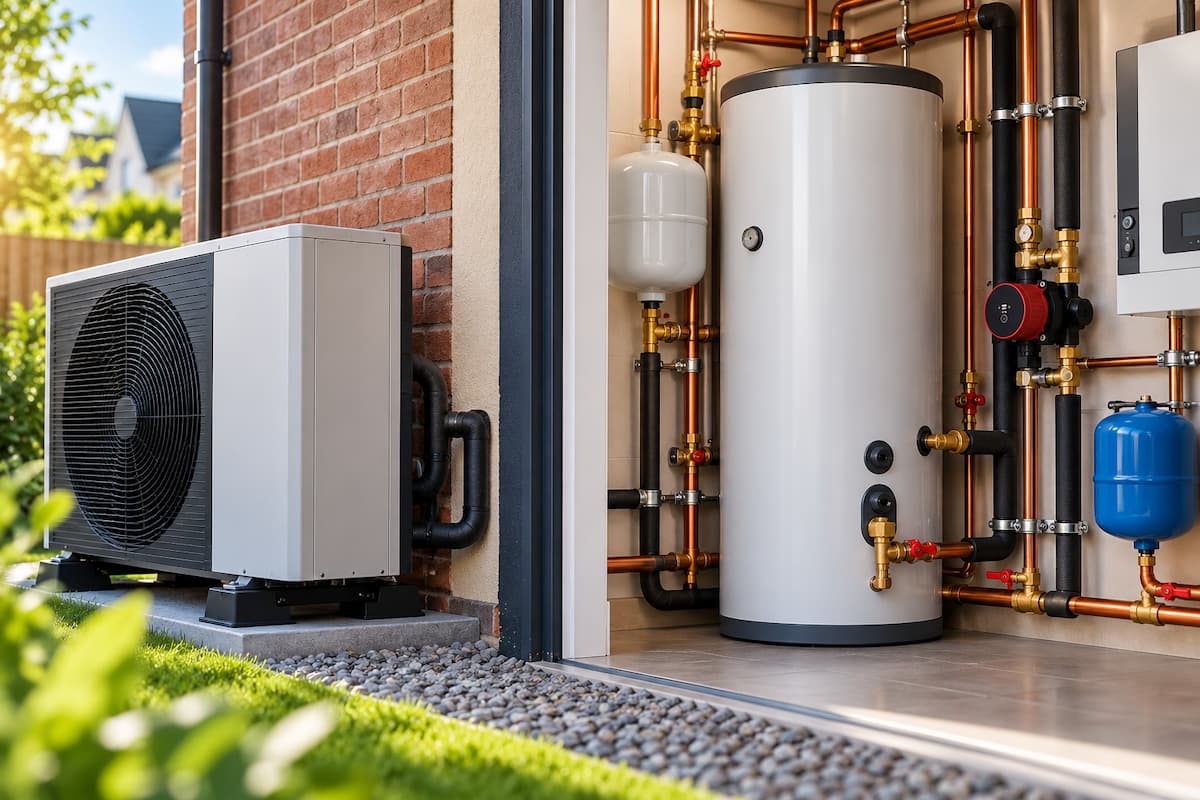
Expansion Vessels and Heat Pumps
Expansion vessels also play an important role in modern heat pump installations.
Air source and ground source heat pump systems may contain significant water volume, particularly where the installation incorporates:
- Underfloor heating
- Large radiator circuits
- Buffer vessels
- Volumisers
- Hydraulic separation
- Multiple heating zones
The expansion requirement must account for the complete primary water volume, not just the heat pump unit itself.
This provides a useful connection between traditional plumbing knowledge and modern renewable heating systems. The physics of thermal expansion remains relevant whether the heat source is a gas boiler or a heat pump.
Buffer Vessels and System Volume
A buffer vessel can add a substantial quantity of water to a heating circuit.
If you introduce one during a system alteration, reconsider the system’s expansion capacity.
For example, adding a large buffer vessel may materially increase total system volume.
The expansion vessel arrangement that was suitable before the modification may no longer provide sufficient acceptance volume afterwards.
This demonstrates the importance of viewing expansion vessel sizing as part of system design rather than as a separate component selection exercise.
Hydraulic Separation
Some modern heating systems incorporate hydraulic separation between the heat source and distribution circuits.
Although hydraulic design may become more sophisticated, each sealed water circuit still needs appropriate provision for expansion.
Plumbers moving into renewable heating therefore need to apply the principles of pressure control and thermal expansion to more complex system layouts.
The fundamentals developed through domestic plumbing and heating remain directly relevant.
Preventing Expansion Vessel Problems
Several good installation and maintenance practices can reduce the likelihood of expansion-related faults.
These include:
- Correct vessel sizing
- Correct pre-charge
- Appropriate cold fill pressure
- Secure vessel mounting
- Unrestricted connecting pipework
- Suitable servicing access
- Correct vessel specification
- Following manufacturer instructions
- Reassessing vessel capacity following system alterations
Correct design at the installation stage is preferable to correcting recurring pressure problems later.
Hot Water Systems and Safety Training
For qualified plumbers and heating engineers progressing into work on unvented hot water systems, Staffordshire Training Services offers the Hot Water Systems and Safety Course.
The course builds knowledge of domestic hot water systems and the safety requirements for their installation, commissioning, servicing, and maintenance.
Areas relevant to the principles covered in this article include:
- Hot water system safety
- Expansion control
- Pressure control
- Safety devices
- Discharge arrangements
- Installation requirements
- Commissioning
- Servicing and maintenance
- Approved Document G requirements
Understanding expansion vessels before progressing into this area gives engineers a much stronger foundation for appreciating the wider safety arrangements used within pressurised hot water systems.
Plumbing and Heating Training at Staffordshire Training Services
At Staffordshire Training Services, our plumbing courses combine technical knowledge with practical training, helping engineers develop skills they can apply across domestic water and heating systems.
For those beginning their plumbing career, our plumbing training provides a foundation in the principles behind components such as expansion vessels, including pipework, hot and cold water systems, system pressure, and domestic plumbing installations.
Engineers progressing into pressurised hot water systems can undertake our Hot Water Systems and Safety Course. This develops the knowledge required around hot water safety, expansion and pressure control, safety devices, commissioning, servicing and the requirements associated with unvented hot water systems.
Expansion vessel knowledge also becomes increasingly important for engineers moving into renewable heating. Heat pump installations can incorporate larger water volumes, buffer vessels, hydraulic separation and multiple heating circuits, all of which make correct expansion provision an important part of system design. Staffordshire Training Services provides specialist renewable energy training for engineers looking to extend their existing plumbing and heating skills into these systems.
Whether working with a sealed central heating circuit, an unvented hot water system or progressing towards renewable heating, understanding the relationship between water volume, temperature, expansion and pressure gives engineers a stronger foundation for installation and fault diagnosis.
Related Articles
- Hot Water Cylinders Explained
- Vented Hot Water Systems In Domestic Plumbing
- Unvented Hot Water Cylinders In Domestic Plumbing
- Understanding Water Pressure In Plumbing Systems
- Direct and Indirect Water Supply Systems
Prefer an AI Summary?