Weather compensation is one of the most important features within modern heat pump systems. Yet it is often one of the least understood by homeowners and even some installers transitioning into renewable heating.
A heat pump can be perfectly sized, correctly commissioned and connected to suitably sized radiators, but without properly configured controls it may never achieve its full efficiency potential.
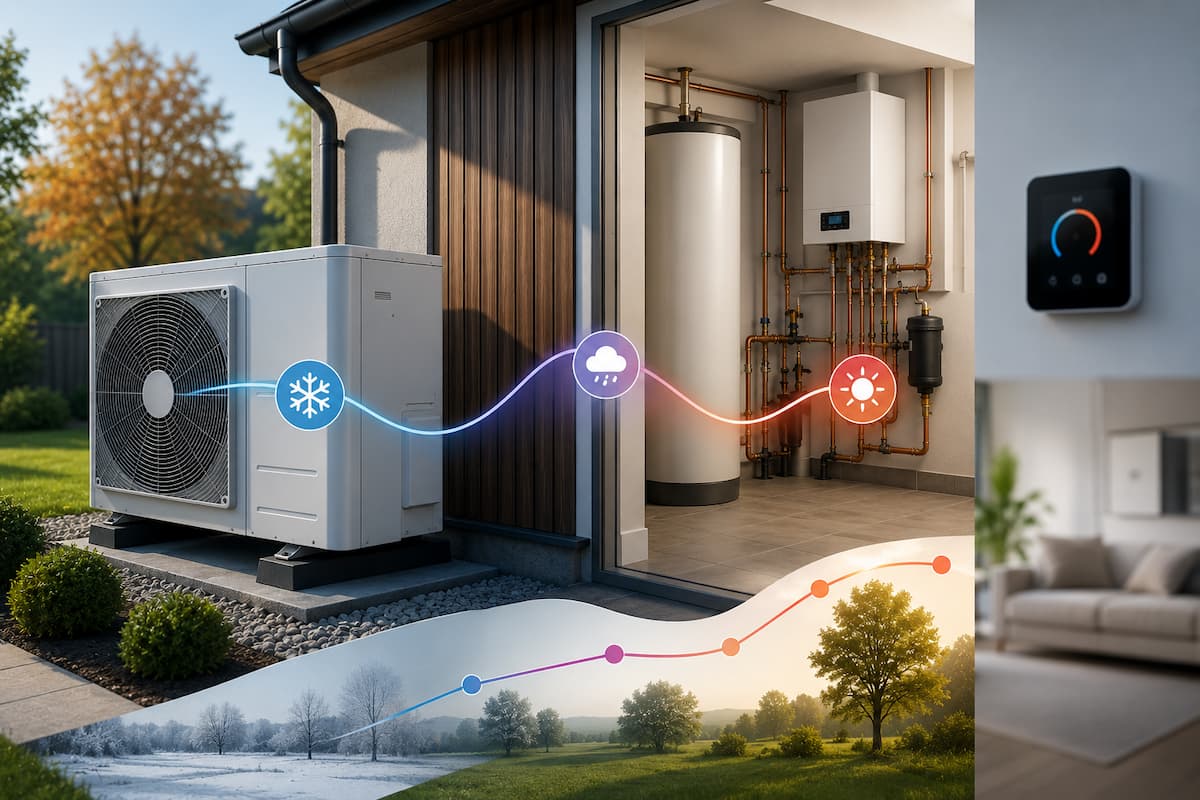
Weather compensation helps a heat pump respond intelligently to changing outdoor temperatures. Rather than operating at a fixed flow temperature year-round, the system continuously adjusts its output to match the property’s heating demand.
For renewable installers, understanding weather compensation is essential for delivering efficient, comfortable and cost-effective heating systems.
Weather Compensation
Weather compensation is a control strategy that adjusts the heating system flow temperature based on outdoor weather conditions.
As outdoor temperatures rise, the heating demand within the property reduces. The heat pump can therefore operate with lower flow temperatures.
As outdoor temperatures fall, the system automatically increases flow temperature to maintain indoor comfort.
This allows the heat pump to provide only the heat required at any given time.
Instead of operating at a fixed temperature such as 50°C throughout the heating season, the heat pump continuously adapts to changing conditions.
This improves both comfort and efficiency.
Traditional Heating Versus Weather Compensation
Traditional boiler systems often operate with simple on-and-off controls.
When the thermostat calls for heat, the boiler produces water at a fixed temperature regardless of outdoor conditions.
Heat pumps work differently.
| Traditional Fixed Temperature Control | Weather Compensation Control |
|---|---|
| Fixed flow temperature | Variable flow temperature |
| Higher energy consumption | Improved efficiency |
| Frequent temperature swings | More stable comfort levels |
| Limited system optimisation | Continuous adjustment |
| Less suitable for low temperature heating | Ideal for heat pump systems |
Weather compensation allows the heating system to respond more accurately to actual building demand.
Heat Pump Efficiency and Flow Temperature
Heat pumps become more efficient as flow temperatures decrease.
The lower the flow temperature, the less work the compressor must perform to deliver useful heat.
This directly affects:
- Coefficient of Performance (COP)
- Seasonal Coefficient of Performance (SCOP)
- Electricity consumption
- Running costs
- Component lifespan
For example, a heat pump operating at 35°C will generally achieve better efficiency than the same system operating at 55°C.
This is why weather compensation is such a valuable tool for renewable heating systems.
Weather Compensation Curves
Weather compensation operates using a heating curve.
The heating curve determines the relationship between outdoor temperature and required flow temperature.
As outside temperatures become colder, the flow temperature gradually increases.
As outside temperatures become warmer, the flow temperature decreases.
A typical example may look like this:
| Outdoor Temperature | Flow Temperature |
|---|---|
| 15°C | 30°C |
| 10°C | 35°C |
| 5°C | 40°C |
| 0°C | 45°C |
| -3°C | 50°C |
Every property will have its own ideal heating curve depending on:
- Heat loss
- Insulation standards
- Radiator sizing
- Underfloor heating design
- Occupancy patterns
- Desired room temperatures
Finding the correct curve is a key part of system commissioning.
Selecting The Correct Heating Curve
Selecting the correct heating curve is one of the most important tasks during commissioning.
The heating curve determines the relationship between outdoor temperature and flow temperature. A curve that is too steep may unnecessarily increase electricity consumption, while a curve that is too shallow may leave the property struggling to maintain comfortable temperatures during colder weather.
Different properties require different heating curves.
| Property Type | Typical Heating Curve Requirement |
|---|---|
| Older solid wall property | Steeper curve |
| Poorly insulated property | Higher flow temperature requirement |
| Modern insulated home | Shallower curve |
| Underfloor heating system | Lower curve settings |
| New build low energy property | Very shallow curve |
The initial curve selected during commissioning should be viewed as a starting point. Real performance monitoring often identifies opportunities for further optimisation.
Installers should avoid setting unnecessarily high curves to avoid customer complaints. Excessively high flow temperatures can significantly reduce heat pump efficiency throughout the heating season.
Relationship With Heat Loss Calculations
Weather compensation only works effectively when accurate heat loss calculations have been completed.
Heat loss calculations determine:
- Room heating demand
- Radiator sizing requirements
- Heat pump sizing
- Design flow temperatures
If heat loss calculations are incorrect, weather compensation settings may also become ineffective.
An undersized emitter may require higher flow temperatures than originally expected.
An oversized heat pump may cycle unnecessarily.
This is why heat loss calculations remain the foundation of renewable heating design.
Relationship With Radiator Sizing
Radiator sizing and weather compensation work together.
Correctly sized radiators allow lower flow temperatures while still delivering sufficient heat output.
Larger radiators often allow:
- Lower operating temperatures
- Higher heat pump efficiency
- Improved comfort
- Reduced cycling
- Lower running costs
A system with undersized radiators may force the heat pump to operate at higher temperatures, reducing many of the benefits of weather compensation.
Emitter Suitability
Weather compensation relies heavily on the heat emitters’ ability to deliver sufficient heat at lower flow temperatures.
A perfectly configured weather compensation curve cannot compensate for undersized radiators or poorly designed heating circuits.
Installers should assess:
- Radiator outputs at design temperatures
- Underfloor heating circuit performance
- Fan assisted emitter suitability
- Room heat loss requirements
- Available wall space for upgrades
Many retrofit properties require emitter upgrades before weather compensation can operate effectively.
Larger radiators and underfloor heating systems generally allow lower operating temperatures, improving both efficiency and comfort.
Underfloor Heating and Weather Compensation
Underfloor heating is particularly well suited to weather-compensation control.
Because underfloor heating uses a large heated surface area, it can often operate at very low flow temperatures.
Benefits include:
- Stable room temperatures
- Excellent heat distribution
- Reduced energy consumption
- Improved heat pump efficiency
- Lower operating temperatures
Many renewable heating systems combine weather compensation with underfloor heating to maximise performance.
Customer Comfort
One of the biggest advantages of weather compensation is improved comfort.
Many homeowners assume that hotter radiators automatically mean a warmer home.
In reality, weather-compensated systems often provide a more comfortable environment because temperatures remain stable throughout the day.
Benefits include:
- Reduced temperature fluctuations
- Consistent room temperatures
- Less overheating
- Improved energy efficiency
- Better overall comfort
The goal is not hotter radiators.
The goal is maintaining the desired indoor temperature using the lowest possible energy input.
Smart Controls and Weather Compensation
Modern renewable heating systems increasingly integrate weather compensation with smart controls.
These controls can provide:
- Remote monitoring
- Mobile app control
- Occupancy scheduling
- Energy reporting
- Performance tracking
- Fault notifications
Many manufacturers now offer advanced control platforms that combine weather compensation with intelligent optimisation algorithms.
Some systems can even adapt automatically based on historical heating performance.
OpenTherm and Renewable Controls
OpenTherm is a communication protocol used by some heating controls to allow more intelligent communication between components.
Rather than simple on and off operation, OpenTherm capable controls can adjust system performance more gradually.
Benefits may include:
- Improved temperature control
- Better energy efficiency
- Reduced cycling
- Improved comfort
Installers should understand each manufacturer’s compatibility requirements before specifying controls.
Commissioning Weather Compensation
Correct commissioning is essential.
The best equipment will not perform efficiently if the weather compensation settings are incorrect.
Commissioning should include:
- Heat loss verification
- Radiator output confirmation
- Flow temperature checks
- Heating curve setup
- Room temperature monitoring
- Customer handover
Many systems require seasonal fine-tuning after installation.
The initial heating curve may need adjustment as real performance data becomes available.
Seasonal Adjustments
Many weather compensation systems benefit from fine tuning during their first year of operation.
Properties behave differently across the seasons due to changing weather patterns, occupancy habits and building fabric performance.
Installers may find that:
- Autumn requires minor adjustments during initial operation
- Winter performance reveals true peak heating demand
- Spring provides opportunities to reduce flow temperatures further
- Summer allows review of domestic hot water settings
Monitoring performance during the first heating season often produces meaningful efficiency improvements.
Where possible, installers should review system performance with customers after several months of operation and adjust heating curves if required.
Practical Example
Consider a three bedroom semi detached property with:
- Air source heat pump
- Correctly sized radiators
- Good loft insulation
- Double glazing
- Weather compensation controls
Without weather compensation, the installer may set a fixed flow temperature of 50°C throughout the heating season.
With weather compensation enabled:
| Outdoor Temperature | Flow Temperature |
|---|---|
| 12°C | 35°C |
| 7°C | 40°C |
| 0°C | 45°C |
| -3°C | 50°C |
For much of the year, the system operates at significantly lower temperatures, reducing electricity consumption while maintaining comfort.
Domestic Hot Water Operation
Weather compensation controls the space heating side of the system but does not usually control domestic hot water production in the same way.
When domestic hot water is required, the heat pump will often temporarily raise its operating temperature to heat the cylinder.
Installers should understand:
- Domestic hot water priority operation
- Cylinder temperature settings
- Reheat schedules
- Legionella protection cycles
- Heat pump recovery times
This distinction is important because customers sometimes assume weather compensation affects all heating functions equally.
Correct commissioning ensures that both space heating and hot water production operate efficiently.
Weather Compensation Faults
Weather compensation systems can experience performance issues if they are not configured correctly.
The symptoms often appear elsewhere in the heating system, making diagnosis more difficult.
| Symptom | Possible Cause |
|---|---|
| Property feels cold | Heating curve too low |
| Property overheats | Heating curve too high |
| High electricity consumption | Excessive flow temperatures |
| Frequent compressor starts | Poor commissioning or incorrect settings |
| Uneven room temperatures | System balancing issues |
| Customer constantly adjusts controls | Insufficient handover guidance |
Understanding these common symptoms can significantly reduce fault-finding time and improve customer satisfaction.
Reducing Compressor Cycling
Compressor cycling occurs when a heat pump repeatedly starts and stops over short periods.
Excessive cycling can:
- Reduce efficiency
- Increase electrical consumption
- Accelerate component wear
- Reduce compressor lifespan
- Create unstable indoor temperatures
Weather compensation helps reduce cycling by matching system output more closely to actual heating demand.
Other factors that help reduce cycling include:
- Correct heat pump sizing
- Adequate emitter sizing
- Proper hydraulic design
- Suitable system volume
- Correct buffer vessel application where required
A properly commissioned weather-compensated system should operate steadily for longer periods rather than repeatedly switching on and off.
Installer Mistakes
Several common mistakes can limit the effectiveness of weather compensation.
These include:
- Disabling weather compensation
- Setting the heating curve too high
- Setting the heating curve too low
- Ignoring heat loss calculations
- Using undersized radiators
- Poor system balancing
- Inadequate commissioning
- Failing to explain operation to customers
Weather compensation should not be treated as an optional feature. It is a fundamental part of efficient renewable heating design.
Monitoring and Optimisation
Many modern systems allow installers to monitor performance over time.
Useful performance indicators include:
- Electricity consumption
- Flow temperatures
- Return temperatures
- COP values
- Runtime hours
- Cycling frequency
Monitoring helps identify opportunities to improve efficiency and refine system settings.
Monitoring is particularly valuable during the first year after installation when weather compensation curves are being refined.
Customer Expectations
Customer education is often overlooked during installation.
Many homeowners are accustomed to boiler systems producing very hot radiators.
Weather-compensated heat pump systems behave differently.
Installers should explain:
- Radiators may feel cooler
- Heating may run for longer periods
- Temperatures remain more stable
- Lower flow temperatures improve efficiency
- Controls should not be adjusted constantly
A clear handover can significantly improve customer satisfaction.
Future Developments
Weather compensation continues to evolve as heating controls become more sophisticated.
Future developments may include:
- Artificial intelligence assisted controls
- Predictive weather forecasting integration
- Dynamic electricity tariff optimisation
- Advanced occupancy detection
- Remote diagnostics
- Automated efficiency optimisation
These technologies are expected to play an increasingly important role in low-carbon heating systems.
Heat Pump Training In Staffordshire
As heat pump installations continue to increase across the UK, installers must understand not only system design but also the controls that influence performance.
At Staffordshire Training Services, heat pump training courses are designed to help engineers build practical skills alongside technical knowledge.
Renewable energy system training combines real installation guidance with current industry best practices to support engineers transitioning to renewable heating technologies.
For installers looking to maximise heat pump efficiency and deliver better customer outcomes, understanding weather compensation is one of the most valuable skills in modern renewable heating design.
Related Articles
- Heat Pump Fault Finding For Renewable Installers
- Low Temperature Heating Systems For Renewable Installers
- Heat Loss Calculations for Renewable System Installers
- Renewable Training Pathway For Heating Engineers
- Heat Pump System Design Basics for Gas Engineers Transitioning to Renewables
Prefer an AI Summary?