Yes, you can become a gas engineer without completing a traditional apprenticeship.
An apprenticeship is a proven route into gas engineering, but it is not the only pathway. For adults changing careers, people already working in plumbing or heating, and other suitable new entrants, a structured Gas Managed Learning Programme can provide an alternative route to the training, practical experience, and competency assessment required to enter the domestic gas industry.
The important distinction is that avoiding an apprenticeship does not mean avoiding practical training or workplace experience.
Gas engineering is safety critical work. Regardless of the training route, an aspiring engineer needs to develop technical knowledge, gain practical experience and demonstrate competence before progressing towards the gas work they intend to undertake professionally.
At Staffordshire Training Services, our Gas Managed Learning Programme provides a structured route for suitable candidates looking to enter the domestic gas industry without following the traditional apprenticeship pathway.
Routes Into Gas Engineering
Different routes into gas engineering exist because candidates enter the industry from very different starting points.
A school leaver may be able to secure an apprenticeship with an employer and combine employment with structured training.
An experienced plumber may already have substantial knowledge of heating systems, pipework, and hot water installations but may need additional gas training and assessment.
Someone changing career at 30, 40 or later may have transferable practical skills but find that the traditional apprenticeship model does not suit their circumstances.
The main routes can therefore include:
- A gas engineering apprenticeship
- A structured Managed Learning Programme
- An appropriate pathway for candidates with relevant existing trade experience
Whichever route you choose, the objective is the same: develop the knowledge and practical competence to progress through the relevant gas assessments and, where appropriate, towards Gas Safe registration.
Our article on building a career as a gas engineer provides a broader look at the profession and the progression available within the industry.
Gas Engineering Apprenticeships
An apprenticeship combines employment with formal training.
The apprentice develops their skills while working within the industry and completing structured learning and assessment.
Staffordshire Training Services offers a Level 3 Gas Engineering Operative Apprenticeship, providing one route for candidates who have access to an appropriate apprenticeship position.
Our guide to the Level 3 Gas Engineering Apprenticeship looks more closely at the training and workplace development involved.
For the right candidate, an apprenticeship can provide an excellent route into the trade.
The difficulty is that it does not suit everybody.
Adult career changers may already have financial and family commitments that make starting an apprenticeship impractical. Others may struggle to secure an apprenticeship position with a suitable employer.
This is where alternative structured training pathways become particularly relevant.
Gas Managed Learning Programmes
A Gas Managed Learning Programme, commonly referred to as an MLP, provides a structured route into domestic gas engineering for suitable candidates who are not following an apprenticeship.
The programme combines training centre learning and practical training with on-site experience and portfolio development.
This is an important point.
An MLP should not be viewed as a way to bypass practical experience. It provides a different structure for gaining the knowledge and competence required to progress within the industry.
At Staffordshire Training Services, candidates following the Gas Managed Learning Programme develop their technical knowledge at our training centre in Stafford alongside practical skills and on-site portfolio experience.
Our guide to starting a gas career with the MLP course provides further information for candidates considering this route.
MLP and Apprenticeship Routes Compared
The main difference between an apprenticeship and an MLP is how they develop training and workplace competence.
An apprentice is employed while completing their programme. Their workplace provides regular exposure to real gas engineering tasks alongside formal training.
An MLP candidate follows a structured training programme and also needs appropriate on-site experience to develop and demonstrate practical competence.
Neither route should be reduced simply to the amount of time spent in a classroom.
Gas engineering requires engineers to apply technical knowledge safely in real properties and across installations that vary considerably in age, design and condition.
Candidates deciding between these pathways can look at our detailed comparison of the Gas Managed Learning Programme versus the Level 3 Apprenticeship.
The right choice depends on the candidate’s circumstances, previous experience and access to suitable workplace opportunities.
Career Changers and Adult Learners
The MLP route can be particularly relevant for adults changing careers.
Someone considering gas engineering later in their working life may not be in the same position as a school leaver.
They may have a mortgage, family responsibilities or an existing career. They may also bring years of practical experience from construction, engineering, maintenance or another technical occupation.
A structured training programme can allow suitable candidates to retrain without relying on the traditional apprenticeship route.
Previous experience does not replace the need to become competent in gas work, but transferable skills can still be valuable.
Mechanical awareness, fault diagnosis, customer communication, safe tool use, and experience in occupied properties can all contribute to professional development.
The focus should remain on gaining the specific knowledge and practical competence required of a domestic gas engineer.
Previous Plumbing Experience
Plumbers and heating engineers represent another group that may consider entering gas engineering without completing a full apprenticeship.
Existing plumbing knowledge can provide a useful foundation.
A plumber may already be familiar with heating systems, pipework, radiators, hot water cylinders, valves, pumps and working within customers’ homes.
However, being a competent plumber does not make somebody competent to undertake gas work.
Gas engineering introduces additional requirements surrounding combustion, gas safety legislation, tightness testing, purging, gas pressures, flues, ventilation and appliance safety.
Candidates with relevant previous experience should therefore have their starting point considered carefully so that they follow an appropriate training and assessment route.
Staffordshire Training Services also provides an ACS Domestic Gas Safety and Appliances Foundation Course for suitable candidates developing the gas knowledge required before assessment.
Technical Knowledge Required
Whether someone follows an apprenticeship or MLP, domestic gas engineering requires competence across a broad range of subjects.
Candidates need to develop knowledge of gas safety legislation, combustion, ventilation, flueing, pipework, pressure, gas rates, tightness testing, purging and appliance operation.
The purpose is not simply to memorise procedures for an assessment.
An engineer needs to recognise the relationship between different parts of an installation and understand the safety implications of the results they obtain.
For example, our guide to the Gas Safety Installation and Use Regulations looks at the legal framework underpinning professional gas work.
Trainees also need to recognise unsafe conditions and understand their responsibilities when they identify problems. Our article on unsafe situations and gas engineer legal duties covers this area in greater depth.
Gas Pipework Skills
Pipework is another important part of the training pathway.
Candidates need to develop practical competence in working with gas installation pipework and understand the requirements affecting materials, jointing, routing, support, protection and sizing.
Pipe sizing is particularly important because an appliance needs an adequate gas supply to operate correctly.
Pipe length, fittings and appliance demand can all influence pressure loss through an installation. Engineers therefore need to consider the complete system, not just the final connection to an appliance.
Our article covering gas pipework installation standards provides further technical information on this part of domestic gas work.
Practical training lets candidates develop these skills before applying them in real installations under appropriate supervision.
Tightness Testing and Purging
Testing is fundamental to safe gas work.
Engineers need to determine whether an installation is gas-tight and understand the procedures required to displace gas or air from pipework safely.
This requires more than simply knowing which equipment to connect.
Candidates need to understand test conditions, pressures, stabilisation, permissible results and the appropriate actions where an installation fails to meet the required criteria.
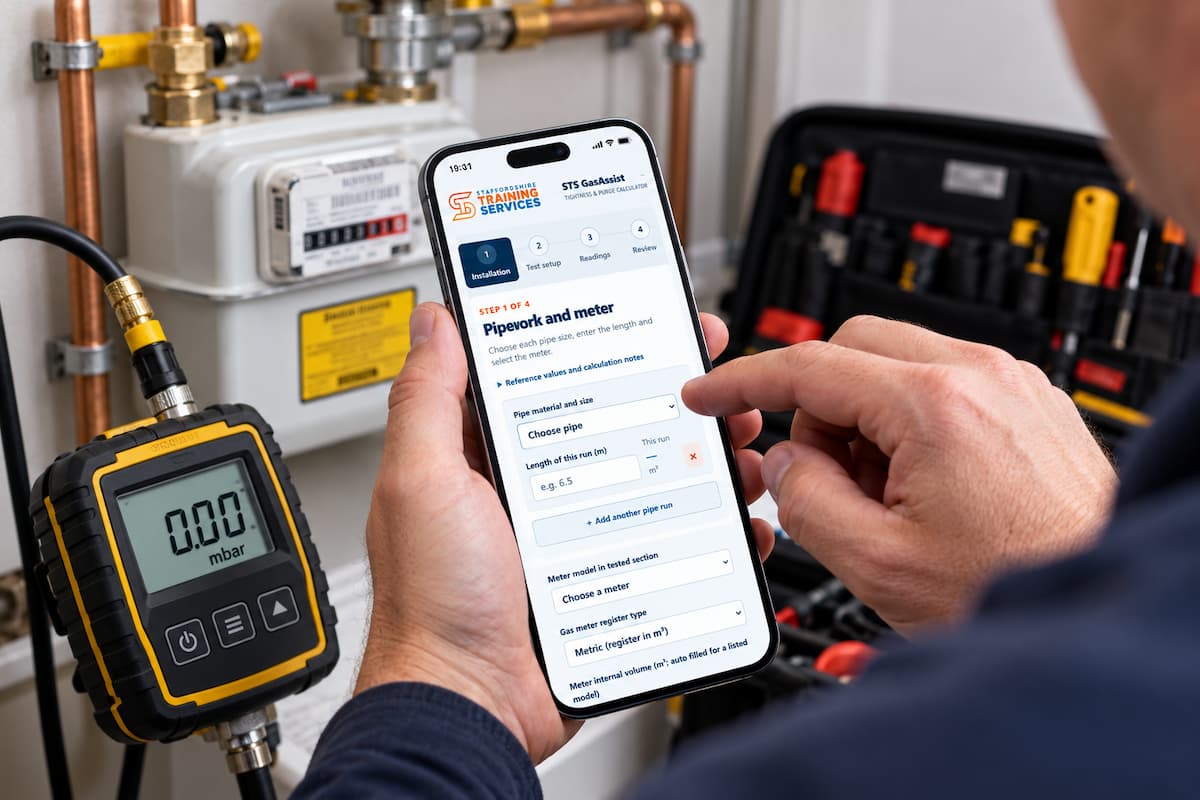
Our guide to tightness testing and gas soundness looks at this essential competency in more detail.
Trainees will also develop knowledge of gas purging procedures and the safety considerations involved when introducing or removing gas from installation pipework.
These are examples of the technical and practical competencies you need to develop, regardless of the route you take into the industry.
Combustion and Flueing
Domestic gas engineers also need a strong grounding in combustion.
Understanding the relationship between fuel, oxygen, ignition and combustion products allows engineers to assess whether appliances are operating safely.
Our guide to combustion principles for gas engineers looks at these fundamentals in greater detail.
Combustion cannot be separated from ventilation and flueing.
Gas appliances need appropriate provision for combustion air where required and a safe means of dealing with combustion products. Engineers therefore need to understand the different flue arrangements they may encounter and the requirements that apply.
The article covering ventilation and flueing requirements for gas appliances provides further technical background for trainees developing this knowledge.
Workplace Experience
One of the biggest misconceptions surrounding non-apprenticeship gas training is that everything can be completed within a training centre.
It cannot.
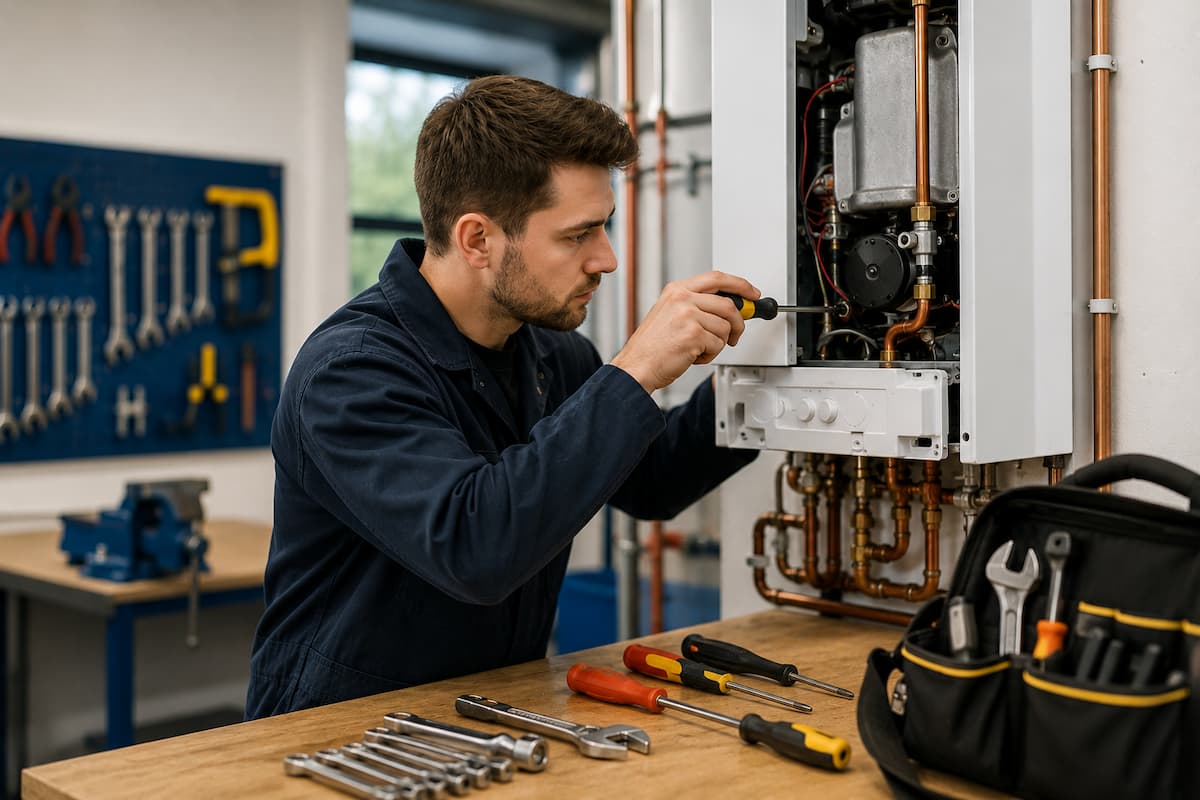
Centre training matters because it lets candidates develop skills in a controlled environment, with access to instructors and training equipment.
Real installations introduce much greater variation.
Properties have different heating systems, pipework arrangements, appliance types, controls and installation histories. Engineers need experience interpreting those differences and applying the principles they have been taught.
MLP candidates therefore need appropriate on-site experience and portfolio evidence as part of their development.
This practical component is essential to the route’s credibility.
The objective is not to create somebody capable of passing an assessment on familiar training equipment. It is to develop an engineer who can apply their knowledge safely in real working environments.
Building An Onsite Portfolio
The onsite portfolio records evidence of practical experience gained during the programme.
Candidates need opportunities to develop and demonstrate relevant skills under appropriate supervision.
The portfolio is therefore not simply an administrative exercise completed at the end of training.
It forms part of the candidate’s development from training centre learning towards occupational competence.
A good placement also exposes trainees to the realities of gas engineering that a training centre cannot fully reproduce.
This may include working around customers, assessing existing installations, dealing with restricted access, recognising previous alterations and seeing the range of appliances found across domestic properties.
Candidates considering an MLP should take the workplace element seriously from the outset.
Progressing To ACS Assessment
Completing training and practical development leads towards competency assessment.
ACS stands for Accredited Certification Scheme and is the recognised competency assessment framework used within the gas industry.
For domestic natural gas engineers, CCN1 provides the core domestic gas safety competency, with relevant appliance categories added according to the work the engineer intends to undertake.
Candidates reaching this stage for the first time can progress through the ACS Domestic Gas Safety and Appliances Initial Assessment.
Our guide to ACS Initial Assessment for domestic gas engineers looks more closely at this stage of the qualification pathway.
Passing an MLP itself should therefore not be confused with passing ACS assessment. Training and assessment have different purposes.
The programme develops competence. ACS assesses it.
CCN1 and Appliance Categories
Domestic gas engineers require competencies relevant to the work they intend to undertake.
CCN1 covers core domestic gas safety and provides the foundation for relevant appliance assessments.
Additional categories can include CENWAT for central heating boilers and water heaters, CKR1 for gas cooking appliances, HTR1 for gas fires and wall heaters and other competencies depending on the engineer’s intended scope.
This category structure matters because no single certificate gives unrestricted competence across every form of gas work.
The assessments an engineer completes influence the categories of work they can subsequently undertake within Gas Safe registration.
Candidates should therefore consider their intended career when choosing an assessment pathway.
Gas Safe Registration
Completing training and the ACS assessment does not automatically make you Gas Safe registered.
The Gas Safe Register is the official register of businesses legally permitted to undertake relevant gas work.
Qualified engineers work through a registered business, with their recognised categories of competence recorded appropriately.
Someone planning to become self-employed therefore needs to consider the business registration stage as well as their individual training and assessment.
An engineer joining an existing Gas Safe registered employer will normally operate through that business once the relevant requirements have been met.
Our guide to the qualifications needed to become a Gas Safe engineer looks at this complete pathway in greater detail.
The key point for MLP candidates is that the route does not end on the final day of the training programme. Training, workplace experience, ACS assessment and Gas Safe registration are distinct stages.
Maintaining ACS Competence
Gas engineering also involves continued competency assessment throughout a professional career.
Domestic ACS certificates are normally valid for five years, after which engineers need to complete the appropriate reassessment to maintain current evidence of competence.
Staffordshire Training Services provides ACS Domestic Gas Safety and Appliances Reassessment for existing engineers reaching this stage.
Our guide to domestic gas ACS reassessment provides additional information about the process.
This illustrates another important aspect of entering the industry.
Gas training isn’t something you complete once and forget. Engineers need to maintain their knowledge, keep up with relevant changes and continue demonstrating competence throughout their careers.
MLP Is Not A Shortcut
The phrase “alternative route” can sometimes give the wrong impression.
A Managed Learning Programme should not be viewed as a shortcut to becoming a gas engineer.
It is an alternative training structure for suitable candidates who are not completing an apprenticeship.
Candidates still need to develop technical knowledge.
They still need practical training.
They still need workplace experience.
They still need to demonstrate competence.
They still need to complete the relevant assessments.
And gas work requiring Gas Safe registration must still be undertaken through an appropriately registered business within the engineer’s recognised scope.
The advantage of the MLP route is not that these requirements disappear. It is that they are organised into a pathway that can be more suitable for adult learners and career changers.
Choosing Between An MLP and Apprenticeship
Neither route is automatically better for every candidate.
An apprenticeship may be an excellent choice for somebody who has secured an appropriate position with an employer and wants to develop their career through employment and structured training.
An MLP can be more appropriate for somebody who wants to retrain through a dedicated programme and has access to the practical experience required to complete their development.
Age alone should not determine the route.
Previous experience, employment circumstances, access to on-site experience and the candidate’s intended career all need to be considered.
Our detailed comparison of the Gas Managed Learning Programme and Level 3 Gas Engineering Apprenticeship can help candidates assess the differences before making a decision.
A Typical MLP Pathway
For someone entering gas engineering without an apprenticeship, the progression can be viewed in broad stages.
- Stage 1: Gas Training
Begin a structured Gas Managed Learning Programme covering the technical knowledge required for domestic gas work.
- Stage 2: Practical Development
Develop practical skills at the training centre across pipework, appliances, testing, combustion, ventilation and other core competencies.
- Stage 3: Onsite Experience
Gain appropriate supervised workplace experience and complete the required portfolio evidence.
- Stage 4: ACS Initial Assessment
Progress to the relevant ACS Initial Assessment and demonstrate competence in core gas safety and the relevant appliance categories.
- Stage 5: Gas Safe Registration
Meet the applicable Gas Safe registration requirements and undertake gas work through an appropriately registered business.
- Stage 6: Professional Development
Continue gaining experience, maintain ACS competencies, and add further qualifications that support the engineer’s career.
This is a substantial professional training pathway, not a short course followed immediately by unrestricted gas work.
Career Prospects After Training
The first qualification is only the beginning of a gas engineering career.
New engineers continue developing their judgement and practical ability as they encounter more appliances, installations and faults.
Our article on whether a gas engineering career is still worth it looks at some of the wider considerations for people entering the industry.
Gas competence can also provide a foundation for further professional development.
Engineers may later add LPG, hot water, electrical safety or renewable heating competencies depending on the services they intend to offer.
With domestic heating continuing to evolve, gas engineers can also progress into renewable energy training and build competence across technologies such as heat pumps.
The aim should be to develop a broad, credible professional skill set over time, rather than view the first qualification as the end of training.
Gas Managed Learning Programme In Stafford
You do not need to complete a traditional apprenticeship to become a gas engineer.
For suitable candidates, the Gas Managed Learning Programme provides a structured alternative that includes technical training, practical development, and on-site experience before progression to ACS competency assessment.
Staffordshire Training Services delivers the Gas Managed Learning Programme at our purpose-built training centre in Stafford.
The programme is particularly relevant for adult career changers and suitable new entrants looking for a defined pathway into domestic gas engineering without following the traditional apprenticeship route.
Candidates develop their knowledge across core gas safety, installation pipework, appliances, combustion, ventilation, flueing, testing and other essential areas before progressing through practical workplace development towards assessment.
We also provide the ACS Domestic Gas Safety and Appliances Initial Assessment, allowing candidates to continue their progression towards professional gas work.
For candidates still deciding between routes, Staffordshire Training Services also offers the Level 3 Gas Engineering Operative Apprenticeship, so our team can help prospective engineers consider the pathway that best reflects their starting point and circumstances.
Our wider range of gas training courses supports engineers from initial training through competency assessment, reassessment and further professional development.
An apprenticeship remains an excellent route into gas engineering, but it is not the only route. For candidates unable or unlikely to follow the apprenticeship pathway, structured MLP training can provide a credible route towards developing the knowledge, practical experience and assessed competence needed for a career in the gas industry.
Related Articles
- Qualifications Needed To Become a Gas Safe Engineer
- Inside the Level 3 Gas Engineering Apprenticeship
- Choosing Between F-Gas Category 1 and Category 2
- From MLP To Gas Safe Engineer In 12 Months
- Gas Managed Learning Programme Versus Level 3 Apprenticeship
Prefer an AI Summary?