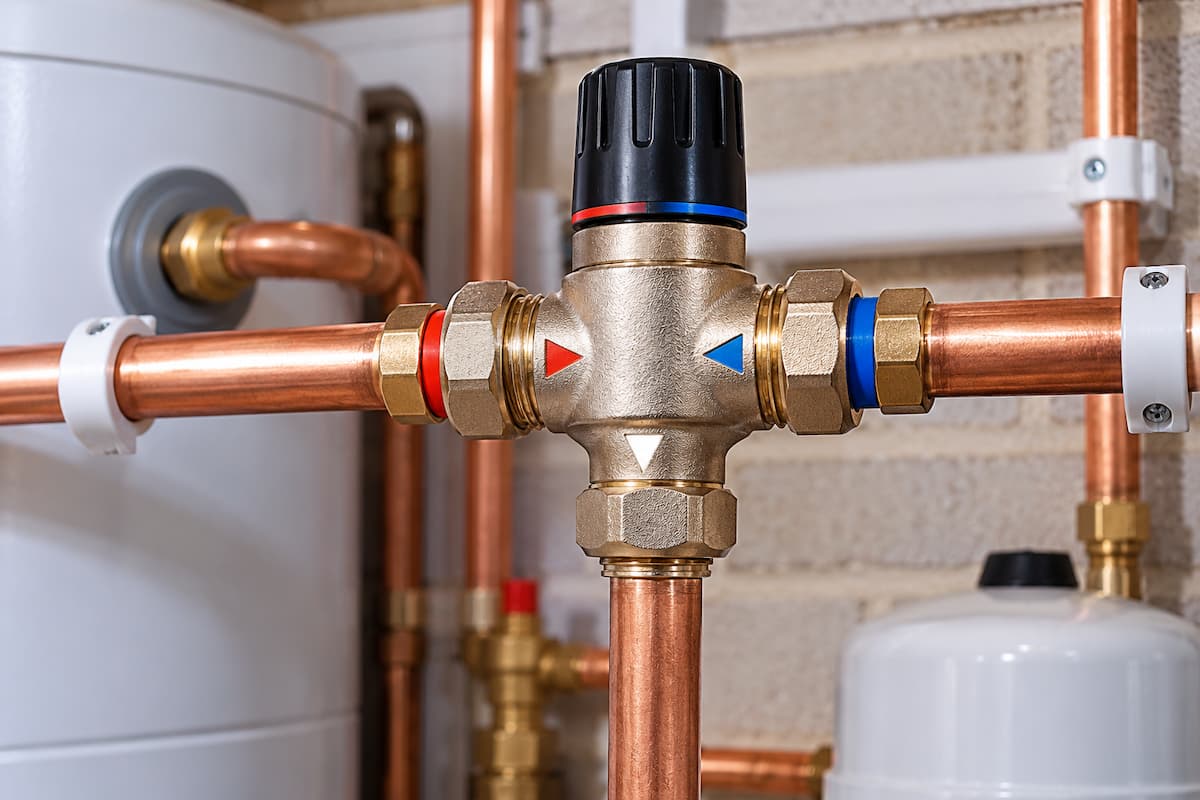
Thermostatic mixing valves play an important role in controlling hot water temperatures within domestic plumbing systems. They blend hot and cold water to produce mixed water at a controlled temperature, helping reduce the risk of excessively hot water reaching an outlet.
For plumbers, understanding a thermostatic mixing valve involves more than knowing that it mixes hot and cold water. The valve must respond to changing inlet conditions while maintaining a suitable mixed temperature. Installation position, water pressure, strainers, check valves and commissioning can all affect its performance.
Thermostatic mixing valves, commonly referred to as TMVs, are particularly relevant where stored hot water needs to remain at an appropriate storage temperature. In contrast, a lower temperature is required at particular outlets.
A Thermostatic Mixing Valve
A thermostatic mixing valve combines hot and cold water to provide mixed water at a controlled temperature.
Instead of reducing the temperature of the complete stored hot water supply, the valve controls the temperature delivered downstream from its mixed outlet.
A typical arrangement can be represented as:
Hot Water Supply ──────┐
│
▼
┌─────────────┐
│ TMV │──────► Controlled Mixed Water
└─────────────┘
▲
│
Cold Water Supply ─────┘
This allows hot water to be generated and stored according to the requirements of the system while controlling the temperature supplied to selected outlets.
Storage, Distribution and Outlet Temperatures
One of the most important principles for trainee plumbers is the distinction between stored water temperature, distribution temperature and the final mixed temperature at an outlet.
A hot water cylinder may contain water at a substantially higher temperature than is desirable at a particular outlet. The hot water then travels through the distribution pipework before reaching a TMV, where cold water is introduced to produce the required mixed temperature.
These are therefore three separate conditions within the system:
- The temperature at which hot water is stored
- The temperature of hot water within the distribution system
- The mixed temperature supplied downstream of the TMV
This distinction matters because lowering the storage temperature to achieve a cooler tap temperature is not the same as controlling temperature at or close to the point of use.
The TMV allows these requirements to be managed separately.
Scalding Risk
Hot water can cause serious burns, with the risk increasing as water temperature rises.
Certain users may be particularly vulnerable, including:
- Young children
- Older people
- People with reduced mobility
- People with reduced sensitivity to temperature
- People unable to move quickly away from hot water
A correctly selected, installed and commissioned TMV can help limit the temperature delivered to an outlet.
The valve should still be considered part of a wider hot water safety strategy rather than a substitute for correct system design and maintenance.
Basic TMV Construction
Designs vary between manufacturers, but a thermostatic mixing valve typically contains:
- Hot water inlet
- Cold water inlet
- Mixed water outlet
- Thermostatic element
- Internal shuttle or piston
- Valve seats
- Temperature adjustment mechanism
- Strainers
- Check valves where incorporated
The thermostatic element is central to the operation of the valve. It senses the temperature of the mixed water and acts on the internal regulating mechanism.
Thermostatic Mixing Valve Diagram
A simplified arrangement helps show the basic operating principle.
Mixed Water Outlet
│
▼
┌─────────────────┐
│ Thermostatic │
│ Element │
│ │ │
│ ▼ │
Hot Water ─────►│ Mixing Chamber │◄───── Cold Water
│ ▲ │
│ │ │
│ Regulating │
│ Mechanism │
└─────────────────┘
The exact internal arrangement differs between valve designs, but the basic principle remains consistent. The valve continually changes the proportions of hot and cold water entering the mixing chamber to maintain the required mixed temperature.
Thermostatic Regulation
The thermostatic element responds to changes in mixed water temperature.
Depending on the valve design, the element may contain a material that expands and contracts as its temperature changes. This movement operates the internal shuttle or regulating mechanism.
If mixed water becomes too hot, the valve alters the proportions of the incoming supplies to reduce the mixed temperature. If it becomes too cool, the regulating mechanism responds in the opposite direction.
This automatic response allows a TMV to compensate for normal changes in inlet conditions within its designed operating range.
Hot water temperature may vary because of cylinder operation, demand, distribution losses or recovery. Cold water temperature can also vary, including through seasonal changes. The mixing ratio therefore does not remain permanently fixed.
The hot inlet must still be sufficiently above the required mixed temperature for effective control. If the TMV receives inadequately heated water, adjusting the valve cannot compensate for a problem with the heat source or hot water system.
Temperature Adjustment and Verification
Many TMVs allow the required mixed temperature to be adjusted within a defined range.
The adjustment mechanism should not be treated like an ordinary tap control. The required setting needs to be established according to the application and the manufacturer’s instructions.
After adjustment, the outlet should be allowed to reach stable operating conditions, and the mixed water temperature should be measured with a suitable thermometer.
Temperature should not be estimated by touch.
Commissioning should confirm that the valve can maintain the intended mixed temperature under the operating conditions for which the installation has been designed.
Responding To Pressure Changes
Temperature is only one side of TMV performance. Pressure conditions at the hot and cold inlets can also affect operation.
If another outlet opens elsewhere in the property, the conditions reaching the valve may change.
A correctly installed TMV should operate within the inlet pressure range specified by its manufacturer, but substantial pressure differences between the hot and cold supplies can affect performance.
This links directly with the principles covered in pressure reducing valves in domestic plumbing systems, where pressure regulation and balanced supplies can become important for downstream equipment.
Balanced Supplies
A significant pressure difference between the hot and cold supplies can make temperature regulation more difficult.
This is particularly relevant where one supply has passed through pressure regulating equipment while the other arrives directly from a higher pressure source.
In some installations, balanced supplies are used so that hot and cold water reaching mixing equipment operate under compatible pressure conditions.
The requirements depend on the hot water system, TMV and manufacturer instructions.
TMVs and Unvented Hot Water Systems
Thermostatic mixing valves can be used with unvented hot water cylinders where controlled outlet temperatures are required.
The two components perform different functions.
The cylinder stores heated domestic water under pressure. The TMV controls the temperature of water supplied downstream by blending hot and cold water.
The TMV does not replace the cylinder’s temperature controls or safety devices. Likewise, the cylinder’s safety controls should not be confused with temperature control at the final outlet.
Point Of Use Mixing
A TMV can be installed close to the outlet it serves.
This is often described as point of use mixing.
Hot Distribution ─────┐
│
▼
TMV ─────► Basin
▲
│
Cold Distribution ────┘
Locating the valve close to the outlet reduces the length of pipework containing mixed temperature water.
This can be important where outlet temperature control and water hygiene both need careful consideration.
Centralised Mixing
Some systems may use mixing equipment to supply controlled temperature water to more than one outlet.
This creates different design considerations because mixed water is distributed through a larger section of pipework.
Factors can include:
- Pipe volume
- Heat loss
- Outlet demand
- Water hygiene
- Temperature monitoring
- Circulation arrangements
- Valve capacity
The appropriate approach depends upon the application and relevant requirements.
TMV2 and TMV3
Plumbers may encounter references to TMV2 and TMV3.
These terms relate to recognised schemes and performance requirements for thermostatic mixing valves used in different applications.
TMV2 valves are associated with domestic applications, while TMV3 valves are intended for higher-risk healthcare environments and applications requiring enhanced performance standards.
The practical point is that a valve should be selected according to its application rather than simply because it is described as thermostatic.
An engineer should check the required approval, operating conditions and manufacturer specifications for the installation.
Valve Sizing
A TMV needs sufficient flow capacity for the outlets it supplies.
An undersized valve may restrict flow, particularly where several outlets are supplied from the same mixing arrangement.
Selection should consider:
- Required flow rate
- Hot inlet temperature
- Cold inlet temperature
- Inlet pressures
- Pressure differential
- Required mixed temperature
- Number and type of outlets
- Manufacturer performance data
Connection size alone does not determine whether a valve is suitable.
Strainers
Small internal waterways and valve seats can be affected by debris.
Strainers may therefore be fitted to protect the TMV from contamination.
Possible debris includes:
- Scale
- Sediment
- Installation debris
- Corrosion products
- Jointing material
Blocked strainers can reduce flow through one or both inlets and affect temperature control.
Accessibility for cleaning and servicing should therefore be considered during installation.
Check Valves
Some TMV arrangements incorporate check valves to prevent unwanted crossflow between the hot and cold supplies.
Without suitable protection, pressure differences can potentially allow one supply to push into the other through the mixing valve.
Check valves may be incorporated within the TMV or installed separately depending on the design.
The engineer should follow the manufacturer’s installation requirements rather than assuming every TMV contains identical internal protection.
Isolation Valves
Suitable isolation allows the TMV to be inspected and serviced without unnecessarily shutting down a larger part of the plumbing system.
Isolation can also make diagnostic testing easier.
Service valves should be left in the correct operating position after work is completed, as a restricted inlet can affect both flow and temperature control.
Installation Position
A TMV should be installed in accordance with manufacturer requirements.
Important considerations can include:
- Correct identification of hot and cold inlets
- Direction of flow
- Permitted valve orientation
- Accessibility
- Service clearance
- Position relative to the outlet
- Pipe support
- Isolation
- Strainer access
Connecting the hot and cold supplies to the wrong ports can prevent correct operation.
Valve bodies are normally marked to identify the connections.
Flushing Before Commissioning
New and altered pipework can contain debris.
Before commissioning a TMV, the system should be flushed appropriately so that installation debris is less likely to enter the valve.
Failure to do this can contaminate strainers or internal valve seats soon after installation.
A newly fitted valve that immediately develops poor flow or unstable operation may therefore have an installation issue rather than a manufacturing defect.
Commissioning a Thermostatic Mixing Valve
Installation is not complete simply because water flows from the outlet.
The valve needs to be commissioned according to the manufacturer’s instructions and the requirements of the application.
A typical process may include:
1. Confirming the correct valve has been installed.
2. Checking hot and cold connections.
3. Confirming isolation valves are fully open.
4. Measuring hot and cold inlet conditions.
5. Checking inlet pressure conditions where required.
6. Running the outlet until conditions stabilise.
7. Measuring the mixed water temperature.
8. Adjusting the valve where permitted.
9. Rechecking the final setting.
10. Carrying out the required fail safe test.
11. Recording commissioning information.
This gives the engineer a reference point for future servicing and provides evidence that the valve was operating correctly when commissioned.
Fail Safe Operation
A major safety feature of suitable thermostatic mixing valves is their response to a failure of one of the supplies.
For example, if the cold supply fails, the valve should respond to prevent continued delivery of dangerously hot water, subject to the operating conditions and performance requirements of the particular valve.
This function is particularly important where users are vulnerable to scalding.
Fail safe performance should be verified during commissioning and servicing in accordance with the manufacturer’s procedure rather than assumed because the valve is labelled thermostatic.
Cold Water Failure Test
A cold water failure test checks the response of the valve when the cold supply is interrupted.
The precise procedure should follow the manufacturer’s instructions and requirements applicable to the valve.
The purpose is to confirm that the TMV reacts appropriately rather than allowing an uncontrolled hot supply to continue through the mixed outlet.
This test provides important evidence that the thermostatic safety function is operating correctly.
TMV Fault Finding
A customer complaint such as “the shower keeps going hot and cold” does not automatically confirm a failed thermostatic mixing valve.
The fault could originate from the TMV, but it could also result from changing supply conditions, a restricted strainer, insufficient hot water, another outlet being used or a wider system problem.
Useful measurements include:
- Hot inlet temperature
- Cold inlet temperature
- Mixed outlet temperature
- Hot and cold inlet pressure where appropriate
- Mixed flow rate
These measurements establish whether the valve is receiving suitable inlet conditions before its internal components are investigated.
Servicing Thermostatic Mixing Valves
A thermostatic mixing valve operates in direct contact with both hot and cold water and contains relatively small internal waterways and moving components. Over time, scale, debris and wear can affect its ability to regulate mixed water correctly.
Regular inspection is particularly important where a TMV protects vulnerable users. A valve that was correctly commissioned when installed should not simply be assumed to continue operating correctly indefinitely.
Servicing requirements and intervals depend on the valve, installation and application. Manufacturer instructions should therefore provide the basis for the maintenance procedure.
Initial Inspection
Before dismantling or adjusting a TMV, the engineer should inspect the installation and establish its current operating condition.
Checks can include:
- Valve make and model
- Intended application
- Hot and cold connections
- Valve orientation
- Signs of leakage
- Condition of surrounding pipework
- Isolation valve positions
- Mixed water temperature
- Available flow
- Previous service information where available
This initial assessment can reveal installation issues before attention moves to the internal components.
Establishing Inlet Conditions
A TMV cannot regulate correctly if the conditions reaching it fall outside the range for which it was designed.
The engineer should establish whether the valve is receiving suitable hot and cold supplies before treating unstable mixed water as an internal valve fault.
Checks may include:
- Hot inlet temperature
- Cold inlet temperature
- Hot inlet pressure
- Cold inlet pressure
- Available flow
Where pressure measurements are appropriate, the principles covered in pressure reducing valves in domestic plumbing systems can help distinguish a mixer problem from a wider supply problem.
If the hot inlet is not sufficiently hot, possible causes can include cylinder temperature, heat source problems, excessive demand or distribution losses. For systems supplied from a hot water cylinder, checking the stored hot water condition can prevent unnecessary adjustment of a correctly operating TMV.
Restrictions on the cold side can be equally important. A partially closed isolation valve, blocked strainer, or upstream restriction can reduce the valve’s ability to blend sufficient cold water with the hot supply.
Establishing both inlet conditions at the beginning avoids repeating these checks later in the diagnostic process.
Strainers and Restrictions
Strainers protect the internal mechanism from debris but can gradually become restricted.
Material collected can include:
- Scale
- Sediment
- Installation debris
- Corrosion products
- Jointing material
Restriction on either inlet can reduce mixed flow and change the proportion of hot and cold water available to the valve.
A restricted hot inlet can result in cooler mixed water, while a restricted cold inlet can result in hotter mixed water. Either condition can also affect overall flow.
Where the valve design permits servicing, strainers should be inspected and cleaned according to manufacturer instructions.
If significant contamination is found, its source should also be considered. Repeatedly cleaning a strainer without addressing continuing debris within the system may only provide a temporary solution.
Scale and Internal Components
Hard water can contribute to scale formation within TMVs, particularly around hot water passages and moving components.
Deposits may affect:
- Thermostatic element movement
- Valve seats
- Internal shuttle or piston
- Small waterways
- Adjustment mechanisms
The thermostatic element senses changes in mixed water conditions and acts on the regulating mechanism. If this movement becomes restricted, the valve may respond slowly or fail to regulate consistently.
Similar problems can occur if the internal shuttle becomes partially seized. The mechanism may remain biased towards either the hot or cold inlet, producing an incorrect mixed condition.
Manufacturer instructions should determine whether affected components can be cleaned or replaced, or whether replacement of the complete valve is required.
Check Valves and Crossflow
Where check valves are incorporated into or installed alongside a TMV, they help prevent unwanted crossflow between the hot and cold supplies.
A failed or contaminated check valve can allow pressure from one supply to influence the other.
Possible signs include:
- Unexpected warming of cold pipework
- Unexpected cooling of hot water
- Unusual behaviour at other outlets
- Changes elsewhere in the hot or cold distribution system
Identifying crossflow may require systematic isolation and testing.
The symptom can appear some distance from the TMV, so engineers should consider the wider system where temperature behaviour cannot be explained by the mixer alone.
Interpreting Mixed Water Problems
Mixed water complaints can usually be approached by comparing the condition at the outlet with the supplies reaching the TMV.
Where the mixed water is excessively hot, possible causes include:
- Restricted cold supply
- Blocked cold strainer
- Incorrect adjustment
- Incorrect hot and cold connections
- Scale or restricted internal movement
- Thermostatic element fault
Where the mixed water remains too cool, possible causes include:
- Insufficient hot inlet temperature
- Restricted hot supply
- Blocked hot strainer
- Incorrect adjustment
- Excessive demand on the hot water system
- Internal TMV fault
Where temperature fluctuates, possible causes include:
- Changing inlet conditions
- Pressure imbalance
- Simultaneous water demand
- Restricted strainers
- Scale
- Internal wear
- Unsuitable valve selection
Grouping these symptoms makes it easier to see that the same supply and internal component problems can produce several different customer complaints.
Reduced Mixed Flow
Poor mixed flow may occur even where the outlet temperature appears relatively normal.
Potential causes include:
- Blocked strainers
- Partially closed isolation valves
- Scale within the TMV
- Restricted upstream pipework
- Inadequate available supply
- Incorrect valve sizing
The engineer should determine whether the restriction exists upstream or within the valve.
Replacing the TMV will not resolve inadequate flow caused by the incoming supply or distribution pipework.
Changing Demand Elsewhere
A TMV may perform normally until another appliance or outlet operates.
For example, a washing machine filling, a WC cistern operating or a second shower being used can alter the conditions available at the valve.
If mixed water performance changes significantly at these times, the investigation may need to include:
- Available mains flow
- Hot water capacity
- Pressure balance
- Pipe sizing
- Distribution arrangement
- Upstream pressure control
This behaviour can be particularly useful diagnostically because it points towards changing system conditions rather than a fault that remains constant.
TMVs and Unvented Cylinder Supplies
Where the hot supply originates from an unvented hot water cylinder, the cylinder’s inlet control arrangement can influence the conditions reaching the TMV.
The hot supply may originate from water regulated to a particular pressure. In contrast, the cold supply to the mixer may come from a balanced connection or another part of the cold distribution system.
If work has recently been carried out on the cylinder inlet controls or cold distribution, this should be considered where TMV performance has subsequently changed.
Fail Safe Testing During Servicing
The safety response of the valve should be checked in accordance with the manufacturer’s servicing procedure and requirements applying to the installation.
A cold water failure test can establish whether the valve responds appropriately if the cold supply is interrupted.
Where the valve does not provide the required response, possible causes include:
- Thermostatic element failure
- Restricted internal mechanism
- Scale
- Incorrect installation
- Valve wear
- Unsuitable operating conditions
The manufacturer’s specified test conditions are important. If suitable operating conditions are present and the valve still fails the required safety test, servicing or replacement may be necessary.
A safety failure should be addressed before the installation is returned to normal operation.
Changes Following Plumbing Work
Where a TMV problem begins immediately after other plumbing work, the engineer should consider whether the installation has been altered.
Possible causes include:
- Debris entering strainers
- Isolation valves left partially closed
- Hot and cold supplies reconnected incorrectly
- Pressure conditions altered
- Balanced supplies changed
- Valve settings disturbed
Establishing the timing of the complaint can considerably narrow the investigation.
TMV Fault Finding
The checks covered above can be brought together into one practical sequence.
Customer Reports TMV Problem
│
▼
Inspect Valve And Installation
│
▼
Check Hot And Cold Inlet Conditions
│
▼
Check Mixed Temperature And Flow
│
▼
Inspect Strainers And Isolation
│
▼
Check For Restrictions Or Crossflow
│
▼
Assess Internal TMV Operation
│
▼
Carry Out Required Safety Test
│
▼
Service, Adjust Or Replace
│
▼
Recommission Valve
The sequence deliberately checks the external operating conditions before assuming the internal TMV mechanism has failed.
Symptoms and Possible Causes
| Symptom | Possible Cause |
|---|---|
| Mixed water too hot | Restricted cold supply, incorrect adjustment, blocked strainer or internal TMV fault |
| Mixed water too cool | Insufficient hot supply, blocked hot strainer, incorrect adjustment or valve fault |
| Temperature fluctuates | Changing inlet conditions, pressure imbalance, scale or internal wear |
| Low mixed flow | Blocked strainers, partially closed isolation, scale, restricted supply or undersized valve |
| Cold pipe becomes warm | Possible crossflow or failed check protection |
| Slow response | Scale, contamination or restricted internal mechanism |
| Failure during safety test | Internal fault, scale, incorrect installation or unsuitable operating conditions |
| Performance changes with other outlets | Supply capacity, pressure balance or distribution issue |
The table should be treated as a diagnostic reference rather than confirmation that a particular component has failed.
Cleaning and Servicing
Where the manufacturer permits servicing, the procedure may involve inspection and cleaning of:
- Strainers
- Check valves
- Internal cartridges
- Valve seats
- Thermostatic components
- Seals
Only suitable replacement parts and cleaning methods should be used.
The engineer should inspect seals and joints during reassembly and confirm that the valve has been correctly reinstated before restoring the water supply.
Replacing a TMV
Replacement may be appropriate where:
- Internal components are damaged
- Correct mixed water control cannot be restored
- Safety performance remains unsatisfactory
- Spare parts are unavailable
- The valve is unsuitable for the application
- The body is damaged or leaking
A replacement should be selected for the actual application rather than simply matching the existing connection size.
Approval, flow capacity, inlet conditions, temperature range and the type of outlets supplied should all be considered.
Recommissioning After Service
A serviced or replaced TMV needs to be recommissioned rather than returned to use.
The engineer should confirm that the supplies are correctly connected, isolation valves are open, the valve is leak-free, and suitable inlet conditions are available.
The mixed outlet should then be checked at the required setting and the relevant safety test completed satisfactorily.
Final settings and test results should be recorded where appropriate.
Maintenance Records
Where TMVs are subject to routine servicing, records can provide useful evidence of changing performance.
Useful information may include:
- Valve identification
- Location
- Mixed temperature
- Hot and cold inlet measurements
- Safety test result
- Work carried out
- Components replaced
- Date of service
Comparing results over time can help identify gradual deterioration that might otherwise go unnoticed.
Developing Practical TMV Skills
TMV diagnosis is primarily about separating problems with the valve from problems with the supplies feeding it.
A complaint about mixed water temperature can originate from restricted flow, insufficient hot water, pressure imbalance, crossflow, scale or an internal valve fault.
For trainee plumbers, a systematic approach reduces unnecessary adjustment and component replacement while helping identify faults elsewhere in the plumbing installation.
TMVs As Part Of The Complete System
A thermostatic mixing valve should not be considered as an isolated fitting. Its performance depends on the hot and cold water systems supplying it, the outlets downstream and the way the complete installation has been designed.
The plumber needs to consider the TMV alongside:
- Hot water generation and storage
- Cold water supply
- Pressure control
- Pipe sizing
- Water demand
- Outlet type
- Water hygiene
- User requirements
- Accessibility for servicing
A correctly selected valve can still perform poorly if the surrounding system cannot provide suitable operating conditions.
Selecting the Mixing Location
One of the main design decisions is the position at which hot and cold water are mixed.
A TMV positioned close to an outlet provides point of use control and limits the amount of mixed water held downstream. Alternatively, a suitable valve may supply several outlets, in which case the design needs to account for combined demand and a greater volume of mixed water pipework.
The location therefore affects:
- Mixed water pipe length
- Flow requirements
- Simultaneous demand
- Heat loss
- Water turnover
- Maintenance access
- Water hygiene
The valve should be positioned as part of the overall plumbing design rather than installed wherever sufficient space is available.
Outlet and Application Requirements
The appropriate TMV arrangement depends on the outlet, expected demand and people using the facility.
Basins, baths and showers can place very different demands on a valve. A basin may require relatively modest flow, while filling a bath can require a considerably greater volume of mixed water. A valve selected for one application may therefore be unsuitable for another even if the pipe connections appear compatible.
Showers can introduce another consideration because many shower valves already incorporate thermostatic control. Installing additional temperature control upstream should only be considered where appropriate for the system, as unnecessary duplication can affect performance.
Where one TMV supplies several outlets, the engineer also needs to consider simultaneous demand. An installation that performs satisfactorily with one outlet open may not maintain the same performance when several are operating.
Valve selection should therefore consider:
- Required flow
- Number of outlets
- Simultaneous demand
- Hot and cold inlet conditions
- Valve capacity
- Required approval
- User requirements
Manufacturer performance data should be used rather than selecting a valve purely by connection size.
Vulnerable Users and Higher Risk Applications
Temperature control is particularly important where users may have difficulty recognising or responding to excessively hot water.
This can include some older people, young children and people with reduced mobility or sensitivity.
The appropriate valve, temperature setting and maintenance arrangements depend on the application and level of risk.
Where work is carried out in healthcare or another specialist environment, the engineer should follow the requirements and guidance applying to that setting rather than assuming standard domestic arrangements are sufficient.
Mixed Water Pipework
Pipework downstream of a TMV deserves particular attention.
Unnecessarily long pipe runs increase the volume of mixed water retained between the valve and outlet. This can increase waiting time, water wastage and heat loss while creating additional water hygiene considerations.
Good installation design should therefore avoid unnecessary lengths of mixed water pipework.
Where one valve serves several outlets, the distribution arrangement should also account for water turnover and expected usage.
Water Hygiene
Temperature control and water hygiene need to be considered together.
A TMV deliberately reduces the temperature of water supplied downstream. This is useful for controlling the temperature presented to the user. Still, it also means sections of the system can contain water at temperatures different from the stored hot water supply.
The design should therefore avoid creating unnecessary areas where water can remain stagnant.
Important considerations include:
- Pipe length
- Water turnover
- Dead legs
- Outlet usage
- Insulation
- Maintenance
- Flushing arrangements where applicable
Temperature control at an outlet should not be achieved by ignoring the wider requirements of the hot and cold water installation.
Legionella Considerations
Legionella bacteria can present a risk in water systems where conditions support their growth.
TMVs form part of this wider water hygiene consideration because they create mixed water downstream of the valve.
For plumbers, the important principle is to distinguish between controlling the temperature experienced by the user and controlling conditions within the wider water system.
Simply lowering the temperature throughout a domestic hot water installation is not equivalent to providing controlled mixed water at a particular outlet.
System design, stored water temperature, distribution conditions, stagnation and outlet usage all need to be considered appropriately.
Hot Water Storage and TMVs
Where a TMV is supplied from stored hot water, the mixing valve should not be used as justification for operating the storage system incorrectly.
The hot water cylinder and its controls perform a different role from the thermostatic mixing valve. The cylinder provides stored hot water while the TMV controls the temperature delivered downstream by mixing that water with the cold supply.
The same distinction applies to unvented hot water cylinders. An unvented cylinder has its own controls and safety devices associated with temperature, pressure and thermal expansion. A downstream TMV does not replace any of these components.
Engineers working on these systems need to recognise the boundary between hot water storage safety and downstream temperature control.
Pressure Control and TMVs
Suitable pressure conditions are important for satisfactory TMV operation.
Where a pressure reducing valve is used elsewhere in the installation, its effect on both hot and cold supplies should be considered.
Reducing pressure to one side of a mixing arrangement while supplying the other side from a different pressure zone may create conditions that affect mixer performance.
The complete water path should therefore be considered from the incoming supply through any pressure controls and hot water equipment to the TMV.
Expansion Control
Pressure regulation, check valves and other devices can create sections of pipework where thermal expansion requires consideration.
An expansion vessel may form part of the wider system where expansion needs to be accommodated.
The TMV itself should not be mistaken for an expansion control device.
Understanding the separate purpose of each component helps prevent incorrect diagnosis and unsuitable modifications.
Backflow Protection
Hot and cold water supplies meet inside a thermostatic mixing valve, making backflow protection an important design consideration.
Check valves may be incorporated into the TMV or provided separately depending on the valve and installation. Their purpose includes preventing undesirable movement of water from one supply into another.
The appropriate backflow protection depends on the installation and the requirements of the Water Supply (Water Fittings) Regulations.
Plumbers should not assume that every thermostatic mixing valve provides the same protection internally.
Water Regulations
TMV installations need to form part of a plumbing system that complies with the Water Supply (Water Fittings) Regulations and associated requirements.
Relevant considerations can include:
- Prevention of contamination
- Backflow protection
- Suitable materials and fittings
- Installation workmanship
- Avoidance of waste
- Accessibility
- Appropriate pipework arrangements
Understanding these principles is particularly useful because a TMV brings hot and cold water together within a single fitting.
A plumber needs to understand not only the mixer itself but also the regulatory principles applying to the supplies connected to it.
Building Regulations
Building Regulations can also influence hot water safety and installation design.
Requirements vary according to the type of installation and building, so engineers should identify the provisions relevant to the work being undertaken rather than relying on a single temperature or installation rule for every situation.
This becomes especially important where work involves unvented hot water storage, sanitary facilities or facilities intended for people who may be at increased risk from hot water.
Current regulatory requirements, applicable standards and manufacturer instructions should be checked for the installation concerned.
TMV2 and TMV3 Applications
TMV2 and TMV3 should not simply be viewed as different quality levels of thermostatic mixing valves.
TMV2 approved valves are associated with domestic applications where thermostatic control is required. The installer still needs to confirm that the particular valve is suitable for the operating pressures, temperatures and flow requirements of the system.
TMV3 approved valves are intended for higher risk applications, particularly healthcare environments where users may be especially vulnerable to scalding. These installations can involve more demanding requirements for valve performance, commissioning, testing and maintenance.
The correct approval should therefore be selected according to the intended application.
Accessibility and Maintenance
A TMV is a serviceable component.
Its installation position should allow engineers to reach:
- Isolation valves
- Strainers
- Check valves where applicable
- Adjustment mechanism
- Removable cartridge or internal components
- Pipe connections
A concealed installation can create significant maintenance problems if routine inspection requires removal of permanent finishes or other equipment.
Future servicing should therefore be considered during the initial installation.
Replacement and System Alterations
Replacing an existing TMV provides an opportunity to reassess the installation rather than automatically fitting an identical arrangement.
The engineer should consider whether:
- The existing valve is suitable for the application
- The required approval is appropriate
- Flow capacity is sufficient
- Inlet conditions are suitable
- Backflow protection is adequate
- Isolation is provided
- Strainers are accessible
- The valve position remains appropriate
Changes elsewhere in the property may also have altered the conditions under which the original valve was selected.
A larger hot water cylinder, additional bathroom or altered incoming mains supply can all affect system behaviour.
Commissioning Records
Commissioning results provide a useful reference for future maintenance.
Depending on the application, records may include:
- Valve make and model
- Valve location
- Outlet served
- Initial mixed temperature
- Hot inlet condition
- Cold inlet condition
- Safety test result
- Adjustment setting
- Commissioning date
If performance later changes, previous results provide useful evidence of the conditions that existed when the valve was operating correctly.
Ongoing Maintenance
TMVs should not be treated as fit and forget components.
The appropriate inspection and maintenance regime depends on the installation, valve and level of risk.
Maintenance may include checking:
- Mixed water performance
- Fail safe response
- Strainers
- Check valves
- Scale
- Internal components
- Isolation
- Leakage
Manufacturer instructions and any requirements applying to the particular installation should determine the servicing procedure and frequency.
Plumbing Training in Staffordshire
Thermostatic mixing valves bring together several areas of plumbing knowledge. Engineers need to understand hot and cold water distribution, pressure, flow, temperature control, backflow protection and water hygiene rather than viewing the TMV as a standalone fitting.
Staffordshire Training Services provides the Water Regulations Certificate for plumbers and other suitable candidates developing their knowledge of Water Regulations, including principles relevant to water fittings, contamination and backflow prevention.
Engineers working with stored hot water can also develop their technical knowledge through the Hot Water Systems and Safety Course, covering important principles associated with domestic hot water systems and their safe installation and operation.
Developing this wider system knowledge helps engineers understand where thermostatic mixing valves fit within a domestic plumbing installation, select suitable equipment and recognise the relationship between temperature control and the wider hot and cold water system.
Related Articles
- Direct and Indirect Water Supply Systems
- Understanding Water Pressure In Plumbing Systems
- Pressure Reducing Valves in Domestic Plumbing Systems
- Water Regulations and Why They Matter for Plumbers
- Expansion Vessels In Domestic Plumbing and Heating Systems
Prefer an AI Summary?