Immersion heaters are widely used in domestic hot water systems, providing a means of heating stored water using electricity. They can operate as the main source of hot water in electrically heated properties or provide supplementary and backup heating in cylinders normally heated by a boiler or heat pump.
Although the basic principle is straightforward, immersion heater installation and maintenance involve several important considerations. The heating element must be compatible with the cylinder, electrical controls must operate correctly, and suitable safety arrangements must protect against overheating.
For plumbers and heating engineers, understanding immersion heaters also means recognising the relationship between electrical heating, hot water storage, thermal expansion and the wider operation of the system.
This article examines immersion heater construction, operation, different configurations, electrical requirements, installation, servicing and practical fault diagnosis.
An Immersion Heater
An immersion heater is an electrical heating element installed directly into a hot water cylinder. When electricity passes through the resistance element, electrical energy is converted into heat and transferred to the surrounding water.
Unlike an indirectly heated cylinder, which receives heat through a coil connected to a boiler or another heat source, an immersion heater transfers heat directly into the stored domestic water.
Immersion heaters are used for:
- Primary hot water heating in electrically heated properties
- Backup heating when a boiler or heat pump is unavailable
- Supplementary heating in indirectly heated cylinders
- Heating selected sections of a cylinder
- Providing additional heating for particular hot water operating cycles
The suitability of each arrangement depends on the cylinder design, heating controls and intended application.
Immersion Heater Construction
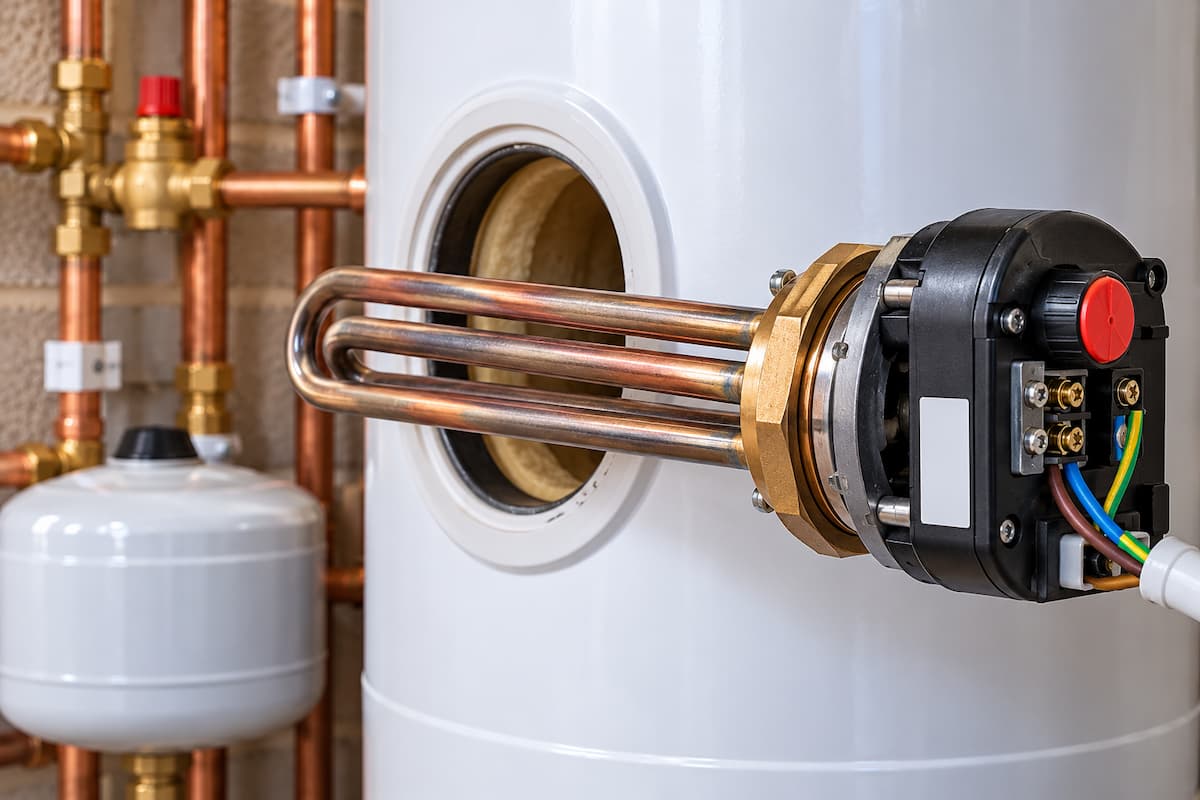
A typical domestic immersion heater consists of several components working together to heat and control the stored water.
The main components include:
- Heating element
- Mounting boss or threaded connection
- Sealing washer or gasket
- Thermostat
- Independent thermal cut-out
- Electrical terminals
- Protective terminal cover
The heating element extends into the cylinder, while the electrical connections and control components remain accessible from the external end of the assembly.
A simplified arrangement is shown below.
Electrical Supply
|
v
+——————+
| Terminal Housing |
| Thermostat |
| Thermal Cut Out |
+——–+———+
|
Mounting Boss
|
+————-+————–+
| | |
| Heating Element |
| | |
| Stored Water |
| |
| Hot Water Cylinder |
| |
+—————————-+
The exact construction varies between manufacturers. Some immersion heaters have replaceable thermostats and elements, while others use assemblies with different servicing arrangements.
Electrical Resistance Heating
Immersion heaters work through electrical resistance.
When current passes through the heating element, electrical energy is converted into thermal energy. The heat passes through the element sheath into the surrounding water.
The relationship between electrical power, voltage and resistance can be expressed as:
Power = Voltage × Current
Alternatively:
Power = Voltage² ÷ Resistance
For example, a nominal 3 kW immersion heater operating at 230 V draws approximately:
3,000 ÷ 230 = 13.0 A
Its nominal resistance at that voltage is approximately:
230² ÷ 3,000 = 17.6 Ω
These calculations help explain the electrical characteristics of an immersion heater. Actual measurements depend on the element rating, supply voltage, temperature and condition.
Immersion Heater Power Ratings
Domestic immersion heaters are available in different power ratings, with 3 kW being a common arrangement.
Higher electrical power generally allows water to be heated more quickly, provided the cylinder and electrical installation are suitable.
However, a higher rated element cannot simply be substituted for an existing heater without checking the electrical supply, protective arrangements and cylinder specification.
The correct replacement must be compatible with both the hot water cylinder and the electrical installation.
Heating Time and Cylinder Capacity
The time required to heat stored water depends on the volume of water, the required temperature rise and the heating power available.
The theoretical energy requirement can be estimated using:
Energy (kWh) = Water Volume (Litres) × Temperature Rise (°C) × 0.001163
For example, heating 150 litres of water from 15°C to 60°C gives:
150 × 45 × 0.001163 = 7.85 kWh
With a 3 kW immersion heater:
7.85 ÷ 3 = 2.62 hours
The theoretical heating time is therefore approximately 2 hours and 37 minutes.
This calculation assumes that the entire volume is heated uniformly, the heater operates continuously at its rated output, and there are no heat losses.
Actual heating time may differ because of cylinder stratification, thermostat position, standing heat losses, element condition and the amount of hot water already stored.
It is also important to distinguish between heating the complete cylinder and obtaining a useful quantity of hot water from the upper section.
Immersion Heaters in Direct Cylinders
A direct hot water cylinder relies on an internal electrical heating element or elements to heat the stored water.
There is no separate primary heating coil transferring heat from a boiler.
These cylinders are commonly associated with properties where domestic hot water is heated electrically.
Some direct cylinders have a single immersion heater, while others incorporate separate upper and lower elements.
The arrangement determines the amount of stored water that can be heated and the available control options.
Immersion Heaters in Indirect Cylinders
An indirect cylinder normally receives heat through a primary coil connected to a boiler, heat pump or another heating source.
An immersion heater may also be fitted to provide backup or supplementary heating.
For example, if the boiler is unavailable, the immersion heater may provide an alternative method of producing hot water.
In a heat pump installation, an immersion heater may be used for supplementary heating or a specified high temperature operating cycle, depending on the system design.
The distinction between direct and indirect heating is covered in greater detail in our article on hot water cylinders.
Single and Dual Immersion Heater Arrangements
Some cylinders incorporate two immersion heaters positioned at different heights.
A lower immersion heater can heat a greater proportion of the stored water, while an upper immersion heater can heat the upper section more quickly.
This arrangement may be useful where a smaller quantity of hot water is required without heating the complete cylinder.
A simplified configuration is shown below.
Hot Water Outlet
|
+———+———+
| |
| Upper Immersion |
| ————— |
| |
| |
| |
| Lower Immersion |
| ————— |
| |
+———+———+
|
Cold Water Inlet
The actual heated volume depends on the element position, cylinder geometry, thermostat location and water movement within the cylinder.
The two elements may be controlled independently, subject to the cylinder manufacturer’s design.
Economy 7 and Off-Peak Heating
Electrically heated cylinders may use an off-peak electricity supply to heat water during periods covered by a suitable tariff.
Historically, Economy 7 arrangements have commonly used a lower immersion heater to heat a larger volume of stored water overnight.
An upper immersion heater may then provide a separately controlled boost during the day.
The operating cost depends on the electricity tariff, actual consumption and control settings.
Time of use tariffs and smart controls may provide other scheduling arrangements, but the electrical installation must be suitable for the intended control system.
Temperature Controls and Overheating Protection
An immersion heater requires suitable controls to regulate normal water heating and provide protection if the operating temperature becomes excessive.
The operating thermostat and an independent thermal cut-out perform the two principal functions.
Operating Thermostat
The thermostat controls normal heating by switching the element on and off according to the temperature sensed at its measuring position.
When the surrounding water is below the selected setting, the thermostat allows heating to operate. As the water temperature rises, the thermostat interrupts the supply to the element.
Many immersion heaters use a rod-type thermostat inserted into a pocket or tube within the assembly.
Because the thermostat measures temperature at a particular position, it does not necessarily represent the average temperature throughout the cylinder.
This is important where thermal stratification produces different temperatures at the top and bottom of the stored water.
Independent Thermal Cut Out
The independent thermal cut-out protects against excessive temperature if normal regulation fails.
Unlike the operating thermostat, which switches repeatedly during normal use, a manual reset thermal cut-out is intended to operate under abnormal conditions.
If the thermal cut-out operates, the cause must be investigated before the heater is returned to service.
Potential causes include:
- Failed operating thermostat
- Incorrect thermostat installation
- Abnormal overheating
- Faulty control arrangements
- Unsuitable replacement components
Repeated resetting without investigating the underlying problem can leave a dangerous condition unresolved.
The thermostat and thermal cut-out therefore perform separate functions and must not be treated as interchangeable.
Vented and Unvented Cylinder Safety
The cylinder arrangement determines the wider safety requirements associated with immersion heating.
A vented hot water system incorporates an open vent arrangement and is normally supplied from a cold water storage cistern.
The open vent provides a route for expansion and venting within the system, but it does not replace the need for suitable immersion heater temperature controls and overheating protection.
An unvented hot water cylinder stores water under pressure and requires additional protective arrangements against excessive temperature and pressure.
These can include:
- Independent temperature limiting controls
- Temperature and pressure relief protection
- Expansion control
- Suitable discharge arrangements
- Manufacturer safety components
The immersion heater must be compatible with the cylinder and preserve its required safety functions.
A replacement element or thermostat must not bypass, remove or compromise the independent protection provided by the cylinder design.
This distinction is particularly important during replacement work because components that appear physically interchangeable may not provide the same safety functions.
Immersion Heater Length and Compatibility
Immersion heaters are available in different lengths and configurations.
The correct length depends on the cylinder design, available internal clearance and manufacturer’s specification.
An element that is too long may interfere with internal components or the cylinder wall.
An unsuitable element shape may also affect installation or heat distribution.
Before selecting a replacement, the engineer should check:
- Cylinder make and model
- Heater power rating
- Element length
- Element shape
- Thread and mounting specification
- Thermostat compatibility
- Thermal cut-out requirements
- Manufacturer approved replacement parts
Matching the visible external connection alone is not sufficient.
Copper, Incoloy and Titanium Elements
Immersion heater elements can be manufactured using different sheath materials.
Copper elements are commonly associated with standard domestic applications.
Incoloy elements are used in various applications where improved resistance to particular operating conditions is required.
Titanium elements may be specified for certain aggressive water conditions or specialist applications.
Material selection should follow the cylinder and element manufacturer’s guidance.
Water chemistry, scale formation and compatibility with the cylinder can influence the suitability of a particular element.
Scale Formation on Immersion Heaters
Hard water can lead to mineral deposits forming on immersion heater elements.
As water is heated, dissolved minerals can precipitate and form scale on hot surfaces.
Over time, heavy deposits can affect heat transfer and create localised overheating of the element sheath.
Possible consequences include:
- Increased element surface temperature
- Reduced heat transfer performance
- Noise during heating
- Premature element failure
- Greater maintenance requirements
The severity depends on water hardness, operating temperature, usage and element design.
Scale deposits should be assessed during maintenance, particularly where immersion heater failures occur repeatedly.
Electrical Safety and Professional Competence
Immersion heaters are fixed electrical appliances, so electrical safety forms an essential part of installation, maintenance and fault finding.
The electrical installation must be suitable for the heater’s power rating and comply with the applicable requirements of BS 7671.
Relevant considerations include:
- Circuit design and cable sizing
- Appropriate protective devices
- Earthing and protective bonding
- Suitable means of isolation
- Secure electrical connections
- Correct thermostat and thermal cut-out arrangements
- Manufacturer instructions
Before electrical work begins, the relevant supply must be safely isolated and proved dead using an appropriate procedure and suitable test equipment.
Switching off a programmer or local control should not automatically be assumed to provide safe isolation.
Some cylinders have more than one electrical supply, particularly where separate upper and lower immersion heaters are fitted.
Plumbing engineers must recognise the limits of their competence. An engineer may be competent to drain a cylinder and replace mechanical components without necessarily being competent to undertake electrical testing or alterations.
A person with the necessary knowledge, skills and competence must carry out electrical work.
Work involving unvented cylinder safety controls also requires appropriate competence in the relevant hot water storage system.
Installing an Immersion Heater
Immersion heater installation requires careful preparation because the element must be mechanically compatible with the cylinder and correctly integrated into its electrical controls.
Before installation, the engineer should confirm the correct replacement component and inspect the cylinder connection.
The cylinder must be isolated and drained to the necessary level before removing the existing heater.
Care is needed when loosening an old immersion heater because excessive force can damage the cylinder boss or surrounding structure.
The replacement should be installed using the correct seal and tightening procedure specified by the manufacturer.
The electrical connections and controls must then be completed and tested by a competent person.
Refilling and Commissioning
After an immersion heater has been installed, the cylinder must be refilled and air removed as appropriate to the system.
The element must be fully immersed before it is energised.
Operating an immersion heater without sufficient water coverage is known as dry firing. Without water to remove heat, the element temperature can rise rapidly and cause permanent damage.
Before returning the installation to normal operation, the engineer should confirm:
1. The correct immersion heater has been installed.
2. The mounting connection is secure and leak-free.
3. The cylinder has been correctly refilled.
4. Air has been removed as appropriate.
5. Electrical connections and protective arrangements have been tested.
6. The thermostat operates correctly.
7. The required independent safety controls are present and functional.
8. The cylinder heats as intended.
The exact commissioning procedure must follow the cylinder and immersion heater manufacturer’s instructions.
Immersion Heater Fault Finding
Immersion heater faults can originate from the electrical supply, heating controls, element or wider hot water system. A complaint of no hot water does not necessarily indicate a failed heating element, and replacing components before establishing the cause can result in unnecessary work.
Diagnosis should begin by identifying the cylinder arrangement, confirming the intended heating schedule and establishing whether the problem affects all stored hot water or only the available volume.
For example, a cylinder with separate upper and lower immersion heaters may provide a limited quantity of hot water if the upper boost element operates, but the lower element does not.
Once the operating arrangement is understood, a competent person can investigate the electrical supply, thermostat, independent thermal cut-out and heating element using appropriate testing procedures.
Electrical Testing
Electrical diagnosis may involve checking the supply, continuity, element resistance, insulation resistance and operation of the control components.
For a nominal 3 kW element rated at 230 V, the calculated resistance is approximately 17.6 Ω. This provides a theoretical reference, although actual measurements depend on the element specification and operating conditions.
A resistance measurement alone does not establish that an element is electrically safe. Insulation resistance and other appropriate tests may also be necessary.
If an RCD or other protective device operates, the cause must be identified rather than repeatedly resetting it. Moisture, damaged wiring and insulation breakdown are among the possible causes.
Similarly, an operated thermal cut-out requires investigation of the thermostat and overheating conditions before the heater is returned to service.
Electrical testing must be undertaken by a competent person using safe isolation procedures and suitable equipment.
Immersion Heater Fault Diagnosis Table
| Symptom | Possible Cause | Diagnostic Focus |
|---|---|---|
| No hot water | Supply fault, timer, thermostat, thermal cut-out, or failed element | Confirm heating demand and test the electrical supply, controls and element |
| Water only becomes lukewarm | Incorrect thermostat setting, insufficient heating time, element fault or excessive demand | Check the heating schedule, thermostat operation and actual cylinder temperature |
| Only a small quantity of hot water | Upper boost heater operating without the lower element or incorrect control operation | Identify which element is operating and the volume of water it is intended to heat |
| Electrical protection trips | Insulation failure, moisture, damaged wiring or another circuit fault | Carry out appropriate electrical testing before restoring the supply |
| Thermal cut out operates repeatedly | Faulty operating thermostat, overheating or unsuitable control arrangement | Investigate temperature regulation and the cause of the safety device operating |
| Noise during heating | Scale deposits, localised boiling or another cylinder condition | Assess scale accumulation, element condition and heating operation |
| Water leaking around the heater boss | Damaged seal, incorrect installation, corrosion or cylinder connection damage | Inspect the mounting connection and surrounding cylinder structure |
| Heating takes longer than expected | Insufficient element output, control operation, heating schedule, demand or heat loss | Check element rating, operating time and cylinder heating performance |
The table provides a diagnostic starting point rather than confirmation of a particular component failure.
Fault Finding Sequence
A structured sequence helps separate electrical faults from problems with cylinder operation.
Hot Water Complaint
|
v
Identify Cylinder And Controls
|
v
Check Heating Schedule
|
v
Test Electrical Supply And Controls
|
v
Test Heating Element If Required
|
v
Assess Cylinder Heating Result
|
v
Repair Or Replace
|
v
Recommission
Where testing identifies a failed component, the replacement must be compatible with the cylinder and its electrical and thermal safety arrangements.
Following repair, the engineer should confirm correct heating operation, thermostat regulation and the required safety functions before returning the installation to service.
Immersion Heaters and Heat Pump Systems
Immersion heaters can form part of domestic hot water systems supplied by heat pumps.
A heat pump generally produces hot water more efficiently than direct electrical resistance heating when operating within suitable conditions.
An immersion heater may therefore be provided for particular operating requirements rather than serving as the normal primary heat source.
Applications can include:
- Supplementary cylinder heating
- Backup heating
- Additional heating where required by the system design
- Specified high temperature cycles
The actual function depends on the heat pump, cylinder and control strategy.
Legionella Control and High Temperature Cycles
Some heat pump systems use programmed high-temperature hot water cycles as part of their water hygiene strategy.
An immersion heater may be used where the heat pump alone cannot achieve the required temperature under the selected operating conditions.
However, not every installation uses the same control arrangement.
The system design, relevant guidance and manufacturer instructions must determine the required temperatures, operating periods and control sequence.
The immersion heater should not be assumed to provide effective water hygiene control simply because it can raise the temperature in part of the cylinder.
Temperature distribution and the complete operating strategy remain important.
Immersion Heaters and Energy Consumption
An immersion heater converts electrical energy directly into heat.
At the point of use, most of the electrical energy consumed becomes heat, but this does not mean that immersion heating is always the most economical method of producing domestic hot water.
A heat pump can often deliver several units of heat for each unit of electricity consumed, depending on operating conditions.
Immersion heater running costs depend on:
- Electrical power
- Operating time
- Electricity tariff
- Required water temperature
- Hot water consumption
- Cylinder insulation
- Heat losses
- Control settings
An immersion heater rated at 3 kW consumes approximately 3 kWh of electricity for each hour it operates continuously at full power.
If electricity costs 25p per kWh, one hour of operation would cost approximately 75p.
This is an illustrative calculation rather than a current tariff quotation.
The actual cost depends on the electricity rate and the amount of time the thermostat allows the element to operate.
Reducing Unnecessary Immersion Heating
Efficient operation depends on matching the heating schedule and control strategy to household demand without compromising hot water safety or hygiene.
Potential improvements include:
- Correct thermostat settings
- Suitable heating schedules
- Adequate cylinder insulation
- Minimising unnecessary heat losses
- Ensuring controls operate correctly
- Avoiding unintended continuous operation
- Maintaining the heating element and associated equipment
Where an immersion heater is intended only as a backup, control settings should prevent it from operating unnecessarily during normal heat pump or boiler operation.
Immersion Heater Maintenance
Routine inspection can help identify developing problems before complete heater failure.
Depending on the cylinder design and manufacturer requirements, maintenance may involve checking:
- Signs of leakage
- Condition of accessible electrical connections
- Thermostat operation
- Thermal safety controls
- Scale deposits
- Heating performance
- Condition of the element
- Cylinder compatibility
- Control settings
A competent person must undertake electrical inspection and testing.
Where an immersion heater forms part of an unvented cylinder, maintenance should also take account of the cylinder manufacturer’s servicing requirements and associated safety controls.
Replacing An Immersion Heater In An Existing Cylinder
Replacing an immersion heater provides an opportunity to assess the wider condition of the installation.
Before selecting a replacement, the engineer should establish whether the existing component is appropriate for the cylinder and whether the fault has affected any other parts of the system.
For example, repeated element failure may indicate scale accumulation, unsuitable element material or abnormal operating conditions.
Similarly, a repeatedly operating thermal cut-out may indicate a problem with temperature regulation rather than the heating element itself.
Replacing the element without addressing the underlying cause may result in another failure.
Hot Water Systems and Safety Training in Staffordshire
Understanding immersion heaters requires knowledge of both the heating component and the wider domestic hot water installation.
Plumbers and heating engineers need to recognise the differences between direct and indirect cylinders, temperature regulation, independent safety controls and the additional requirements associated with unvented hot water storage.
At Staffordshire Training Services, the Hot Water Systems and Safety Course supports engineers developing their knowledge of domestic hot water systems, including the principles associated with safe installation, operation and maintenance.
The Water Regulations Certificate also provides relevant training in water fittings, water supply arrangements and the prevention of contamination within plumbing installations.
Delivered at our dedicated training centre in Stafford, these courses help engineers strengthen their understanding of domestic hot water systems and develop the technical confidence needed to work safely and competently.
Electrical installation and testing competence must be obtained separately where required, as hot water systems training does not itself establish competence to undertake electrical work.
Related Articles
- Hot Water Cylinders Explained
- Unvented Hot Water Cylinders In Domestic Plumbing
- Vented Hot Water Systems In Domestic Plumbing
- Domestic Hot Water Design for Heat Pumps
- Heat Pump Fault Finding For Renewable Installers
Prefer an AI Summary?