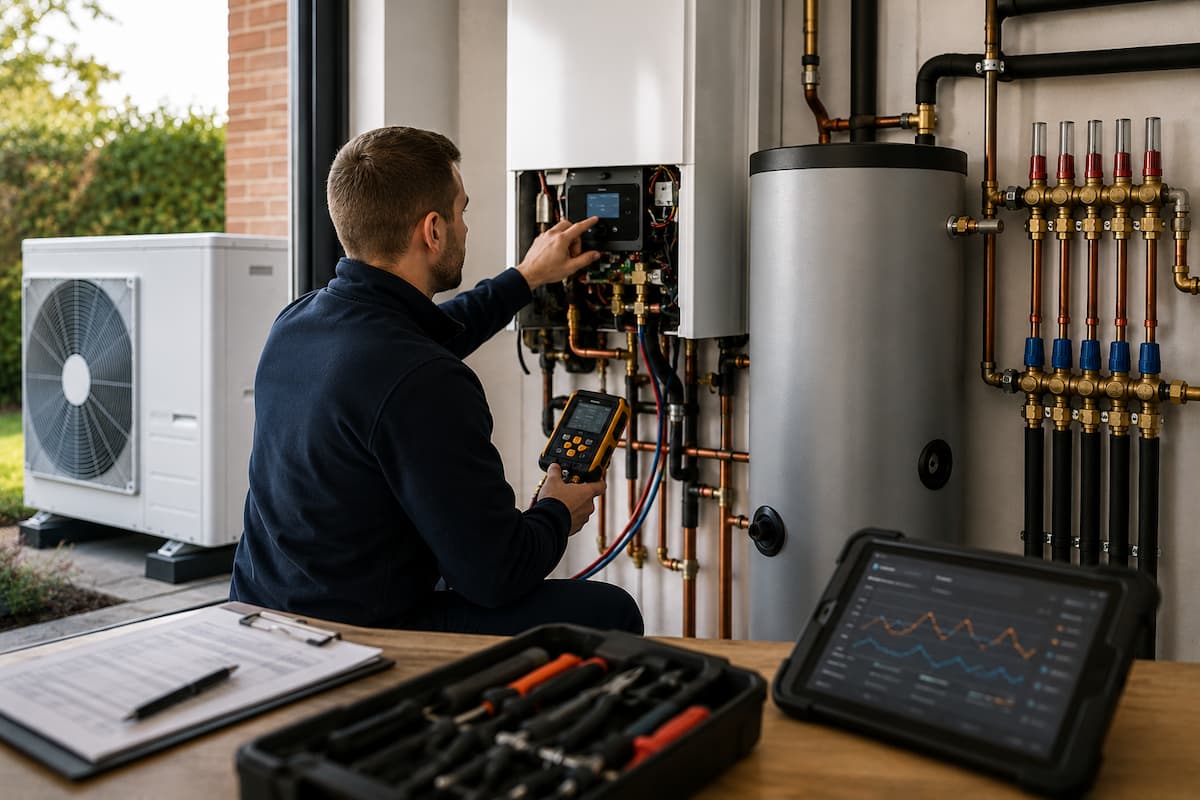
Heat pump commissioning is one of the most important stages of any renewable heating installation. A system can be designed correctly, installed professionally and equipped with quality components, yet still perform poorly if commissioning is not completed thoroughly.
Commissioning is the process of verifying that the heat pump system operates safely, efficiently and in accordance with the original design. It ensures that every component, from the heat pump itself to the controls, emitters and domestic hot water system, works together as intended.
For renewable installers, commissioning is far more than a final inspection. It is the stage that determines performance, efficiency and customer satisfaction.
Commissioning Objectives
The primary objective of commissioning is to confirm that the system performs safely and efficiently under normal operating conditions.
Effective commissioning helps deliver:
- Maximum system efficiency
- Stable indoor temperatures
- Reliable domestic hot water production
- Reduced energy consumption
- Correct control operation
- Equipment reliability
- Customer comfort
- Compliance with manufacturer requirements
A properly commissioned system should perform as closely as possible to the original design calculations.
Pre-Commissioning Checks
Before energising the heat pump, installers should carry out a detailed inspection of the installation.
Checks should include:
- Pipework quality
- Electrical connections
- System pressure
- Valve positions
- Expansion vessel charge
- Insulation installation
- Control wiring
- Condensate drainage
- Cylinder connections
Any defects identified during these checks should be rectified before commissioning begins.
Starting a system before completing these inspections can lead to faults, inefficiencies, and unnecessary callbacks.
System Water Quality
System water quality has a major impact on the performance of renewable heating systems.
Poor water quality can lead to:
- Reduced heat transfer
- Restricted flow rates
- Pump wear
- Heat exchanger fouling
- Reduced efficiency
Before commissioning, installers should verify:
- The system has been flushed correctly
- Debris has been removed
- Inhibitor has been added
- Magnetic filters are installed
- Water quality meets manufacturer requirements
This is particularly important in retrofit projects where existing radiators and pipework remain in service.
Pressure Testing and Filling
Pressure testing confirms the integrity of the system before operation begins.
The process helps identify:
- Leaks
- Faulty joints
- Valve defects
- Installation issues
Installers should follow manufacturer recommendations regarding:
- Filling pressures
- Pressure testing procedures
- Expansion vessel settings
- Air removal techniques
Removing air from the system is particularly important as trapped air can affect circulation and reduce efficiency.
Heat Pump Configuration
Modern heat pumps require correct configuration before operation.
Installer settings include:
- Design flow temperatures
- Weather compensation settings
- Domestic hot water temperatures
- Heating schedules
- Circulation pump settings
- Auxiliary heater operation
- Defrost parameters
- Time and date settings
Many commissioning issues occur because default factory settings remain unchanged.
Every installation should be configured according to the property’s design requirements.
Manufacturer Commissioning Differences
While the principles of commissioning remain similar, manufacturers often use different control philosophies and setup procedures.
Differences may include:
- Weather compensation terminology
- Heating curve scales
- Domestic hot water strategies
- Flow rate requirements
- Commissioning software
- Defrost settings
- Fault code structures
Manufacturers such as Daikin, Mitsubishi, Samsung, Vaillant and NIBE all have unique interfaces and commissioning procedures.
Installers should understand the underlying commissioning principles but always follow the manufacturer’s guidance for the equipment being commissioned.
Flow Rate Verification
Correct flow rate is fundamental to heat pump performance.
Insufficient flow can lead to:
- Reduced heat transfer
- Higher operating temperatures
- Reduced efficiency
- Increased cycling
Excessive flow can create control issues and unnecessary pump energy consumption.
Commissioning should verify:
- Design flow rates
- Circulation pump operation
- Pressure drops
- Flow meter readings
- System balancing
Flow rates should be checked before detailed optimisation begins.
Electrical Commissioning Checks
Heat pumps rely heavily on electrical systems and control wiring.
Electrical commissioning should verify:
- Supply voltage
- Protective devices
- Earth continuity
- Isolation arrangements
- Communication wiring
- Smart control connections
- Sensor wiring
Electrical faults often appear as heating performance issues, making thorough verification essential.
Sensor Verification
Modern heat pumps depend on accurate sensor information.
Installers should verify:
- Outdoor temperature sensors
- Flow temperature sensors
- Return temperature sensors
- Cylinder temperature sensors
- Room sensors
- Buffer vessel sensors where applicable
Faulty or inaccurate sensors can result in:
- Poor weather compensation performance
- Domestic hot water issues
- Excessive cycling
- Reduced efficiency
- Customer comfort complaints
Sensor verification should be included within every commissioning procedure.
Heat Loss Verification
Commissioning provides an opportunity to confirm that the installed system reflects the original design.
Installers should review:
- Heat loss calculations
- Heat pump sizing
- Radiator sizing
- Underfloor heating outputs
- Design temperatures
Any significant variation between the design and installation should be investigated before handover.
Emitter Performance Checks
Heat emitters should be assessed to confirm that they can deliver the required heat output.
Checks should include:
- Radiator outputs
- Underfloor heating circuits
- Thermostatic valve operation
- Flow distribution
- Room temperature performance
The system should achieve design temperatures at the intended operating conditions.
Failure to achieve target temperatures may indicate balancing issues, undersized emitters or incorrect commissioning settings.
System Balancing
System balancing ensures that heat is distributed evenly throughout the property.
Without balancing:
- Some rooms may overheat
- Others may remain underheated
- Flow rates may become uneven
- Efficiency may suffer
Installers should assess:
- Lockshield valve settings
- Flow and return temperatures
- Pump operation
- Underfloor heating manifold adjustments
- Differential temperatures
Proper balancing supports both comfort and efficiency.
Weather Compensation Setup
Weather compensation is one of the most important tools for improving heat pump efficiency.
Commissioning should include:
- Outdoor sensor verification
- Heating curve setup
- Flow temperature optimisation
- Control configuration
- Initial performance testing
Weather compensation allows the heat pump to adjust flow temperatures based on outdoor conditions automatically.
This helps maintain comfort while reducing energy consumption.
Minimum and Maximum Flow Temperatures
Commissioning should confirm that operating temperatures remain within the design parameters.
| Operating Condition | Typical Flow Temperature |
|---|---|
| Underfloor Heating | 30°C to 40°C |
| Low Temperature Radiators | 35°C to 50°C |
| Older Retrofit Systems | 45°C to 55°C |
| Domestic Hot Water Production | 50°C to 60°C+ |
The goal is to achieve the lowest practical flow temperature while maintaining comfortable indoor conditions.
Selecting the Correct Heating Curve
Choosing the correct heating curve is one of the most important commissioning decisions.
Different property types require different curve settings.
| Property Type | Typical Heating Curve Requirement |
|---|---|
| Older solid wall property | Steeper heating curve |
| Poorly insulated property | Higher flow temperature requirement |
| Modern insulated home | Shallower heating curve |
| Underfloor heating system | Lower curve settings |
| New build low energy property | Very shallow curve |
The initial heating curve is often refined after several weeks or months of operation.
Domestic Hot Water Commissioning
Domestic hot water should be commissioned separately from space heating.
Checks should include:
- Cylinder temperatures
- Reheat schedules
- Sensor operation
- Priority settings
- Recovery times
- Backup heater operation
- Legionella protection cycles
Customers should understand that domestic hot water production may temporarily affect space heating operation.
Defrost Cycle Verification
Air source heat pumps periodically enter defrost mode to remove ice from the outdoor heat exchanger.
Commissioning should verify:
- Defrost activation
- Condensate drainage
- Pipe insulation quality
- Frost protection settings
- Recovery following defrost
Understanding normal defrost behaviour helps installers explain operation to customers and reduces unnecessary service calls.
Reducing Compressor Cycling
Excessive cycling can reduce efficiency and shorten equipment lifespan.
Short cycling may lead to:
- Higher electricity consumption
- Reduced COP performance
- Increased component wear
- Temperature instability
Commissioning should ensure the system operates steadily rather than repeatedly starting and stopping.
Factors affecting cycling include:
- Heat pump sizing
- Weather compensation settings
- System volume
- Buffer vessels
- Flow rates
- Emitter sizing
Monitoring Performance Data
Modern heat pumps provide valuable performance information.
Commissioning should include monitoring:
- Flow temperatures
- Return temperatures
- Flow rates
- Runtime hours
- Compressor starts
- Electricity consumption
- COP performance
These figures help establish a performance baseline for future servicing and optimisation.
Performance Targets
Installers should establish measurable performance targets during commissioning.
| Performance Measure | Purpose |
|---|---|
| COP | Instant efficiency measurement |
| SCOP | Seasonal efficiency assessment |
| Flow Temperature | System optimisation |
| Return Temperature | Heat transfer verification |
| Compressor Starts | Cycling assessment |
| Energy Consumption | Operating cost analysis |
Recording these figures provides useful benchmarking information.
Remote Monitoring and Diagnostics
Many modern heat pumps support remote monitoring platforms.
These systems allow installers and service engineers to monitor:
- Energy consumption
- Temperatures
- Fault codes
- Compressor operation
- Weather compensation performance
- Domestic hot water production
Remote diagnostics can reduce site visits and identify performance issues before they become major faults.
Commissioning Faults
Several issues regularly arise during commissioning.
| Issue | Potential Cause |
|---|---|
| Poor room temperatures | Undersized emitters or incorrect balancing |
| High energy consumption | Excessive flow temperatures |
| Frequent cycling | Poor control settings or oversized system |
| Uneven heating | Balancing issues |
| Slow hot water recovery | Incorrect cylinder settings |
| Customer discomfort | Poor commissioning or inadequate handover |
Recognising these faults early can prevent performance issues.
Seasonal Commissioning Adjustments
Commissioning often continues beyond the installation date.
Performance reviews during the first year can help refine system settings.
Installers may find that:
- Autumn reveals early operating characteristics
- Winter confirms peak heating demand
- Spring identifies opportunities to lower flow temperatures
- Summer allows domestic hot water optimisation
Seasonal adjustments often improve efficiency significantly.
Heat Pump Commissioning Checklist
| Commissioning Item | Completed |
|---|---|
| System flushed and cleaned | ✓ |
| Inhibitor added | ✓ |
| Pressure tested | ✓ |
| Air removed | ✓ |
| Flow rates verified | ✓ |
| Heat pump configured | ✓ |
| Weather compensation setup | ✓ |
| Domestic hot water tested | ✓ |
| System balanced | ✓ |
| Customer handover completed | ✓ |
Commissioning Example
Consider a three-bedroom semi-detached property fitted with an air source heat pump.
The installation includes:
- New radiators
- Weather compensation controls
- Domestic hot water cylinder
- Magnetic filtration
- Pipework upgrades
During commissioning, the installer:
- Verifies flow rates
- Confirms radiator outputs
- Balances the system
- Configures weather compensation
- Tests domestic hot water production
- Reviews operating data
- Completes customer training
Following optimisation, the system operates efficiently at lower flow temperatures while maintaining comfortable indoor conditions.
MCS and Documentation Requirements
Commissioning should be supported by accurate documentation.
Records may include:
- Heat loss calculations
- System design information
- Flow rate calculations
- Commissioning records
- Water treatment documentation
- Electrical test records
- Manufacturer settings
- Warranty information
Good documentation supports future servicing and demonstrates professional standards.
Customer Education and Handover
Customer education is one of the most important stages of commissioning.
Many homeowners are unfamiliar with low temperature heating systems and weather compensation controls.
Installers should explain:
- Weather compensation behaviour
- Expected radiator temperatures
- Heating schedules
- Domestic hot water controls
- Defrost operation
- Filter maintenance
- Seasonal operation
- Service requirements
A clear handover helps reduce confusion, improve satisfaction and minimise unnecessary service calls.
Heat Pump Training In Staffordshire
As heat pump installations continue to increase across the UK, commissioning skills are becoming increasingly important for heating engineers. A successful installation depends on much more than selecting the correct equipment. Engineers must understand heat loss calculations, low-temperature heating design, emitter sizing, weather compensation, system balancing, and commissioning procedures to achieve efficient and reliable system performance.
At Staffordshire Training Services, our Air Source Heat Pump Systems (Level 3), Ground Source Heat Pump Systems (Level 3) and Air and Ground Source Heat Pump Systems Combined Course (Level 3) provide the practical knowledge and technical understanding required to work confidently with modern heat pump systems. Training covers key areas including system design, installation principles, commissioning procedures, controls, optimisation and fault-finding.
For engineers looking to enter the renewable heating sector or expand their existing skills, professional renewable energy system training provides the confidence and competence needed to commission systems correctly, improve efficiency and deliver better outcomes for customers. As the UK continues its transition towards low-carbon heating, commissioning expertise remains one of the most valuable skills a renewable installer can develop.
Related Articles
- Weather Compensation and Heat Pump Efficiency
- Radiator Sizing For Heat Pumps
- Heat Loss Calculations for Renewable System Installers
- Heat Pump Fault Finding For Renewable Installers
- Heat Pump System Design Basics for Gas Engineers Transitioning to Renewables
Prefer an AI Summary?
Share with someone you know!

Accredited training and assessment centre providing professional training for plumbing, gas, & renewable energy sectors
Got any questions
01785 562146
Training courses
Quick Links
© Staffordshire Training Services 2023 - 2026 TukTuk Creative Marketing • All Rights Reserved.