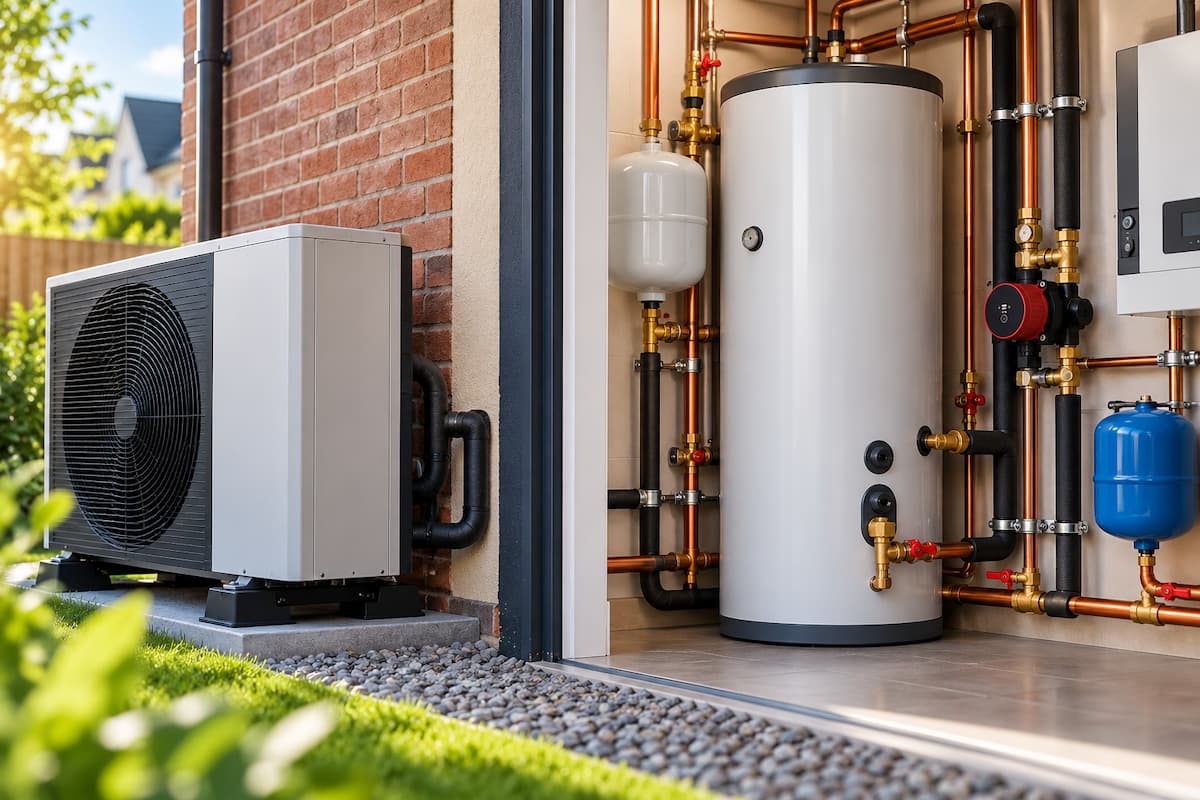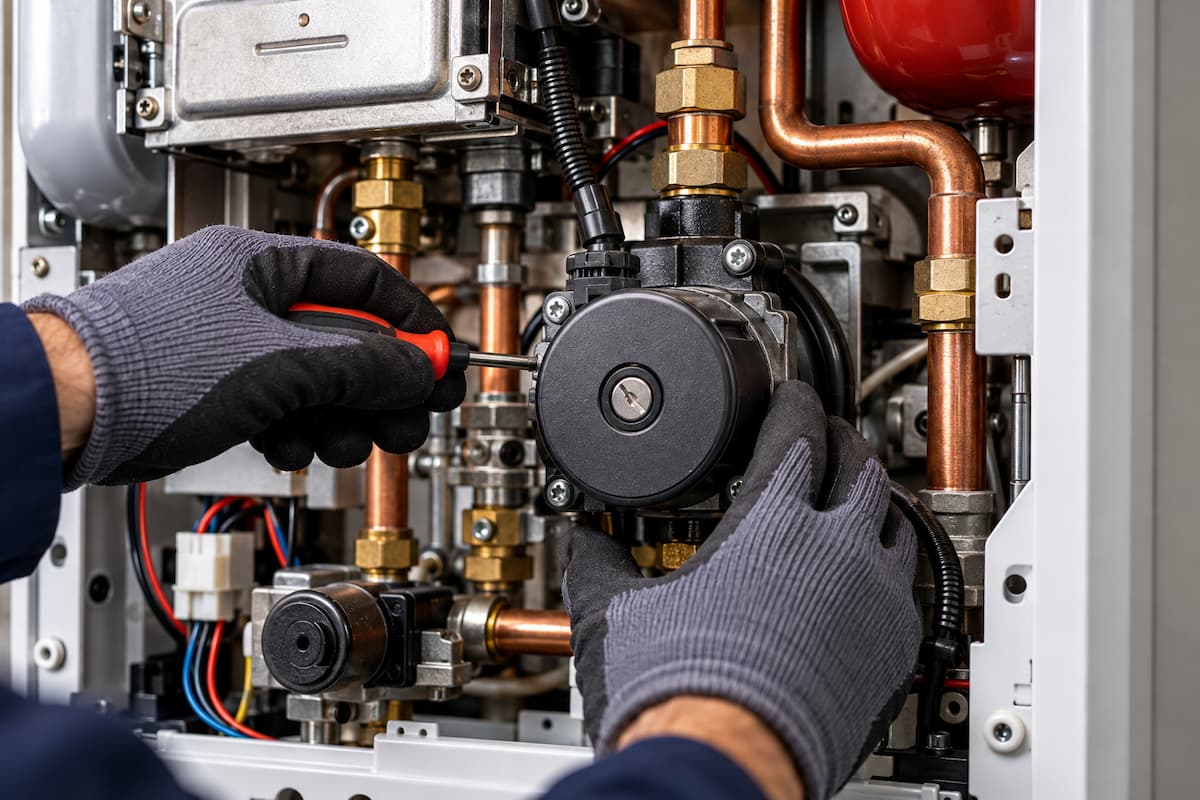
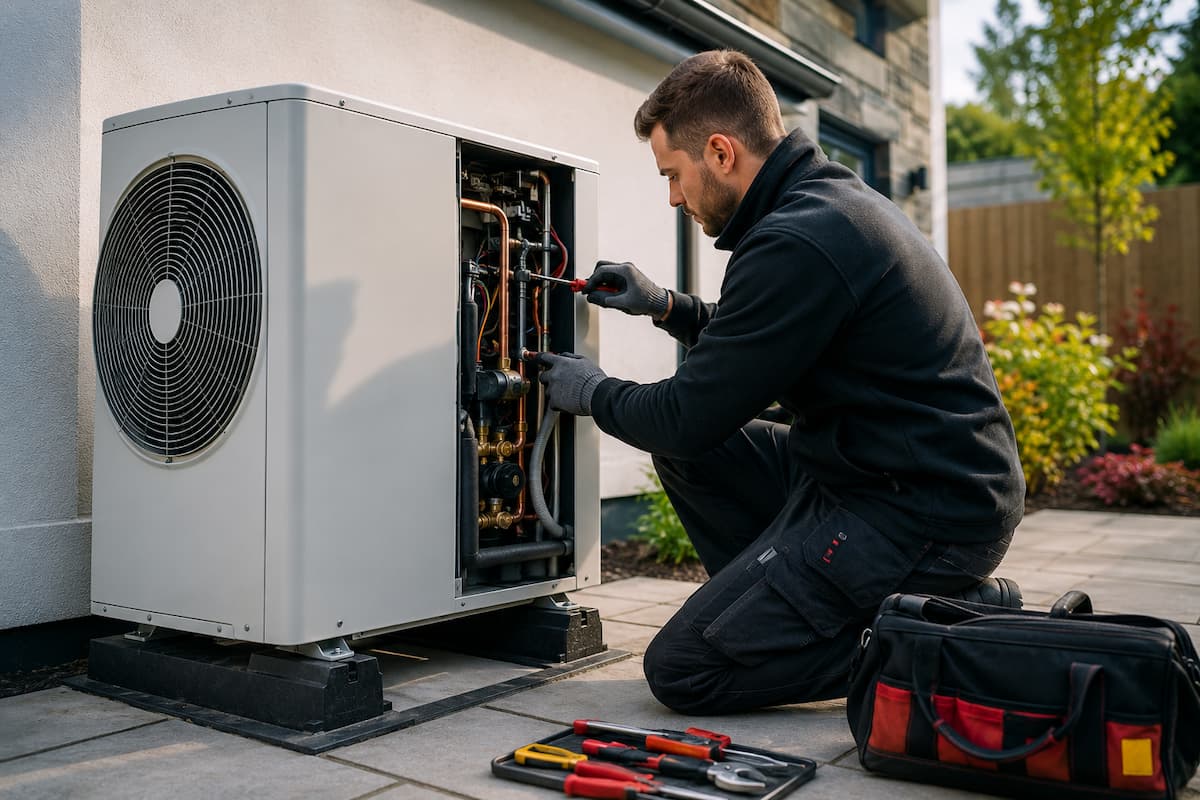
Heat pump installation is becoming an increasingly valuable skill for plumbing and heating engineers as more UK properties move towards lower carbon heating. For engineers already experienced with boilers, heating systems and hot water, it can provide a natural progression into renewable technologies.
Becoming a competent heat pump installer, however, involves more than learning how to connect an outdoor unit to a heating system.
Heat pumps operate differently from traditional boilers. Successful installation requires an understanding of heat loss, lower-flow temperatures, emitter sizing, hydraulic design, controls, hot-water provision, commissioning, and system optimisation. Depending on the equipment being installed and the work being undertaken, additional refrigerant qualifications may also be relevant.
There is also an important distinction between completing a heat pump qualification and becoming an MCS certified installation business.
For engineers considering renewable energy training, understanding these different requirements helps establish the most appropriate route into professional heat pump installation.
Existing Skills and Experience
Heat pump training is primarily a progression route for people who already possess relevant plumbing, heating or building services competence.
An experienced heating engineer already understands many of the principles that remain important in a heat pump installation, including pipework, circulation, heating controls, domestic hot water and heat emitters.
The technology does, however, require engineers to apply this knowledge differently.
A boiler can produce relatively high water temperatures and may, to some extent, compensate for shortcomings elsewhere in a heating system. A heat pump is generally designed around lower operating temperatures, which makes system design particularly important.
This is why moving into heat pumps should be viewed as an extension of heating engineering competence rather than simply learning to fit a new appliance.
Our guide to the renewable training pathway for heating engineers looks at the wider progression available to people moving from conventional heating into renewable technologies.
Level 3 Heat Pump Qualifications
A recognised Level 3 heat pump qualification provides an important route for experienced engineers developing competence in the installation and maintenance of these systems.
Staffordshire Training Services provides separate training routes depending on the technology an engineer intends to work with.
Our Level 3 Air Source Heat Pump Systems course focuses specifically on air source technology.
Engineers intending to work with ground source systems can undertake the Level 3 Ground Source Heat Pump Systems course.
For engineers wanting competence across both technologies, the Level 3 Combined Air and Ground Source Heat Pump Systems course provides a broader training pathway.
The most appropriate qualification therefore depends partly on the services an engineer intends to provide after training.
Air Source Heat Pump Training
Air source heat pumps are likely to be the starting point for many heating engineers as they move into renewable technologies.
These systems extract heat from the outside air and transfer it into the property’s heating and hot water system.
Installation requires much more than positioning the outdoor unit.
Engineers need to understand system design, hydraulic arrangements, controls, heat emitters, domestic hot water requirements, electrical considerations and commissioning.
Our Air Source Heat Pump Systems Level 3 course is designed for engineers looking to develop the knowledge and practical competence required to work with this technology.
The course route is particularly relevant for heating engineers wanting to add heat pump installation to an existing range of domestic heating services.
Ground Source Heat Pump Training
Ground source heat pumps use energy collected from the ground through buried pipework rather than directly from the outside air.
Although the basic refrigeration cycle and low-temperature heating principles are similar to those of air-source systems, the installation’s source side introduces additional considerations.
Ground arrays, boreholes, circulating fluid, available land, ground conditions and collector design can all influence the installation.
Engineers intending to work specifically with this technology can undertake the Ground Source Heat Pump Systems Level 3 course.
Those seeking a broader renewable heating skill set may instead consider combined air and ground source training.
Combined Heat Pump Training
For heating businesses looking to offer a broader range of renewable heating services, training in both air-source and ground-source technologies can provide greater flexibility.
The Air and Ground Source Heat Pump Systems Level 3 Combined course covers both technologies within one training pathway.
This can be particularly useful for engineers who do not want their future work restricted to one heat source.
The right choice still depends on the type of installations the engineer expects to encounter. Our article covering air source, ground source and combined heat pump training looks more closely at the differences between these training options.
For heating businesses considering the commercial case as well as the technical differences, which heat pump training offers the best return for heating engineers provides another useful perspective.
Low Temperature Heating Knowledge
One of the biggest adjustments for engineers moving from boilers to heat pumps is understanding low-temperature heating.
A traditional boiler system may operate at considerably higher flow temperatures. Heat pumps generally perform most efficiently when they can supply the required heat at lower water temperatures.
That changes the relationship between the heat source and the rest of the heating system.
Radiators may need to be larger. Underfloor heating may operate particularly effectively with lower temperatures. Pipework and flow rates need to be considered carefully. Controls also need to support the heat pump’s operating characteristics.
Staffordshire Training Services offers a dedicated Level 3 Low Temperature Heating and Hot Water Systems course for engineers developing this area of competence.
Our article on low temperature heating systems for renewable installers provides additional technical background.
Heat Loss Calculations
Correct heat pump sizing begins with understanding the property’s heating requirements.
This makes heat loss calculations particularly important.
An installer needs to consider the amount of heat lost through walls, floors, roofs, windows, doors, and ventilation so that the heating system can be designed around the building’s actual requirements.
Simply replacing a boiler with a heat pump based on the boiler’s existing output is not an appropriate substitute for proper heat loss assessment.
An oversized heat pump may cycle unnecessarily and operate inefficiently. An undersized system may struggle to maintain the required indoor temperature under design conditions.
Our detailed guide to heat loss calculations for renewable system installers looks at this fundamental part of heat pump system design.
Radiator and Emitter Sizing
Once the heat requirements of individual rooms are known, the installer needs to consider whether the property’s existing emitters can deliver the required output at the proposed system temperatures.
This is particularly important in retrofit installations.
A radiator that performed adequately with high-temperature water from a boiler may produce considerably less heat when supplied with lower-temperature water.
Some existing radiators may remain suitable, while others may need to be replaced or increased in size.
Correct assessment prevents unnecessary radiator replacement while also avoiding the opposite problem of retaining emitters that cannot deliver the required room output.
Our guide to radiator sizing for heat pumps covers this relationship between heat loss, flow temperature and emitter output in more detail.
Heat Pump System Design
Heat pump performance depends heavily on the quality of the complete heating system design.
The heat pump itself is only one component.
Pipework, circulation, emitters, controls, hot water storage, system volume, and hydraulic arrangements all influence how the installation performs.
Engineers transitioning from boiler work, therefore, need to develop a systematic approach.
Our article covering heat pump system design for gas engineers transitioning to renewables provides a useful introduction for experienced heating engineers making this change.
A successful installation should be designed so the heat pump can operate efficiently for extended periods rather than continually being forced into operating conditions that reduce performance.
System Volume and Hydraulic Design
Heat pump manufacturers specify operating requirements that must be considered in system design.
Adequate water volume and flow can be particularly important for stable operation, defrost cycles and preventing excessive cycling.
Depending on the system design, additional components may sometimes be used to provide volume or hydraulic separation.
A volumiser in a heat pump system increases available system water volume without necessarily providing hydraulic separation.
A buffer vessel can perform a different hydraulic role depending on the way the system has been designed.
These components should not simply be added to every installation as a standard solution. Competent installers need to understand the system requirement and select an appropriate arrangement.
Commissioning Competence
Installation does not finish once the heat pump and pipework are physically connected.
Correct commissioning is essential.
The installer needs to verify that the system has been installed in accordance with the design and manufacturer requirements, then configure and test its operation.
This can involve checking flow rates, temperatures, controls, hydraulic performance, system pressures and hot water operation.
Commissioning is also the point at which the installer can identify whether the completed installation is operating as intended.
Our guide to heat pump commissioning procedures for renewable installers looks at this stage in greater detail.
Competence in commissioning becomes increasingly valuable because poor settings can undermine the performance of an otherwise correctly installed system.
Fault Finding Skills
Professional heat pump installation also entails ongoing maintenance and fault diagnosis.
A problem that appears to originate with the heat pump may actually result from flow, controls, sensors, system pressure, emitters or another part of the installation.
Engineers therefore need to assess the system as a whole.
Our article on heat pump fault finding for renewable installers examines some of the principles involved in diagnosing performance and operational problems.
Existing heating engineers often bring valuable diagnostic experience to renewable work, but heat pump training allows them to apply those skills to a different technology.
F-Gas Qualifications
F-Gas is another area that can confuse engineers entering the heat pump sector.
A heat pump qualification and an F Gas qualification serve different purposes.
Heat pump training covers the installation and operation of the heating technology and associated system. F Gas certification relates to work involving fluorinated greenhouse gases and refrigerant circuits where the applicable regulations require certification.
Whether an individual installer needs F Gas certification therefore depends on the type of equipment and the work they intend to undertake.
Many monobloc air source heat pumps contain a sealed refrigerant circuit within the outdoor unit. An engineer installing the water side of such a system may not be opening or working on the refrigerant circuit.
Split systems are different because the refrigerant pipework connects separate parts of the system, and the refrigerant work may form part of the installation, servicing, or repair.
Engineers intending to undertake work that falls within F Gas certification requirements need the appropriate qualification.
Staffordshire Training Services provides F-Gas training for engineers working with refrigeration, air conditioning and heat pump equipment.
Our article covering F Gas certification for engineers and installers provides further information on the role of certification. In contrast, F Gas legal responsibilities for installers looks more closely at the regulatory responsibilities involved.
Combining F Gas and Heat Pump Training
Engineers planning to offer a wider range of heat pump installation, maintenance, and repair services may benefit from holding both heat pump and F-Gas competencies.
This is particularly relevant where the intended work involves equipment with refrigerant circuits that need to be installed, opened, serviced or repaired.
The qualifications remain separate, however.
Completing an F Gas course does not make somebody a qualified heating system designer, just as completing heat pump training does not automatically provide competence to undertake regulated refrigerant work.
Our article on combining F Gas and heat pump training looks at the professional opportunities created by developing both areas of competence.
Engineers whose work includes brazed refrigeration pipework may also require appropriate practical competence in jointing techniques. Staffordshire Training Services provides a Level 3 Oxy Fuel Brazing course for engineers working within the RACHP sector.
Electrical Safety
Heat pumps incorporate electrical supplies, controls, pumps and other electrical components.
Heating engineers are not automatically electricians, and the scope of electrical work undertaken must remain within the engineer’s competence and applicable requirements.
They do, however, need to understand electrical safety when working around electrically powered heating equipment.
Safe isolation is particularly important before work begins on equipment where electrical energy could present a hazard.
Staffordshire Training Services offers a Safe Isolation of Electrical Installations course covering the procedures required to establish safe working conditions.
Heat pump businesses may also work alongside suitably qualified electrical contractors where installation requirements fall outside the heating engineer’s own competence.
Heat Pump Qualifications and MCS Certification
One of the most important distinctions for prospective heat pump installers is the difference between an individual training qualification and MCS certification.
Completing a Level 3 heat pump qualification does not automatically make an installation business MCS certified.
MCS is a quality assurance scheme covering smaller renewable energy technologies. It establishes standards for heat pump design and installation and provides a certification framework for businesses operating in the sector.
An engineer can therefore complete appropriate heat pump training and hold recognised technical qualifications without their business automatically becoming MCS certified.
MCS certification is a separate process.
For businesses intending to operate within government-backed schemes or to provide customers with MCS certified installations, this distinction is extremely important.
MCS Requirements For Heat Pump Businesses
A business seeking MCS certification must apply through an appropriate certification body and demonstrate compliance with the relevant scheme requirements.
Current government guidance identifies separate MCS heat pump standards for design and installation.
This is significant because competent heat pump work involves both sides of the process.
The system needs to be appropriately designed for the property, then installed and commissioned in accordance with the relevant requirements.
Training in heat loss calculations, low-temperature heating, emitter sizing, hydraulic design, and commissioning therefore has practical relevance beyond simply passing a heat pump assessment.
Engineers planning to establish their own renewable heating business should view technical training as one part of a broader progression towards meeting the sector’s standards.
Boiler Upgrade Scheme Installations
MCS certification becomes particularly important for businesses intending to undertake installations through the Boiler Upgrade Scheme.
The Boiler Upgrade Scheme operates in England and Wales and provides grants for eligible low-carbon heating installations.
For an installer business to apply for a Boiler Upgrade Scheme grant on behalf of a property owner, it must be MCS-certified for the relevant technology.
The installer is responsible for the application and needs to ensure the installation meets the scheme requirements.
This means there is a clear difference between being technically qualified to work with heat pumps and having a business set up to deliver MCS certified installations through the Boiler Upgrade Scheme.
For engineers considering heat pumps as a commercial service, understanding both sides of that pathway is important.
Working Before Your Own Business Gains MCS Certification
Completing heat pump training does not mean an engineer has to establish an MCS certified business immediately.
Government guidance identifies subcontracting through an MCS-certified installer operating an appropriate umbrella arrangement as one potential route for engineers who are not yet ready to obtain certification for their own businesses.
This can provide an opportunity to gain experience of real heat pump installations and understand the processes involved before deciding whether to pursue independent MCS certification.
The MCS certified business remains responsible for ensuring the work complies with the applicable MCS requirements.
For newly trained engineers, working alongside experienced renewable installers can also provide valuable exposure to the variation found in real properties.
Gas Safe Registration and Heat Pumps
Gas Safe registration is not, by itself, a requirement simply because someone installs a heat pump.
A heat pump does not burn gas, so installing one does not automatically involve gas work.
However, many engineers moving into the sector are already Gas Safe registered because they come from a boiler and heating background.
Gas competence can remain relevant on retrofit projects where an existing gas appliance needs to be disconnected, or other gas work forms part of the project.
Any work on gas installations or appliances that falls within Gas Safe requirements must still be carried out by an appropriately registered engineer working within their recognised competencies.
Heat pump qualifications should therefore be viewed as additional renewable heating competence rather than a replacement for Gas Safe registration where gas work continues to be undertaken.
Plumbing Skills and Heat Pump Installation
Heat pumps are closely integrated with wet heating and domestic hot water systems, making plumbing competence particularly valuable.
Installers may need to modify heating pipework, connect cylinders, alter emitters, install valves and pumps, fill and flush systems, and configure hydraulic arrangements.
Knowledge of water regulations and hot water safety can therefore complement heat pump qualifications.
Engineers working with unvented hot water cylinders need appropriate competence for that work. Staffordshire Training Services provides a Hot Water Systems and Safety course covering the installation, commissioning and servicing of relevant hot water systems.
Our Water Regulations Certificate can also support engineers developing the wider water-related knowledge relevant to plumbing and heating installations.
A Typical Heat Pump Training Pathway
The exact route depends on an engineer’s existing qualifications, experience and intended work, but a progression pathway can broadly look like this.
Stage 1: Establish Existing Competence
Start with appropriate knowledge and practical experience in plumbing, heating, or building services.
Stage 2: Develop Low Temperature Heating Knowledge
Build an understanding of heat loss, emitter sizing, flow temperatures, domestic hot water and heating system design.
The Level 3 Low Temperature Heating and Hot Water Systems course can support this stage.
Stage 3: Complete Heat Pump Training
Choose an appropriate Air Source, Ground Source or Combined Heat Pump Systems Level 3 qualification.
Stage 4: Add Supporting Competencies
Depending on the work being undertaken, this could include F-gas, electrical safe isolation, hot water systems, or additional water-related qualifications.
Stage 5: Build Installation Experience
Develop practical experience applying heat pump design, installation and commissioning principles to real properties.
Stage 6: Consider MCS Certification
Businesses intending to provide MCS certified installations can progress through the separate MCS certification process to demonstrate compliance with the applicable design, installation, and consumer protection requirements.
Stage 7: Continue Professional Development
Develop further competence in system design, commissioning, fault finding and additional renewable technologies as experience grows.
This pathway demonstrates why no single certificate covers every aspect of becoming a professional heat pump installer.
The Right Heat Pump Qualification
The right qualification depends on the engineer’s existing skills and intended work.
An experienced heating engineer looking to add domestic air-source installations may find a focused air-source qualification appropriate.
An engineer expecting to work with ground arrays and ground-source technology needs training that specifically covers those systems.
A business wanting the flexibility to work across both technologies may benefit from combined training.
Engineers should also consider the work surrounding the heat pump itself.
If the intended service includes refrigerant work, F-gas competence may be required. If the engineer will be working with unvented cylinders, hot water qualifications become relevant. Low-temperature system design knowledge is valuable in virtually every heat pump installation.
The aim should therefore be to develop a coherent professional skill set rather than simply collecting individual certificates.
Building A Renewable Heating Career
For existing gas, plumbing and heating engineers, heat pumps can represent an extension of skills already developed throughout their careers.
Understanding heating systems, customer properties, pipework and fault diagnosis provides a useful starting point, but renewable technology introduces new design priorities and operating characteristics.
Our article on renewable energy careers for gas and heating engineers looks at the wider opportunities available to people considering this transition.
Heating businesses can also consider the commercial implications of broadening their services. Adding renewables to a heating business examines some of the practical considerations involved.
The strongest progress comes from combining existing trade experience with genuine competence in renewable heating, rather than treating heat pumps as an isolated technology.
Heat Pump Training With Staffordshire Training Services
Staffordshire Training Services provides accredited renewable heating training at our training centre in Stafford.
Our renewable energy courses support experienced engineers developing the technical knowledge and practical competence required to work with modern low carbon heating systems.
Candidates can choose the Level 3 Air Source Heat Pump Systems course, the Level 3 Ground Source Heat Pump Systems course or develop competence across both technologies through our Level 3 Combined Air and Ground Source Heat Pump Systems course.
Engineers can also strengthen their system design knowledge through our Level 3 Low Temperature Heating and Hot Water Systems course. In contrast, F Gas training is available for engineers whose intended work requires refrigerant handling competence.
Becoming a capable heat pump installer is not simply about learning to fit an outdoor unit. It requires an understanding of the complete heating system, from property heat loss and emitter sizing through to hydraulic design, controls, commissioning and ongoing performance.
For experienced heating professionals, developing these skills provides a practical pathway into renewable heating and an opportunity to broaden the services they can confidently provide.
Related Articles
- Renewable Training Pathway For Heating Engineers
- Quick Heat Pump Guide for Installers
- Advantages of Training in Both Heat Pump Technologies
- Choosing Between Combined or Focused Heat Pump Training
- Adding Renewables to Your Heating Business
Prefer an AI Summary?