Water quality is an important part of heat pump system design, installation and maintenance. Contamination, corrosion and unsuitable water treatment can affect circulation, restrict heat transfer and reduce the reliability and efficiency of an installation.
Heat pumps rely on effective water circulation to transfer thermal energy from the heat source to the heating system. Components such as plate heat exchangers, circulation pumps, control valves and flow sensors can be particularly sensitive to contamination and restricted water flow.
These issues are especially relevant when installing a heat pump in an existing property where radiators and pipework previously served a conventional boiler. Existing deposits and corrosion products can remain within the system and circulate through newly installed equipment.
For renewable heating engineers, water treatment should form part of the installation specification rather than being treated as a separate maintenance task.
This article focuses on water quality within closed primary heating circuits, including system cleaning, corrosion protection, filtration, frost protection, commissioning and ongoing maintenance.
Water Quality in Heat Pump Systems
The water circulating through a heat pump heating system acts as a medium for transferring thermal energy. Its condition and chemical composition can influence heat transfer, hydraulic performance and the service life of system components.
In a typical air source heat pump installation, primary heating water may circulate through:
- The heat pump heat exchanger.
- Heating distribution pipework.
- Radiators and underfloor heating circuits.
- Buffer vessels and volumisers.
- Domestic hot water cylinder coils.
- Circulation pumps and control valves.
- Hydraulic separation equipment.
Although the primary heating circuit may supply heat to a domestic hot water cylinder, the heating water remains separate from the stored domestic water in a correctly functioning indirect system.
This distinction is important because water treatment products intended for closed heating circuits must not be introduced into potable water supplies.
Primary Heating Water Quality
Several characteristics influence the suitability of water within a closed heating circuit.
| Water Quality Parameter | Potential Effect on System Performance |
|---|---|
| pH | Influences corrosion and material compatibility |
| Water hardness | Can contribute to mineral deposits and scale formation |
| Dissolved oxygen | Supports corrosion reactions |
| Suspended solids | Can restrict circulation and contaminate components |
| Electrical conductivity | Influences electrochemical corrosion processes |
| Chloride concentration | Can increase corrosion risks for certain metals |
| Inhibitor concentration | Influences the effectiveness of corrosion protection |
| Glycol concentration | Affects frost protection, viscosity and heat transfer |
Acceptable values depend on the equipment installed, construction materials and water treatment products specified. Installers should establish the relevant manufacturer requirements rather than applying a single set of water quality limits to every installation.
Contamination in Heat Pump Systems
Contamination can occur in both new and existing heating installations. Even newly installed pipework may contain materials introduced during manufacturing, storage or installation.
Typical contaminants include:
- Metal particles and installation debris.
- Soldering flux residues.
- Jointing compounds and sealant residues.
- Magnetite and other corrosion products.
- Mineral deposits and limescale.
- Residual cleaning chemicals.
- Degraded water treatment products.
Once circulation begins, these contaminants can travel throughout the primary circuit and accumulate within components with narrow internal waterways.
The consequences may include increased hydraulic resistance, reduced heat transfer, circulation pump problems and heat pump operating faults.
Existing Heating System Contamination
Replacing a gas boiler with a heat pump does not necessarily mean replacing the entire heating distribution system. Existing radiators and pipework may be retained where they are suitable for the proposed operating temperatures and hydraulic requirements.
However, older heating systems may contain significant quantities of corrosion products, particularly where water treatment has been inadequate, or the system has experienced repeated water loss and replenishment.
The condition of the existing circuit should therefore be assessed alongside radiator suitability, pipe sizing and the requirements of low temperature heating systems.
Connecting new heat pump equipment to a contaminated heating circuit without suitable preparation can introduce avoidable performance and reliability problems.
Corrosion and Magnetite Formation
Corrosion occurs when metallic materials react with their surrounding environment. Within heating systems, water chemistry, dissolved oxygen, temperature and material compatibility influence the rate and type of corrosion.
Magnetite is a black iron oxide commonly associated with corrosion within heating systems containing steel and other ferrous materials.
Although magnetite can form a relatively protective surface layer under certain conditions, loose magnetite particles can circulate through the system and accumulate within components.
Magnetite and other corrosion products can contribute to:
- Restricted waterways within heat exchangers.
- Reduced radiator performance.
- Blocked strainers and filters.
- Circulation pump wear or obstruction.
- Reduced flow through control valves.
- Increased system pressure losses.
Removing existing contamination is important, but preventing further corrosion is equally necessary.
Oxygen Ingress
Dissolved oxygen is a significant factor in corrosion within closed heating circuits. Although some oxygen is introduced during initial filling, a correctly installed and maintained sealed system should limit the introduction of additional oxygen.
Potential sources of oxygen ingress include system leaks, repeated topping up, unsuitable pipe materials, inadequate system pressure and poorly configured expansion arrangements.
Repeatedly replenishing a system with fresh mains water introduces additional dissolved oxygen and may dilute corrosion inhibitors.
Where a heating system regularly loses pressure, the underlying cause should be investigated rather than relying on repeated filling and chemical dosing.
Material Compatibility and pH
Heat pump systems may contain several different materials, including copper, steel, stainless steel, brass, aluminium and various polymers.
The water treatment regime must be compatible with all relevant materials and components.
Water with an unsuitable pH can increase corrosion risks, particularly where aluminium components are present. Excessive concentrations of certain dissolved substances, including chlorides, can also contribute to localised corrosion in susceptible metals.
Installers should follow the water quality requirements of the heat pump, heat exchangers, emitters and treatment product manufacturers.
Water Hardness and Scale Formation
Water hardness primarily results from dissolved calcium and magnesium compounds. Under suitable chemical and temperature conditions, these compounds can contribute to mineral deposits on internal system surfaces.
Heat pumps generally operate at lower heating water temperatures than conventional boilers, which can reduce the tendency for certain types of scale formation. However, lower operating temperatures do not eliminate the need to assess fill water quality.
Scale formation within a closed heating circuit is influenced by:
- The hardness of the original fill water.
- System operating temperatures.
- The total system water volume.
- Water chemistry and material compatibility.
- The frequency of system replenishment.
Unlike domestic hot water systems, a correctly functioning closed heating circuit does not continuously receive fresh mains water. The quantity of scale-forming minerals introduced should therefore remain relatively limited after filling.
Repeated water replenishment can increase the quantity of minerals entering the circuit.
Depending on manufacturer requirements and local water quality, suitable fill water treatment may include demineralisation or other approved conditioning methods.
Softened water and demineralised water are not equivalent. Water softening generally exchanges calcium and magnesium ions for sodium ions, whereas demineralisation removes a wider range of dissolved ions.
Neither method should be specified without establishing its suitability for the equipment and complete heating system.
Heat Exchanger Protection
Many heat pumps use brazed plate heat exchangers to transfer thermal energy between the refrigerant circuit and primary heating water.
These heat exchangers contain a series of plates that create narrow flow channels and provide a large effective heat transfer surface.
Their compact construction supports efficient heat transfer but can make them vulnerable to contamination and restricted circulation.
Contamination within a plate heat exchanger can have two significant effects.
Firstly, deposits on heat transfer surfaces can increase thermal resistance, reducing the effectiveness of heat transfer.
Secondly, accumulated debris can restrict the available flow area, increasing pressure loss and reducing primary water circulation.
Depending on the system design and operating conditions, the heat pump may experience reduced thermal output, abnormal flow and return temperatures, increased circulation pump demand or protective shutdowns.
Maintaining suitable water quality helps protect the heat exchanger and preserve the hydraulic conditions established during system design.
System Cleaning and Flushing
Heating systems should be suitably cleaned before new heat pump equipment is brought into operation.
The cleaning method depends on whether the installation is new or incorporates existing heating distribution equipment.
The principles of BS 7593, alongside equipment manufacturer instructions, guide the preparation, commissioning and maintenance of domestic heating and cooling water systems.
Cleaning New Heating Systems
New heating installations may appear clean but can contain manufacturing residues and debris introduced during assembly.
The cleaning process should remove contaminants such as metal particles, flux residues, oils and jointing materials.
Installers should ensure that all relevant circuits receive adequate circulation during cleaning and flushing. This is particularly important where underfloor heating manifolds, multiple heating zones or hydraulic separation arrangements are present.
Sensitive equipment should be isolated or bypassed during cleaning where required by the manufacturer.
Cleaning Existing Heating Systems
Existing heating systems may require more extensive cleaning before connection to a heat pump.
The appropriate method depends on the condition of the installation, the extent of contamination and the suitability of existing components.
| Cleaning Method | Typical Application |
|---|---|
| Mains water flushing | Removal of loose debris and residual installation contaminants |
| Chemical cleaning | Loosening and dispersing suitable corrosion products and deposits |
| Circulation cleaning | Circulating an approved cleaning solution through the heating circuit |
| Power flushing | Removal of substantial contamination where the system is suitable for the process |
| Individual circuit flushing | Cleaning separate radiators, zones or underfloor heating loops |
| Magnetic filtration during cleaning | Capturing circulating ferrous corrosion products |
Power flushing is not automatically required for every heat pump installation. The cleaning method should be selected following an assessment of the existing system.
Chemical products, cleaning temperatures, circulation periods and flushing pressures must remain within the limitations of the equipment and materials involved.
Final Flushing and Filling
Following chemical cleaning, the system must be flushed sufficiently to remove loosened contaminants and cleaning product residues, in accordance with the product instructions.
Filters and strainers should be inspected and cleaned as necessary.
The system can then be filled using water that satisfies the relevant manufacturer requirements, with the specified corrosion inhibitor or other treatment added where required.
Completing the cleaning process correctly is important because residual chemicals may interfere with subsequent treatment or affect material compatibility.
Chemical Inhibitors and Corrosion Protection
Corrosion inhibitors are used within closed heating systems to reduce corrosion and protect metallic components.
Different inhibitor formulations operate through different chemical mechanisms. Some help establish protective surface films, while others influence water chemistry to reduce conditions that promote corrosion.
An inhibitor should be selected according to the requirements of the complete heating circuit rather than solely on its suitability for conventional boilers.
Relevant considerations include:
- Compatibility with the heat pump manufacturer’s requirements.
- Compatibility with metallic and non-metallic system materials.
- Suitability for the intended operating temperatures.
- Compatibility with glycol where antifreeze is required.
- The total system water volume.
- Required concentration and testing procedures.
Mixing different water treatment products without confirming compatibility can reduce treatment effectiveness or create undesirable chemical reactions.
Where the existing treatment cannot be identified, the installer should establish an appropriate cleaning and replacement treatment procedure.
Calculating Inhibitor Dosage
Correct inhibitor concentration depends on the total system water volume and the treatment manufacturer’s dosing instructions.
Consider an installation with the following estimated primary water volumes:
| System Component | Estimated Water Volume |
|---|---|
| Heat pump and connecting components | 8 litres |
| Distribution pipework | 32 litres |
| Radiators | 45 litres |
| Volumiser | 25 litres |
| Domestic hot water cylinder coil | 10 litres |
| Total system volume | 120 litres |
Assume an approved inhibitor requires a concentration of 1% by volume.
The required product volume is:
Inhibitor volume = Total system volume × Required concentration ÷ 100
120 × 1 ÷ 100 = 1.2 litres
Approximately 1.2 litres of inhibitor would be required for a final system volume of 120 litres under these illustrative dosing instructions.
Actual dosing requirements vary between products. The calculated quantity should be supported by concentration testing where the treatment manufacturer provides a suitable test method.
Buffer vessels and volumisers can significantly increase the total primary water volume and must be included in treatment calculations.
Glycol and Frost Protection
Frost protection is particularly important in monobloc air source heat pump installations where primary heating water circulates through equipment located outdoors.
If water freezes within external pipework or the heat pump heat exchanger, expansion can damage components and result in water leakage or equipment failure.
Depending on the installation design and manufacturer requirements, frost protection may involve:
- Approved glycol-based heat transfer fluids.
- Mechanical antifreeze protection valves.
- Automatic frost protection controls.
- Suitable external pipework insulation.
- Protective circulation strategies.
Each approach has different operating limitations. For example, frost protection that depends on automatic pump operation may be ineffective during an extended electricity supply interruption.
The selected protection strategy must account for foreseeable operating conditions and equipment manufacturer requirements.
Glycol Concentration
Glycol-based heat transfer fluids reduce the freezing point of the circulating liquid.
Inhibited propylene glycol products are commonly used in heating applications where glycol is specified, although the exact product must be approved for the installation.
The required concentration depends on the anticipated minimum temperature, the level of protection required and the properties of the selected fluid.
Installers should distinguish between freeze protection and burst protection. These are not necessarily achieved at the same glycol concentration.
A concentration that limits the risk of pipe rupture may not maintain a fully liquid and pumpable heat transfer fluid at the design minimum temperature.
Manufacturer concentration charts should therefore be used rather than relying on a universal percentage.
Glycol and Hydraulic Performance
Adding glycol changes the physical properties of the circulating fluid.
Compared with untreated water, a glycol mixture will generally have a lower specific heat capacity and greater viscosity. These changes become particularly important at lower fluid temperatures.
| Fluid Property | Typical Effect of Adding Glycol |
|---|---|
| Freezing point | Reduced |
| Specific heat capacity | Reduced |
| Viscosity | Increased |
| Density | Generally increased for typical aqueous glycol mixtures |
| Hydraulic resistance | May increase |
| Heat transfer performance | May be reduced |
| Circulation pump requirements | May increase |
These changes must be included in hydraulic design calculations.
A system designed using the properties of untreated water may not achieve the intended thermal output or circulation performance once glycol is introduced.
Glycol and Heat Transfer Calculations
The relationship between thermal output, fluid flow and temperature difference can be expressed as:
Q = ṁ × cp × ΔT
Where:
- Q = Thermal output in kW.
- ṁ = Mass flow rate in kg/s.
- cp = Specific heat capacity in kJ/kg·K.
- ΔT = Flow and return temperature difference in K.
For an illustrative heating duty of 8kW and a temperature difference of 5°C, the required mass flow rate can be calculated for different fluid properties.
| Fluid | Illustrative Specific Heat Capacity | Required Mass Flow Rate |
|---|---|---|
| Water | 4.18 kJ/kg·K | 0.383 kg/s |
| Glycol mixture | 3.80 kJ/kg·K | 0.421 kg/s |
| Glycol mixture | 3.60 kJ/kg·K | 0.444 kg/s |
The example demonstrates that a fluid with a lower specific heat capacity requires a greater mass flow rate to transfer the same thermal output at the same temperature difference.
The specific heat capacities used here are illustrative and do not correspond to prescribed glycol concentrations.
Actual calculations must use the fluid manufacturer’s properties at the relevant concentration and operating temperature. Density must also be included when converting mass flow into volumetric flow.
These fluid characteristics are particularly important when calculating heat pump circulation requirements and selecting pumps capable of overcoming system pressure losses.
Magnetic Filters and Dirt Separators
Filtration provides additional protection against contamination circulating within the heating system.
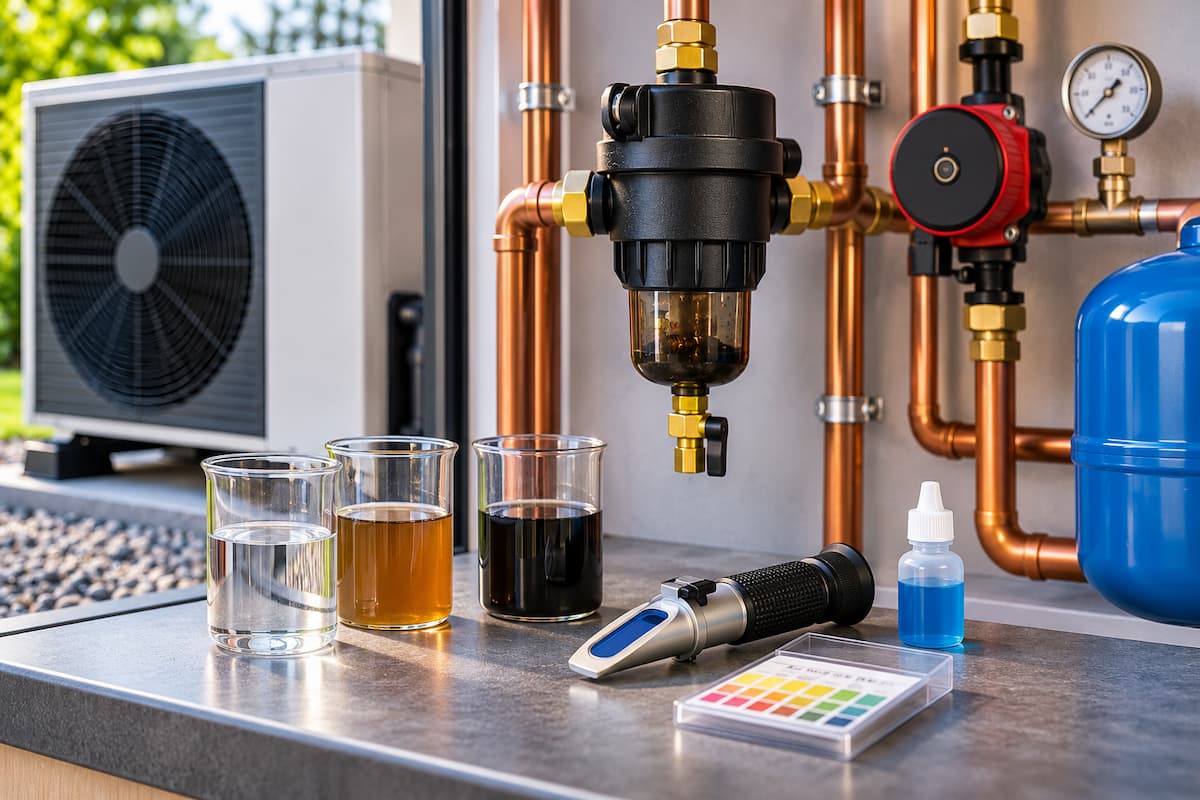
Magnetic filters capture ferrous particles such as magnetite, while mechanical strainers and dirt separators can remove other types of suspended debris, depending on their design.
These devices perform different functions and should not automatically be regarded as interchangeable.
| Component | Primary Function |
|---|---|
| Magnetic filter | Captures magnetic corrosion products |
| Mesh strainer | Retains particles larger than the specified mesh openings |
| Dirt separator | Separates suspended particles from circulating water |
| Combined magnetic dirt separator | Captures magnetic and other separable debris |
| Air separator | Assists with the removal of entrained air and gas bubbles |
Filtration equipment should be selected for the required flow rate, operating pressure, fluid compatibility and acceptable pressure loss.
Filter Positioning and Maintenance
Filters are commonly positioned within the return circuit upstream of the heat pump to reduce the quantity of contamination entering sensitive equipment.
However, the precise location must follow the system design and equipment manufacturer instructions.
Adequate access should be provided for inspection, cleaning and servicing.
A heavily contaminated filter or blocked strainer can itself become a source of hydraulic resistance. This can reduce circulation and prevent the heat pump from achieving its minimum required water flow.
Filter maintenance should therefore form part of the commissioning and ongoing servicing procedures.
Water Quality Testing
Water quality testing allows installers to assess the condition of the heating fluid and establish whether the specified treatment remains effective.
The tests required depend on the system materials, equipment requirements and treatment products used.
| Test | Purpose |
|---|---|
| Visual water sample inspection | Identifies visible contamination, discolouration and suspended debris |
| pH testing | Assesses acidity or alkalinity against specified limits |
| Inhibitor concentration testing | Confirms the concentration of the specified treatment product |
| Glycol concentration testing | Assesses antifreeze concentration and associated frost protection |
| Hardness testing | Establishes calcium and magnesium hardness where relevant |
| Conductivity testing | Indicates dissolved ionic content |
| Chloride testing | Assesses chloride concentration where material compatibility requires it |
A clear water sample does not necessarily indicate that the system has suitable chemical protection. Similarly, conductivity alone cannot establish inhibitor concentration or confirm that corrosion protection is adequate.
Test results must be interpreted against the requirements of the equipment and treatment manufacturers.
Glycol Testing
A suitable refractometer can be used to assess the concentration or freezing characteristics of certain glycol-based fluids.
The instrument must be appropriate for the type of glycol used and calibrated in accordance with its instructions.
Different glycol formulations have different relationships between refractive index, concentration and freezing point. Using an incorrect measurement scale can produce misleading results.
Where glycol degradation is suspected, additional testing may be required to assess pH, inhibitor condition and fluid suitability.
Water Quality During Commissioning
Water quality should be verified as part of the wider heat pump commissioning process.
Before the installation is placed into normal operation, the engineer should confirm that the heating circuit has been adequately cleaned, filled and treated.
The system should also be checked for satisfactory circulation, correct operating pressure and effective air removal.
Commissioning measurements provide a reference against which future maintenance findings can be compared.
Water Treatment Commissioning Record
| Commissioning Item | Information to Record |
|---|---|
| System cleaning method | Cleaning and flushing procedure completed |
| Cleaning product | Manufacturer and product details |
| Fill water | Source and any conditioning undertaken |
| System water volume | Calculated or measured volume |
| Corrosion inhibitor | Product and quantity added |
| Inhibitor concentration | Test result where applicable |
| Glycol product | Manufacturer and fluid type |
| Glycol concentration | Measured concentration where applicable |
| Frost protection | Specified protection level and verification |
| System pH | Measured value and acceptable range |
| Additional water quality tests | Results required by equipment manufacturers |
| Filters and strainers | Inspection and cleaning completed |
| Primary flow rate | Measured operating flow rate |
| System pressure | Cold fill and relevant operating pressures |
The completed record should be retained with the installation documentation.
Where a system subsequently requires draining, component replacement or significant replenishment, the original treatment information helps the engineer restore suitable water quality.
Water Treatment Standards and Manufacturer Requirements
Water treatment for heat pump installations should be undertaken with reference to applicable standards, installation requirements and manufacturer instructions.
Relevant documents include:
| Standard or Guidance | Application |
|---|---|
| BS 7593 | Preparation, commissioning and maintenance of domestic heating and cooling water systems |
| BS EN 14336 | Installation and commissioning of water-based heating systems |
| BS EN 12828 | Design requirements for water-based heating systems |
| MCS heat pump installation requirements | Relevant requirements for installations undertaken within the MCS framework |
| Water Supply (Water Fittings) Regulations 1999 | Protection of the mains water supply, including appropriate filling and backflow prevention arrangements in England and Wales |
| Heat pump manufacturer instructions | Equipment specific water quality, treatment and operating requirements |
| Water treatment manufacturer instructions | Product compatibility, dosage, testing and maintenance |
Standards provide an important framework for good installation practice, but individual heat pump manufacturers may specify particular water quality limits or approved treatment products.
Where requirements differ between components, compatibility should be established before installation.
Engineers should consult the current applicable editions of standards and technical documentation rather than relying on generic water quality limits.
Water Quality Fault Finding
Water quality problems can produce symptoms similar to circulation pump faults, hydraulic design problems and incorrect control settings.
A systematic investigation is therefore necessary before attributing a heat pump performance issue to contamination.
| Observed Problem | Possible Water Quality Cause | Recommended Investigation |
|---|---|---|
| Low primary water flow | Blocked filter, strainer or heat exchanger | Inspect filtration equipment and measure circulation |
| Increased pressure loss | Accumulated debris or excessive fluid viscosity | Compare differential pressure with design and commissioning data |
| Reduced heat transfer | Fouling or deposits within the heat exchanger | Assess thermal output, flow and operating temperatures |
| Uneven radiator heating | Accumulated corrosion products | Investigate radiator condition and hydraulic balance |
| Circulation pump noise | Contamination, entrained air or unsuitable fluid conditions | Inspect pump operation and system water condition |
| Repeated low flow faults | Progressive contamination or blocked filtration | Check filters, strainers and primary circulation |
| Black heating water | Possible magnetite contamination | Assess corrosion protection and system cleanliness |
| Inadequate frost protection | Incorrect or diluted glycol concentration | Test fluid concentration against the product specification |
| Repeated system pressure loss | Potential corrosion damage or leakage | Investigate the source of water loss |
| Abnormal water chemistry | Degraded, diluted or incompatible treatment | Test water quality and review treatment history |
The results should be assessed alongside the original design conditions and commissioning measurements.
For example, a low flow fault may result from a blocked filter, but it could also be caused by incorrect pump settings, undersized pipework or unsuitable valve operation.
The principles of heat pump fault finding remain important when distinguishing water quality problems from other hydraulic and mechanical faults.
Ongoing Water Quality Maintenance
Water treatment is not limited to the initial installation. The condition of the heating fluid should be assessed throughout the operating life of the system.
Maintenance requirements depend on the equipment, fluid specification, installation condition and manufacturer recommendations.
Routine servicing should include appropriate checks of:
- System operating pressure and evidence of water loss.
- Magnetic filters, dirt separators and strainers.
- Corrosion inhibitor concentration where applicable.
- Glycol concentration and fluid condition where applicable.
- Water quality parameters specified by the manufacturer.
- Evidence of corrosion, contamination or restricted circulation.
- Primary flow rates where performance problems are suspected.
Following repairs that involve draining part of the system, the engineer should establish whether the treatment concentration has been affected.
Adding untreated water to a glycol-protected circuit can reduce frost protection. Similarly, repeated replenishment can dilute corrosion inhibitors and introduce additional oxygen.
Maintaining accurate service records helps identify changes in water quality and circulation performance before they develop into more significant faults.
Heat Pump Training in Staffordshire
Effective water treatment requires an understanding of heating system materials, hydraulic design, heat transfer and equipment operating requirements.
Renewable heating engineers must be able to assess existing heating systems, identify potential contamination risks and establish suitable cleaning, treatment and commissioning procedures.
At Staffordshire Training Services, our Low Temperature Heating and Hot Water Systems Level 3 Course supports engineers developing their knowledge of heating system design and operation.
Our Air Source Heat Pump Systems Level 3 Focused Course and Air and Ground Source Heat Pump Systems Level 3 Combined Course provide accredited training for engineers developing their renewable heating installation skills.
Delivered by qualified engineers and instructors at our training centre in Stafford, our courses help candidates develop the technical knowledge and practical confidence required to install and commission renewable heating systems.
Correct water treatment, supported by effective filtration, suitable frost protection and ongoing maintenance, helps preserve the performance and reliability of heat pump installations throughout their operating life.
Related Articles
- Heat Pump Commissioning Procedures for Renewable Installers
- Heat Pump Circulation Pumps and Flow Rates
- Heat Pump Fault Finding for Renewable Installers
- Hydraulic Separation in Heat Pump Systems
- Low Temperature Heating Systems for Renewable Installers
Prefer an AI Summary?