Designing domestic hot water (DHW) is an important part of a successful heat pump installation. While space heating systems can operate efficiently at relatively low water temperatures, producing stored hot water requires different temperature, heat transfer, storage capacity, and control requirements.
A heat pump must provide sufficient hot water for the occupants without spending unnecessary time operating at higher temperatures. The cylinder, heat exchanger coil, diverter valve, temperature sensors, and control settings all affect the outcome.
For renewable installers, correct domestic hot water design involves more than selecting a cylinder based on the number of bedrooms. Consider household demand, cylinder recovery time, heat pump output, and heat exchanger suitability together.
A poorly matched system may produce insufficient hot water, take too long to recover or consume more electricity than necessary. Correct design and commissioning help balance hot water availability, operating efficiency and water hygiene requirements.
Domestic Hot Water Demand and Cylinder Selection
Start by establishing the property’s likely hot water requirements.
Two households living in identical properties may have very different demand. One might take a single shower each morning, while another regularly takes several showers, a large bath, and uses multiple outlets within a short period.
Installers should assess the number of occupants, bathing habits, outlet flow rates, simultaneous use and the times of day when demand is highest.
The important distinction is between total daily consumption and peak demand. A household might use a substantial amount of hot water throughout the day but place relatively little demand on the cylinder at any one time. Another household may use most of its hot water within a short morning period.
Cylinder selection must therefore consider the volume required during peak periods and the time available for the heat pump to replenish the stored energy.
Storage capacity must also be considered alongside the stored water temperature. A cylinder containing water above the required outlet temperature can provide more mixed water. However, the actual usable volume depends on the cylinder’s performance and draw-off conditions.
| Cylinder Size | Design Consideration |
|---|---|
| 150 litres | May suit properties with modest peak demand where recovery performance is adequate |
| 200 litres | Provides additional storage for households with greater bathing demand |
| 250 litres | Can support larger peak demand or longer intervals between recovery cycles |
| 300 litres | May suit high hot water demand, subject to recovery, available space and hygiene considerations |
These are illustrative capacity considerations rather than fixed recommendations based on occupancy. Actual selection must be based on calculated demand and cylinder performance.
Heat Pump Hot Water Temperatures
Heat pumps generally operate more efficiently when the temperature difference between the heat source and the heating water is relatively small.
Space heating can often be designed around flow temperatures considerably lower than those traditionally associated with boiler systems. Low temperature heating systems use correctly sized emitters to deliver the required heat without relying on unnecessarily high flow temperatures.
Domestic hot water production differs because stored water must reach temperatures suitable for household use and support an appropriate water hygiene strategy.
The heat pump may therefore need to increase its primary flow temperature during a cylinder heating cycle. This higher operating temperature can reduce efficiency compared with space heating operation.
The maximum temperature achievable with the compressor alone varies by heat pump model. Some systems require supplementary electrical heating to meet specific temperature requirements, while others can reach higher cylinder temperatures without it.
The manufacturer’s technical information should determine the operating limits and appropriate control settings.
Indirect Hot Water Cylinders
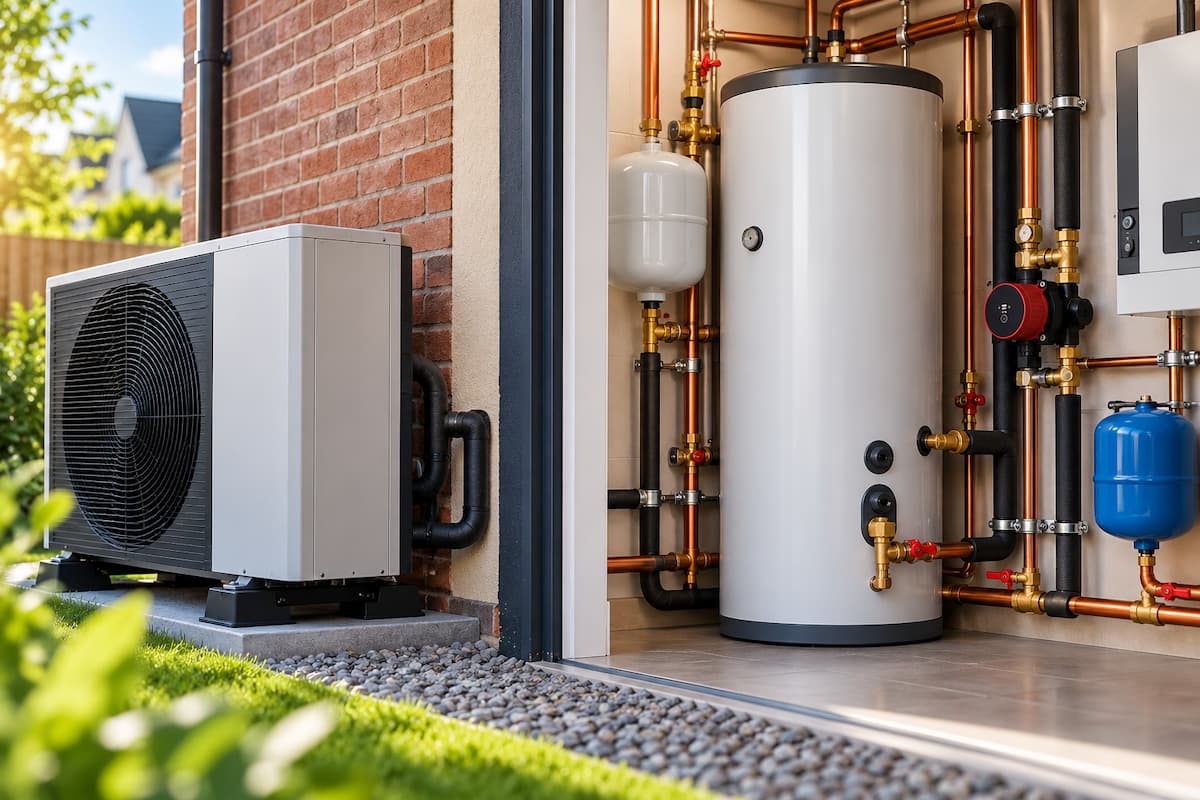
Most domestic heat pump installations with stored hot water use an indirect cylinder.
The cylinder stores potable domestic water, while a separate primary circuit transfers heat from the heat pump through an internal heat exchanger coil or another approved heat transfer arrangement.
The primary heating water and stored domestic water remain separated.
Simplified Indirect Cylinder Arrangement
HOT WATER OUTLET
│
▲
┌─────────────────┐
│ │
│ STORED HOT │
│ WATER │
│ │
PRIMARY FLOW ─┤ ┌─────────┐ │
FROM HEAT │ │ HEATING │ │
PUMP │ │ COIL │ ├──► PRIMARY RETURN
│ └─────────┘ │ TO HEAT PUMP
│ │
└────────┬────────┘
▲
│
COLD WATER INLET
The cylinder must be suitable for the intended heat pump application. A cylinder designed for high boiler flow temperatures may have a heat exchanger unsuitable for transferring the required output at lower heat pump temperatures.
The principles of stored water heating are also covered in hot water cylinders, including the distinction between direct and indirect heating arrangements.
Cylinder Coil Sizing and Heat Transfer
The heat exchanger coil is one of the most important components in selecting a heat pump cylinder.
Heat transfer depends on several factors, including the coil’s effective surface area, construction, primary water flow, temperature difference and the characteristics of the stored water.
A conventional boiler may supply a cylinder coil with primary water at a much higher temperature than a heat pump. This creates a larger temperature difference and can let a relatively compact coil transfer substantial heat.
At lower primary temperatures, the same coil may transfer considerably less energy.
Heat pump cylinders therefore often use larger heat exchanger surfaces or alternative heat transfer arrangements to achieve suitable performance.
However, coil surface area alone does not establish suitability. Two coils with similar areas can perform differently because of their geometry, construction and hydraulic characteristics.
Heat Pump Output Versus Coil Performance
An 8kW heat pump does not necessarily transfer 8kW into the cylinder throughout a heating cycle.
The actual transfer rate depends on the heat pump’s available thermal output at the operating conditions and the cylinder coil’s ability to transfer that energy into the stored water.
As the cylinder warms, the temperature difference between the primary heating water and stored water becomes smaller. Heat transfer through the coil can then decrease.
If the coil is undersized, the heat pump may reach its maximum permitted primary temperature before the cylinder reaches its target temperature.
This can lead to longer heating cycles, reduced efficiency, or more frequent use of supplementary heating than expected.
Installers should therefore examine manufacturer performance data at temperatures and flow rates representative of the proposed installation, rather than relying solely on nominal heat pump output or coil surface area.
Hot Water Energy and Recovery Calculations
The amount of energy needed to heat a cylinder can be estimated from its water volume and required temperature rise.
For water, the approximate calculation is:
Energy (kWh) = Volume (litres) × 4.18 × ΔT ÷ 3600
Where:
Energy is the thermal energy required in kWh.
Volume is the water volume in litres.
ΔT is the required temperature rise in °C.
4.18 is the approximate specific heat capacity of water in kJ/kg°C.
Stored Energy Calculation
Consider a 200 litre cylinder heated from 10°C to 50°C.
The temperature rise is 40°C.
Energy = 200 × 4.18 × 40 ÷ 3600
Energy = approximately 9.3kWh
This represents the theoretical energy needed to raise the water temperature. It does not include cylinder heat losses, distribution losses or any additional energy associated with the heat transfer process.
Cylinder Recovery Time
Recovery time is the period required to restore the cylinder to its intended temperature after hot water has been used.
A basic estimate can be obtained by dividing the required thermal energy by the average heat transfer rate into the stored water.
For the 200 litre example, assume the cylinder requires 9.3kWh and the heat pump transfers an average of 6kW into the water.
Recovery time = 9.3 ÷ 6 = 1.55 hours
This gives a theoretical recovery time of approximately 93 minutes.
Actual recovery can take longer because heat transfer through the cylinder coil changes as the stored water warms. The heat pump may also reduce its output or operate against a temperature limit towards the end of the heating cycle.
The following figures illustrate theoretical recovery times to heat 200 litres by 40°C, assuming constant heat transfer.
| Average Heat Transfer | Theoretical Recovery Time |
|---|---|
| 4kW | 139 minutes |
| 5kW | 111 minutes |
| 6kW | 93 minutes |
| 8kW | 70 minutes |
These are illustrative calculations, not guaranteed cylinder performance figures. Use manufacturer recovery data for equipment selection.
Usable Hot Water Volume
Stored cylinder volume and the volume available at a mixed outlet are not necessarily the same.
If the stored water is hotter than the required outlet temperature, you can mix it with incoming cold water to increase the total volume.
For a simplified calculation:
Mixed volume = Stored hot water volume × (Hot temperature − Cold temperature) ÷ (Mixed temperature − Cold temperature)
Consider:
Stored water volume: 200 litres
Stored water temperature: 50°C
Incoming cold water temperature: 10°C
Required mixed temperature: 40°C
The calculation becomes:
200 × (50 − 10) ÷ (40 − 10) = approximately 267 litres
In theory, 200 litres stored at 50°C could provide approximately 267 litres of water mixed to 40°C.
In practice, usable volume depends on cylinder stratification, draw-off rate, cold-water mixing within the cylinder, and the minimum acceptable delivery temperature.
It would therefore be incorrect to promise 267 litres of usable shower water from every 200 litre cylinder operating under these conditions.
This calculation helps compare storage arrangements, but it should not replace manufacturer draw-off performance data.
Hot Water Priority and Controls
Heat pumps supplying both space heating and domestic hot water frequently use hot water priority control.
During normal space heating operation, the heat pump circulates water through the heating distribution system. When the cylinder requires heating, a diverter valve redirects the primary water through the cylinder heat exchanger.
Simplified Hot Water Priority Arrangement
HEAT PUMP
│
▼
THREE PORT
DIVERTER VALVE
│
┌──────────┴──────────┐
│ │
▼ ▼
DOMESTIC HOT WATER SPACE HEATING
CYLINDER CIRCUIT
│ │
└──────────┬──────────┘
│
▼
HEAT PUMP RETURN
Hot water priority lets the heat pump operate at the temperature required for cylinder heating without also supplying the space heating circuit at that higher temperature.
Once the cylinder reaches its target, the diverter valve can return to the space heating position.
The interruption to space heating is usually manageable when the cylinder is correctly sized and recovery periods are reasonable. However, extended cylinder heating can become noticeable during cold weather if the heat pump spends too much time away from space heating.
Diverter Valves and Temperature Sensors
The diverter valve directs primary water to the appropriate circuit, while the cylinder temperature sensor tells the controller when stored water needs heating and when the target has been reached.
Incorrect sensor placement or poor thermal contact can produce misleading readings.
A sensor in the wrong pocket may stop a heating cycle before the intended water volume is heated. Alternatively, a poorly positioned sensor may extend the cycle unnecessarily.
A diverter valve that fails to move fully can cause unwanted circulation through the space heating system or prevent sufficient heat from reaching the cylinder.
Installers should verify sensor positioning, wiring, valve operation, and control configuration per the equipment manufacturer’s instructions.
Primary Flow Through The Cylinder Coil
The heat pump primary circuit must deliver sufficient flow through the cylinder heat exchanger.
An undersized connection, restrictive valve, or unsuitable coil can limit heat transfer even when the heat pump operates correctly.
Consider flow through the cylinder coil alongside its pressure loss and heat transfer performance.
The relationship between flow, circulation pump head and circuit resistance is particularly relevant during hydraulic design involving primary and secondary circuits.
Where a cylinder circuit shares components with the space heating system, the designer must establish that the required primary flow can be maintained during both operating modes.
Legionella Control And Water Hygiene
Stored domestic hot water must be designed and operated with appropriate consideration for Legionella risk.
Legionella bacteria can multiply in water systems under favourable conditions, particularly where temperatures and stagnation support bacterial growth.
The Health and Safety Executive’s temperature control guidance identifies hot water storage at 60°C or above and distribution reaching at least 50°C within one minute as the traditional temperature control approach. The applicable risk assessment and building use remain important.
Heat pump installations may use lower routine cylinder temperatures alongside a manufacturer hygiene cycle or supplementary heating arrangement. Assess such strategies for suitability, and do not assume they provide equivalent protection simply because the controller includes an antibacterial or pasteurisation function.
Installers must establish whether the selected system can achieve the required hygiene temperatures, whether supplementary heating is necessary, and whether the intended temperature is reached throughout the relevant stored volume.
A cylinder temperature sensor reaching its target does not, by itself, prove that the entire cylinder has completed an effective hygiene cycle.
Immersion Heating and Scalding Protection
Many indirect cylinders include an electric immersion heater.
In a heat pump installation, the immersion heater may provide supplementary temperature boosting, backup heating or part of the water hygiene strategy.
Electrical resistance heating delivers approximately 1kWh of heat for each 1kWh of electricity consumed at the element. Under suitable operating conditions, a heat pump can often deliver more heat than the electricity it consumes.
Unnecessary immersion heater operation can therefore increase running costs.
The control strategy should define the immersion heater’s intended role rather than allowing it to operate routinely without a clear purpose.
Scalding Protection
Stored water temperatures required for hygiene control can create a risk of scalding at outlets.
Thermostatic mixing valves can control delivered water temperatures where appropriate.
The location and selection of mixing valves should account for the intended outlet, building occupants, water hygiene and applicable guidance.
Installers should avoid creating unnecessary lengths of pipework containing mixed warm water, particularly where outlets are infrequently used.
Consider water hygiene and scald protection together, rather than treating one as separate from the other.
Unvented Cylinder Safety
Many heat pump installations use unvented hot water cylinders supplied from the incoming mains.
These systems require suitable pressure control, expansion provision, temperature protection, and safety-discharge arrangements.
The installation must comply with the relevant requirements of Building Regulations Approved Document G, including Requirement G3 where applicable.
Work involving the installation and commissioning of unvented hot water systems requires appropriate competence. Safety devices must never be removed, bypassed or altered to resolve a heating performance problem.
The principles of pressure control, expansion and safety arrangements are covered in unvented hot water cylinders in domestic plumbing.
Cylinder and Distribution Heat Losses
A stored hot water cylinder gradually loses heat to its surroundings.
The rate of heat loss depends on the cylinder insulation, surface area, stored temperature, and the surrounding space temperature.
Manufacturers normally provide standing heat-loss information that lets you compare products under stated test conditions.
A cylinder with lower standing heat losses reduces the energy needed to maintain stored water temperatures, especially when hot water is stored for extended periods between uses.
The cylinder’s position also matters. A cylinder installed in a cold garage or poorly insulated space may experience different conditions than one located in a heated part of the property.
Distribution Pipework
Hot water distribution pipework can also lose substantial heat, particularly where pipe runs are long or poorly insulated.
Good design keeps pipe routes reasonably direct while providing suitable insulation and access for maintenance.
Unnecessarily long pipework can increase occupant wait times for hot water and the volume of cooled water discharged before it reaches the required temperature.
Where secondary hot water circulation is proposed, consider the additional heat losses and circulation pump electricity consumption. Continuous circulation can increase the energy required to maintain distribution temperatures.
The pipework layout should also avoid unnecessary dead legs and stagnant sections, which may increase water hygiene risks.
Hot Water Controls and Efficiency
Domestic hot water production can significantly affect overall heat pump electricity consumption. Heating a cylinder generally requires higher flow temperatures than space heating, which can reduce the heat pump’s coefficient of performance (COP). This means more electricity may be required to deliver the same amount of heat.
The overall efficiency of domestic hot water production also depends on the cylinder’s heat-transfer performance, storage temperatures, heat losses, and the operation of supplementary heating.
Several design decisions can help improve efficiency:
- Selecting a cylinder with a heat exchanger suitable for the heat pump’s operating temperatures and output.
- Avoiding unnecessarily high routine storage temperatures while maintaining an appropriate water hygiene strategy.
- Reducing cylinder standing losses and insulating hot water distribution pipework.
- Scheduling cylinder heating around household demand and available electricity tariffs.
- Preventing unnecessary immersion heater operation through correct control settings.
- Maintaining suitable primary water flow and correctly configured temperature sensors and diverter valves.
These measures help reduce avoidable energy consumption while maintaining adequate hot water availability, recovery performance and water hygiene.
Hot Water Heating Schedules
Heat pump controls usually allow domestic hot water heating periods to be scheduled.
The best schedule depends on household demand, cylinder capacity, recovery performance, and the electricity tariff.
For example, a household with predictable morning and evening demand may benefit from scheduled cylinder heating that ensures adequate storage before those periods.
Time of use electricity tariffs can also make certain heating periods less expensive. However, any cost savings must be balanced against cylinder standing losses, comfort, and the water hygiene strategy.
Scheduling should therefore support the household’s needs rather than simply running the cylinder at its maximum temperature throughout the day.
The objective is not simply to produce hot water as quickly as possible. The system must provide sufficient stored energy, acceptable recovery, and suitable hygiene control without unnecessary electricity consumption.
Domestic Hot Water Commissioning
Domestic hot water commissioning should confirm that the system operates correctly as a complete installation.
The process should include checking cylinder and heat pump compatibility, confirming primary water flow, verifying diverter valve operation, and ensuring the cylinder temperature sensor is installed correctly.
The installer should then observe a representative cylinder heating cycle.
Measurements should include primary and return flow temperatures, cylinder temperature progression, and the time required to reach the target.
Also check any supplementary heating or hygiene functions according to the manufacturer’s instructions.
These checks are part of the wider heat pump commissioning process and help confirm the system performs as intended before handover.
Commissioning Record
| Measurement Or Check | Commissioning Record |
|---|---|
| Cylinder manufacturer and model | Record installed equipment |
| Nominal storage capacity | Record litres |
| Cylinder heat exchanger specification | Record model and performance reference |
| Primary circuit flow | Record measured value |
| Hot water target temperature | Record control setting |
| Initial cylinder temperature | Record measured value |
| Final cylinder temperature | Record measured value |
| Recovery time | Record observed duration |
| Diverter valve operation | Confirm correct operation |
| Supplementary heating | Record configuration and test outcome |
| Water hygiene controls | Record specified strategy and verification |
| Safety controls and discharge arrangements | Record applicable checks |
These records provide a useful reference if hot water performance changes after installation.
Domestic Hot Water Fault Diagnosis
Investigate hot water problems systematically rather than immediately increasing the cylinder temperature setting.
| Symptom | Possible Cause |
|---|---|
| Insufficient hot water during peak use | Undersized storage, high demand or incomplete cylinder recovery |
| Extended cylinder recovery | Limited coil transfer, insufficient primary flow or reduced heat pump output |
| Heat pump reaches high primary temperature without completing cylinder heating | Heat exchanger limitation, flow restriction or sensor issue |
| Space heating operates during a DHW priority cycle | Diverter valve fault, incorrect configuration or unwanted circulation |
| Frequent immersion heater operation | Control settings, temperature requirements or heat pump operating limitations |
| Hot water temperature fluctuates | Sensor, mixing valve, control or recovery issue |
| High hot water electricity consumption | High storage temperature, excessive losses or supplementary heating use |
| Water at outlets takes too long to become hot | Long distribution runs, cooled pipework or circulation issue |
These symptoms provide possible diagnostic directions rather than definitive conclusions.
The principles covered in heat pump fault finding remain relevant because cylinder performance, heat pump output, circulation and controls can influence one another.
Domestic Hot Water Design Example
Consider a household that requires a stored hot water system served by an air-source heat pump.
The occupants regularly use two showers during the morning and occasionally fill a bath during the evening. The installer must therefore establish peak hot water demand rather than selecting a cylinder based solely on the number of bedrooms.
A 200 litre indirect cylinder is considered as an initial option.
Storage and Energy Requirement
Assuming the cylinder contains 200 litres at 10°C and the intended calculation temperature is 50°C, approximately 9.3kWh of thermal energy is required to heat the stored water.
This establishes the theoretical energy requirement but does not confirm that the cylinder is suitable.
Coil Performance
The installer checks the cylinder manufacturer’s performance data against the heat pump’s available output, primary water temperatures and flow rate.
The cylinder coil must transfer sufficient heat under these conditions. A coil rated using much higher boiler temperatures may not deliver the required performance with the proposed heat pump.
Recovery Time
If the selected heat pump and cylinder combination transfers an average of 6kW into the stored water, the theoretical recovery time is approximately 93 minutes.
The installer then compares this estimate with the manufacturer’s recovery data and the household’s demand pattern.
If occupants regularly require substantial quantities of hot water in a shorter period, a larger cylinder or a different recovery arrangement may be necessary.
Controls and Water Hygiene
The design must also confirm that the heat pump can reach the required cylinder temperature, that hot-water priority operation is suitable, and that the selected water-hygiene strategy can be implemented correctly.
Establish any supplementary immersion heating requirements before installation.
The cylinder is selected after considering usable stored volume, coil performance, recovery capability, heat pump operating temperatures and household demand together. This reduces the risk of installing a cylinder that appears adequate by volume but cannot deliver the required hot water performance.
Heat Pump Training In Staffordshire
Domestic hot water design brings together heat pump performance, stored water requirements, heat transfer, controls and installation safety. Heating engineers need to understand these relationships to select suitable equipment and commission systems that provide reliable hot water without unnecessary energy consumption.
At Staffordshire Training Services, the Low Temperature Heating and Hot Water Systems Level 3 Course covers relevant principles of domestic hot water sizing, heating design, emitter selection, pump sizing and system configuration.
Engineers developing their installation knowledge can also undertake the Air Source Heat Pump Systems Level 3 Focused Course or the Air and Ground Source Heat Pump Systems Level 3 Combined Course.
For engineers working with unvented cylinders, the Hot Water Systems and Safety Course provides relevant training in stored hot water safety and associated installation requirements.
Developing these skills helps installers design domestic hot water systems that match the property, the heat pump, and the occupants. Suitable storage, effective heat transfer, appropriate controls and accurate commissioning all contribute to reliable hot water performance.
Related Articles
- Vented Hot Water Systems In Domestic Plumbing
- Unvented Hot Water Cylinders In Domestic Plumbing
- Hydraulic Separation In Heat Pump Systems
- Heat Pump Circulation Pumps and Flow Rates
- Hydraulic Balancing for Heat Pump Systems
Prefer an AI Summary?